

EU Imposes Sanctions Calling For Strait of Hormuz Freedom of Navigation
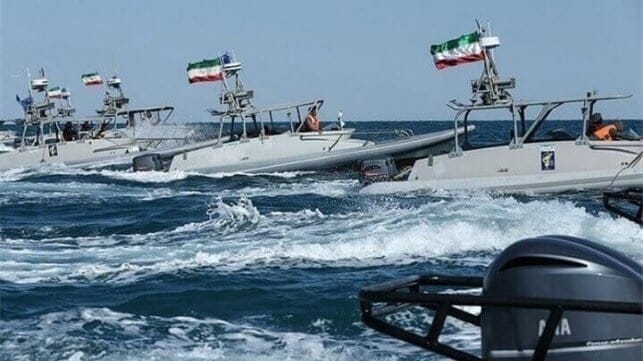
The European Council announced on Monday that it was imposing sanctions, including on Iran’s IRGC, while calling for freedom of navigation through the Strait of Hormuz. The move comes as the Europeans also appear to be setting the stage for a mine clearance program in the Strait of Hormuz.
The Council said it was extending its legal framework targeting those involved in Iran’s actions and policies threatening the freedom of navigation in the Middle East. It said the actions are contrary to international law and infringe upon established rights of both transit and innocent passage through international straits. It also follows the move by the Council in March supporting the UN Security Council resolution while emphasizing the need to ensure maritime security and respect the freedom of navigation.
In today’s action, the Council listed the Hormozgan Provincial Command of the Islamic Revolutionary Guard Corps Navy (IRGCN), which was previously listed by the EU. The Council highlighted that the IRGC Navy has assumed control of the Strait of Hormuz and implemented a toll system whereby vessels are now required to provide identifying documentation, as well as cargo and destination information, which is ultimately passed onto the Hormozgan Provincial Command. Using this information, the Hormozgan Provincial Command screens vessels and determines which ones are allowed to transit through the strait, sometimes after paying tolls.
The United States has already sanctioned the tolling system and the launch of Iran’s Persian Gulf Strait Authority. The U.S. said it was a front for the IRGC and IRGC Navy to control the waterway, while Donald Trump has repeatedly said the Strait must be open as part of any peace agreement.
The EU Council reported it also listed two indiivduals which is said were directly supporting Iran’s actions impeding lawful transit passage and freedom of navigation. Mohammad Akbarzadeh, Deputy Commander for Political Affairs of the IRGC Navy and its spokesperson, was included with the Council citing his threats to use missiles or drones against vessels transiting the strait. Hamid Hosseini, a representative of Iran’s Oil, Gas and Petrochemical Products Exporters’ Union and a member of Iran’s Chamber of Commerce, was included for promoting the policy of submitting, undergoing assessment, and paying transit fees to Iranian authorities for safe passage through the Strait of Hormuz.

that matters most
Get the latest maritime news delivered to your inbox daily.
With today’s listings, the European Council noted that restrictive measures under this amended framework now apply to 26 natural and legal persons and 27 entities from a range of countries. Those listed under the sanctions regime are subject to an asset freeze, and it is prohibited to provide them with funds or economic resources, either directly or indirectly. Additionally, a travel ban to the EU applies to all natural persons listed.
While the Europeans have not formally announced their plan for mine clearance in the Strait of Hormuz, actions appeared to show a force being formed in anticipation of progress in the talks between the United States and Iran. British, French, Italian, Dutch, and German assets all appeared to be moving toward the formation of the effort. It is anticipated that the Europeans would go forward once an agreement and stability are achieved in the region.