
Refit Adds Mini “Whale Tail” to Increase Versatility of 20-Year-Old Ship
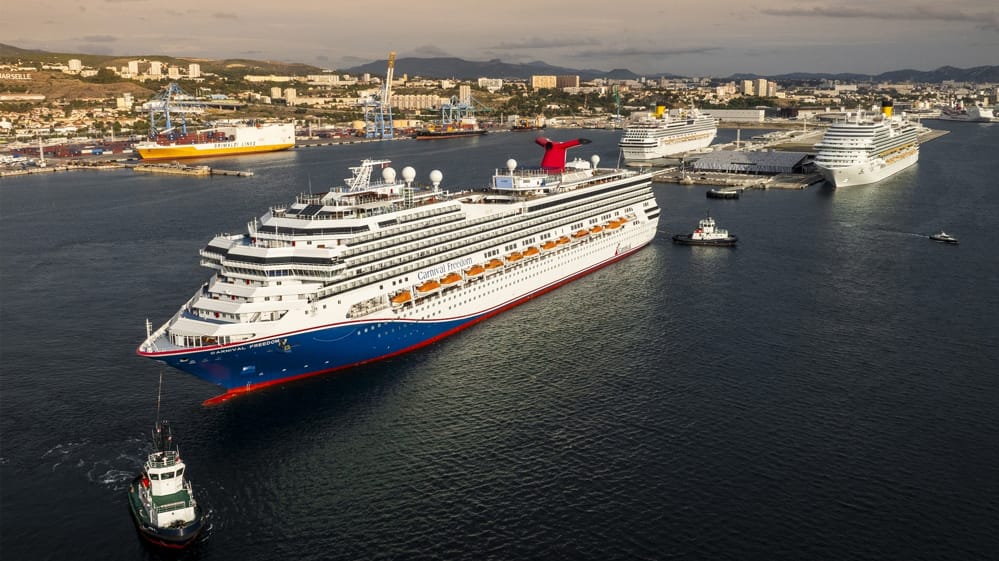
The recent refit of the Carnival Freedom cruise ship provided an interesting example of the convergence of branding and operational considerations, along with Carnival Corporation’s strategy to maximize the value of its fleet. It is a rare, if not unique, example for a cruise ship getting “shorter” to increase its versatility.
The Carnival Freedom (110,000 gross tons) was built by Fincantieri in Italy and introduced in 2007 as one of five sisters in the so-called Conquest class, larger versions of the earlier Destiny class. At 952 feet (290 meters), the ship has a capacity for approximately 3,700 passengers (2,980 passengers double occupancy) and has become a familiar part of the fleet.
As built, the ship had an air draft of approximately 180 feet to the top of its famous “whale tail” funnel. A design harkening back to the famed ocean liner France of the 1960s, and first introduced by Carnival in 1984 on the first Tropicale, the funnel has two wings to help keep smoke off the deck. Indeed, the unique funnel shape has become a signature of the brand used in logos, advertising, and even a shipboard character.
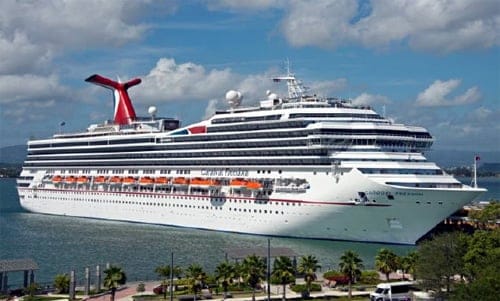
Carnival freedom with her original, taller funnel (Carnival Cruise Line)
For Carnival Freedom, the signature funnel has also proven to be a problem. Docked at Grand Turk in the Turks and Caicos Islands, the ship had a funnel fire in May 2022. While it was limited to the funnel and there were no injuries, the resolution was to cut the wings off to get the ship back into service. Sixteen months later, she got her winged funnel back during a larger overhaul that also included the addition of Carnival’s red, white, and blue hull livery and modification to the passenger amenities at the Navantia Shipyard in Spain. However, it was short-lived, as in March 2024 a second funnel fire broke out, this time blamed on a lightning strike. Once again, the ship lost her distinctive wings.
Three times a charm, Carnival Cruise Line had a new funnel fitted on the ship during her September-October 2026 dry docking at the Chantier Naval de Marseille shipyard in France. The ship was in for a 35-day overhaul that also saw the casino expanded, updates to the video arcade and retail spaces, and accessibility improvements. Unlike in the past, observers, however, noticed a change this time.
“Carnival Freedom’s new whale tail features a lower height to allow access to additional ports,” Carnival Cruise Line confirmed in a statement. The company has not confirmed the specifics of the new air draft, but speculation is that they lopped off as much as 20 feet with a shorter, wider funnel that still has the signature “whale tail.”
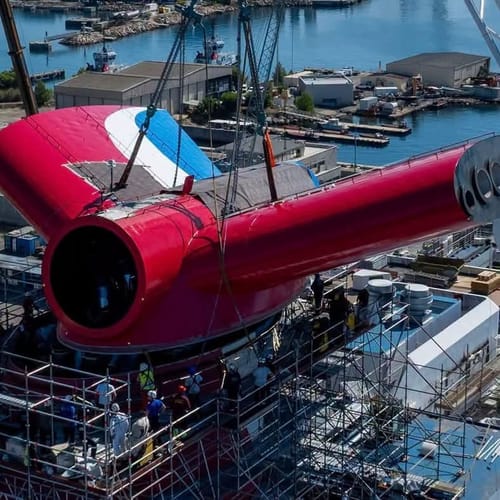
New funnel being fitted to the ship in Spain (Carnival Cruise Line)
It may be the first time a cruise ship has actually gotten “shorter.” The line has not confirmed how it might change the deployment of the cruise ship, which is currently homeporting in Port Canaveral, Florida, and scheduled to move to Norfolk, Virginia, in May 2027.
The air draft has been a challenge for the class of ships before. In 2002, Carnival Cruise Line and power provider Entergy were in discussions about power lines crossing the Mississippi River. Observers noted that one of the sister ships, Carnival Conquest, was hugging the side of the channel because the power lines suspended from 300-foot towers sagged to 176 feet in the middle of the river. Similarly, Carnival Cruise Line is limited in which ships it can send into ports such as Tampa, where the Sunshine Bridge has an 181-foot clearance, Jacksonville, Florida, where the Dames Point Bridge has a 175-foot clearance, and the Chesapeake Bay Bridge, which has an 186-foot clearance. Carnival Cruise Line had previously said it was exploring sending a Conquest ship to Baltimore, but expressed concerns about the air draft clearances.
Funnels historically were a signature item for the ships, seen as an expression of size, strength, and speed and, of course, had the distinctive color schemes of their owners. Cunard, after World War II, boasted that its new dual-purpose liner Caronia had the largest funnel fitted on a passenger ship. The massive red, white, and blue funnels of the S.S. United States were the signature of the ship, but liner funnels stood about 65 feet, rarely 100 feet, off the deck. Some designers had tried to “streamline” funnels, especially in the 1930s, but they often found soot on the deck, and the funnels got taller, such as the S.S. America, which added 15 feet to each of her funnels in 1940 after her sea trials because the yard reported there was too much soot on the decks. By the 1950s, designers and lines considered funnels passé and explored pipes or other ways to reduce the funnels.
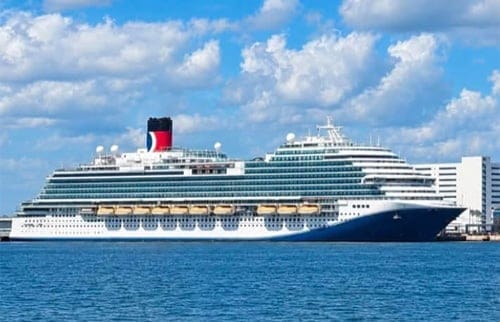
While not sporting a "whale tail," Carnival Venezia now has the Carnival funnel livery (Port Canaveral)
that matters most
Get the latest maritime news delivered to your inbox daily.
Carnival Cruise Line has preserved (and even celebrated) its heritage with the funnels while other cruise lines appear to hide them surrounded by the amusements on deck. In a further unifying of the brand, Carnival recently also added its red, white, and blue livery to the funnel of the Carnival Venezia, which had previously retained the Costa Cruises “C” after the transfer between brands.
The line has other classes of ships that also have lower air drafts, but the change gives the 20-year-old Carnival Freedom added options in the future. There was no indication that Carnival would consider “shortening” any of the sister ships in the future to also increase their versatility.