


Photos: U.S. Hits Iranian Ports and Military Bases in New Wave of Strikes
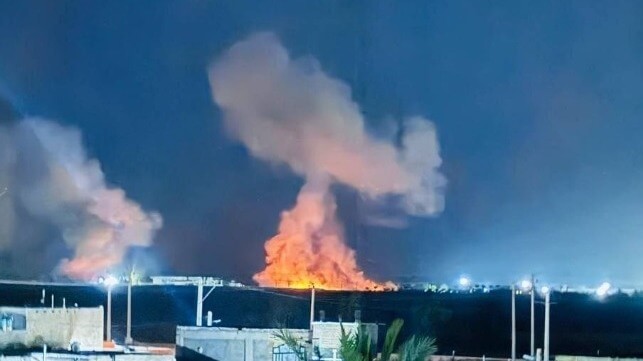
Late Wednesday, U.S. Central Command announced that it is launching more airstrikes against targets in Iran, hoping to blunt the Islamic Revolutionary Guard Corps' ability to mount attacks on merchant shipping in the Strait of Hormuz. The IRGC recently resumed strikes on ships in the Omani sector of the strait, hitting two tankers and one VLCC overnight Monday.
"The United States is holding Iran accountable for recent unjustified aggression against commercial shipping and civilian crews freely navigating a vital international waterway," CENTCOM said in a statement.
Early reports from within Iran suggest that the port authority's control tower at the port of Chabahar was hit in the strikes, along with the Imam Ali Nesdah base, a station for the Islamic Revolutionary Guard Corps. Other areas hit included the Shahid Beheshti dock area - a recently-modernized wharf rebuilt with Indian participation - and the Chabahar police force's dock.
Footage of an American airstrike hitting the Iranian port of Chabahar tonight, knocking out the maritime control tower. pic.twitter.com/dTlTD9siUb
— OSINTtechnical (@Osinttechnical) July 8, 2026
According to Iranian State Broadcaster IRIB, U.S Airstrikes at Chabahar Resulted in Damage to:
— Armed Forces Update (@ArmedUpdat1947) July 8, 2026
- Shahid Beheshti Dock.
- The Police Station Dock.
- The Maritime Traffic Control Tower.
Roughly Half of Chabahar is currently without Electricity, following the Air Strikes. https://t.co/MMDqCc0ugN pic.twitter.com/5RwzuirfPH
Other hits were reported in Bandar Abbas, Konarak, Bushehr, Sirik and Qeshm Island.
In a statement, U.S. President Donald Trump described the strikes as payback. “This is in retribution for yesterday’s bombing of ships by Iran. If it happens again, it will get much worse!” Trump said in a brief social media post.
In the early hours of Thursday (local time), social accounts close to the Iranian regime reported that counterattacks on "a wide range of targets associated with the United States and the Israeli regime" had begun. Iran is widely expected to retaliate by targeted high-value targets in neighboring GCC states, as it did during the first two months of the conflict.
The new U.S. strikes follow an earlier operation on Tuesday night, which hit 80 targets in Iranian territory, according to CENTCOM. Among other IRGC assets targeted, CENTCOM said that it hit 60 of the organization's attack boats. Iran has not confirmed the claims of damage.
After CENTCOM's Tuesday attack, Iran launched a large-scale drone and missile counterattack on U.S. targets in Kuwait and Bahrain, notably including the often-targeted base for U.S. 5th Fleet in Manama. U.S. forces asserted that all of the Iranian munitions were intercepted and that there was no damage during this round.

that matters most
Get the latest maritime news delivered to your inbox daily.
In comments to the press on Wednesday, Trump suggested that - given the exchange of fire - he considers the ceasefire MOU with Iran to be "over," just three weeks after it was signed. "As far as I'm concerned, it's just a waste of time dealing with them," Trump said.
A collapse of the MOU has been long predicted, given the vast gulf between the two sides' negotiating positions on nuclear enrichment and control of the Strait of Hormuz. "What we’re seeing now is simply the reality that both sides, and the mediators, sought to postpone. The deconfliction held for a while, but it lacked the foundations for a durable settlement. So what happened next was perhaps inevitable," Al Jazeera correspondent Ali Hashem wrote in a social post, echoing many other Mideast commentators.
