


Pentagon Pursues a Carrier-Free Unmanned Strike Aircraft for the Navy
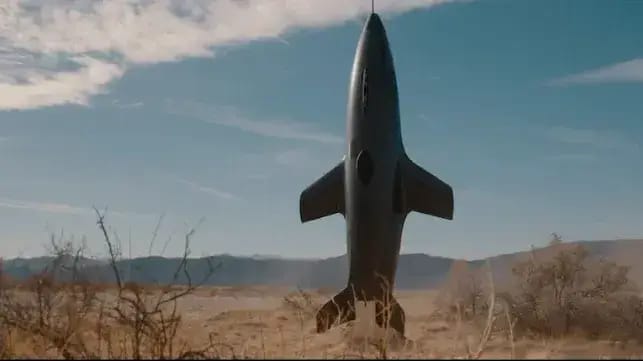
The U.S. Navy's carrier aviation community abandoned early efforts towards an unmanned fighter aircraft in the late 2010s and has yet to formally revive the concept in program form - and in a strange twist, it could be eclipsed in this field by non-aviators. The Defense Innovation Unit - housed outside of the Navy - is beginning to award contracts for the development of experimental airframes for its Runway Independent Maritime & Expeditionary Strike (RIMES) aircraft, a long-range UAV that could take off from a destroyer and deliver the same weapons as an F/A-18 Super Hornet.
RIMES' requirements suggest an aircraft that would allow a surface combatant to mount a scaled-down version of a carrier's kinetic strike capability, without the cost, logistics footprint, crew or pilots of a true carrier. The spec sheet calls for a one-way loaded range of 1,400 nautical miles; ability to carry 1,000-pound class weapons, like standard guided bombs; affordable price; and a high degree of mission autonomy.
The DIU says that the concept grew out of a need to give surface combatants more standoff strike capacity in order to stay out of range of increasingly deadly (and ubiquitous) anti-ship missiles. In DIU's view, launching a two-way unmanned strike aircraft from the back deck would be a way for a destroyer to achieve this goal, and to get around the problem of limited magazine depth (and high cost) that restricts a combatant's missile firepower.
"We are determined to dramatically lower our cost-per kill, while reducing our risk to force, replacing warfighters with economical fires and robots," said DIU Director Owen West.

that matters most
Get the latest maritime news delivered to your inbox daily.
One early awardee is Mach Industries, which will be developing a RIMES prototype in conjunction with electric jet-fan maker Whisper Aero, designer of the JetFoil propulsion system. Their Atlas device will be hybrid-electric, tolerant of austere launch and landing sites, mechanically simple, "highly efficient" on fuel, and unusually quiet due to JetFoil's properties, Mach said in a statement.
The award follows shortly after Mach Industries concluded a $300 million Series C funding round. The company has been growing rapidly with a portfolio of five products for strike and ISR, including long-range strike - all designed for large-scale, cost-effective production.
