
Partner in Shipping Energy Transition: TIPC Reaches Milestone in Industry
[By: Taiwan International Ports Corporation]
The inaugural launch of alternative fuel bunkering services this year (2026) by Taiwan International Ports Corporation (TIPC) marks an important step toward establishing sustainable maritime fuel supply capabilities at all of Taiwan’s commercial ports. In line with international decarbonization trends, growing shipping company demand, and national net-zero emissions goals, TIPC announced plans in 2023 to implement alternative fuel bunkering services across its subsidiary port network. Port of Kaohsiung, Taiwan’s main container port, was targeted for the initial rollout, with alternative fuel services intended to complement ongoing efforts to transform Kaohsiung from a traditional container port into a green container hub. Looking ahead, TIPC will conduct a staged rollout of alternative fuel bunkering services at its other subsidiary ports in a manner that reflects both the current needs and future growth priorities of each port, and promotes TIPC’s overall sustainability objectives.
The Road to Alternative Marine Fuels
Alternative fuel bunkering services are already available at several hub ports in East and Southeast Asia. Port of Singapore, for example, currently offers regular biofuel and liquid natural gas (LNG) bunkering services and is in the process of promoting routine methanol and other low-carbon / low-alcohol fuel bunkering operations and related technical standards. In the face of increasingly strict shipping industry emissions standards and growing shipping company demand for alternative fuels, Taiwan’s commercial ports must install alternative fuel bunkering service capabilities to retain their competitiveness and standing in the global shipping market.
TIPC started from square one in designing Port of Kaohsiung’s alternative fuel bunkering service. Firstly, data and research tools accessible via the online Alphaliner platform were used to regularly track and analyze the numbers and fuel-supply orders of dual-fuel vessels operated by major shipping companies to identify the currently most-used alternative marine fuels and associated development trends. Also, TIPC staff and officials met multiple times with international and domestic fuel suppliers and shipping companies to share information and gain strategic insights into the alternative fuel service capabilities being developed at other ports and the global alternative fuel supply landscape. The findings were then consolidated and used to determine which alternative marine fuel should be the focus of Port of Kaohsiung’s bunkering services in Stage 1.
Once this process had settled on biofuel as the focus of the (Port of Kaohsiung) Stage 1 rollout, the Ministry of Transportation and Communications (MOTC) convened the cross-agency Marine Alternative Fuel Working Platform (MAFWP) in 2025 to integrate public and private-sector resources before formally announcing support of the staged implementation of national alternative fuel bunkering service capabilities. Thereafter, with strong support and guidance from the MAFWP, TIPC steadily laid the groundwork necessary for related bunkering service operations at Port of Kaohsiung, setting the stage for the expansion of such services to ports throughout the country.
Alternative marine fuels currently in regular use by the international shipping industry include biofuel, LNG, methanol, green ammonia (NH 3 ), and hydrogen. TIPC carefully evaluated the potential of each both in light of market development trends, maturity, and supply stability and in the context of short, mid, and long-term promotion plans detailed in the MAFWP’s strategic blueprint for alternative fuel bunkering services, as outlined below.
- Stage One: Biofuel
- Biofuel is a specific mixture of traditional fuel oil and B100 biofuel. The B24 marine fuel blend currently popular in shipping is a 24:76 mixture of B100 biofuel and a mineral-oil based fuel. Because they may be used directly in standard ship engines without retrofitting or replacement, biofuel is a relatively low-cost option for shipping companies to reduce vessel carbon emissions and currently one of the most widely used alternative marine fuels. Biofuel is thus a popular near-term shipping industry strategy for reducing carbon emissions and represents for Port of Kaohsiung the least challenging path to establishing green fuel bunkering services.
- Burning one metric ton (mt) of traditional low-sulfur fuel oil generates 3.151 mt of greenhouse gas emissions. By comparison, burning the same quantity of low-sulfur B24 generates 20% (0.599 mt) fewer greenhouse gas emissions. Thus it is an attractive near-term alternative fuel transition strategy for vessels. After completing necessary contracting procedures, Port of Kaohsiung formally launched biofuel bunkering services in the fourth quarter of 2026. Once fully online, TIPC will expand biofuel bunkering services to other commercial ports nationwide.
- Stage Two: LNG, Methanol
- CPC Corporation’s 7 th LNG Terminal located in Port of Kaohsiung’s Intercontinental Container Terminal (Phase II) is expected to begin regular operations in 2029. TIPC is currently planning the infrastructure necessary to connect wharves and other sites throughout the port in anticipation of leveraging 7 th LNG Terminal supplies for port LNG bunkering services. Also, in light of the number of LNG dual-fuel vessels being built and scheduled for launched in the near term, TIPC is in active discussions with CPC regarding the potential of securing LNG supplies for bunkering services prior to the 7 th LNG Terminal’s 2029 start date. TIPC is also actively working to secure support and assistance from related government agencies and organizations to smooth the path forward for alternative marine fuels at Taiwan ports.
- The alternative marine fuel green methanol (CH?OH), generated using renewable energy or sustainable raw materials, produces extremely low levels of greenhouse emissions when burned. However, green methanol cannot currently be produced in sufficiently large quantities and is prohibitively expensive. Thus, TIPC will make initial contacts with prospective suppliers and develop plans to roll out green methanol bunkering services as soon as feasible and in line with other peer ports in the region.
- Stage Three: Green Ammonia, Hydrogen
- Hydrogen and ammonia are the cleanest alternative marine fuels. However, the technologies required for commercial-scale production are not mature and market prices can fluctuate widely, making these fuels currently impractical for commercial shipping fleet use. TIPC will roll out hydrogen and ammonia bunkering services at specific ports when justified by international shipping trends and supported by sufficiently mature technologies. The southern end of reclaimed land at Port of Kaohsiung, optimally sited for alternative marine fuel facility development and expansion, will host the port’s expansive New Energy Industrial Zone, a dedicated greenfield site for firms engaged in alternative marine fuel-related operations.
- The initiatives outlined for each stage are not arranged in a fixed sequence. TIPC will continue to adjust its plans in response to factors such as decarbonization trends in shipping , shipping companies' fleet construction plans, and the development timelines of alternative fuel supply chains. TIPC will also actively consult and engage with various alternative fuel suppliers to facilitate the introduction of qualified suppliers that can meet market needs and provide alternative fuel bunkering services at the Port of Kaohsiung.
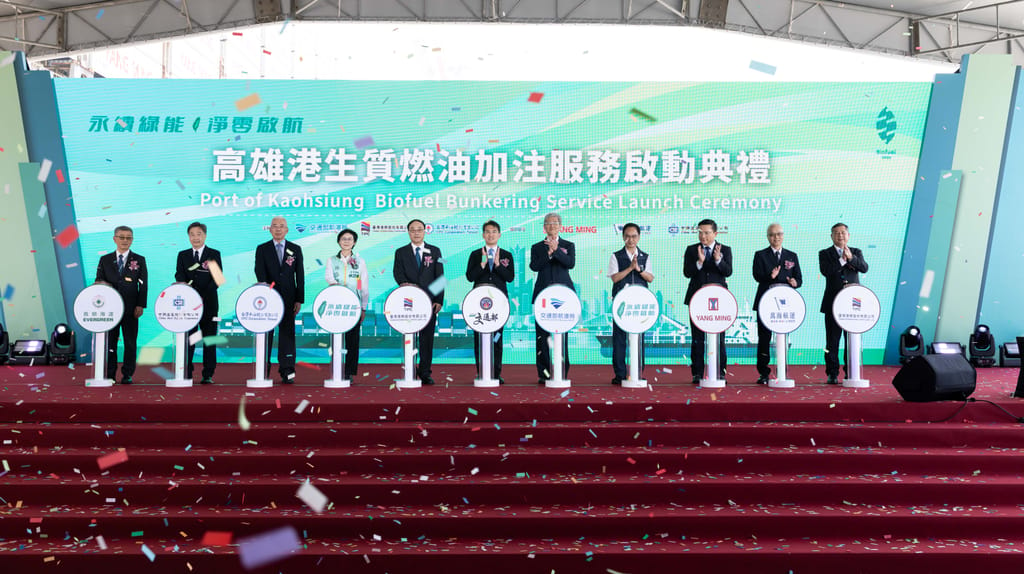
After over a year of preparation, TIPC issued an open bid for biofuel bunkering services at the Port of Kaohsiung in September 2026. The two winning bids went to CPC Corporation and Chant Oil Company, Ltd. To announce the start of biofuel bunkering services at the port and reaffirm TIPC’s long-term commitment to energy transition, TIPC convened the Port of Kaohsiung Biofuel Bunkering Service Launch Ceremony on October 5 th at Kao Ming Container Terminal’s facility in Port of Kaohsiung’s 6 th Container Terminal, joined by MOTC’s Maritime and Port Bureau, CPC Corp., and shipping company representatives.
CPC, which currently prepares and delivers all the marine biofuel available for port bunkering systems, is ISCC EU certified, has comprehensive carbon footprint traceability, and can provide requisite sustainability certifications, providing the evidence needed by shipping companies to support their effective reduction of carbon emissions. Port of Kaohsiung biofuel bunkering services are currently being tapped by three major shipping company customers, including Yang Ming Marine Transport, Wan Hai Lines, and China Steel Express, with 1,200mt of biofuel supplied to fleet vessels already. Other major shipping companies currently promoting low-carbon shipping strategies such as Evergreen Marine and U-Ming Marine Transport may also reach out to port biofuel bunkering service providers when refueling at Port of Kaohsiung.
The launch of biofuel bunkering services at Port of Kaohsiung marks the crucial first step to bringing alternative marine fuel bunkering systems and services to commercial ports throughout the country. Even more, it demonstrates Taiwan’s long-term commitment to seeing the global shipping sector navigate its way to a green, sustainable future. Looking ahead, TIPC will continue working under MOTC guidance and in partnership with the private sector to implement and further optimize alternative fuel bunkering services at all of Taiwan’s commercial ports in line with international shipping industry trends and shipping company needs. As a steadfast partner of the global shipping sector, TIPC is committed to helping shipping companies meet their international net-zero goals and Taiwan’s shipping sector achieve national net-zero targets.
The products and services herein described in this press release are not endorsed by The Maritime Executive.