

ONE Joins Maersk, Hapag, and Others in Return to Suez Canal
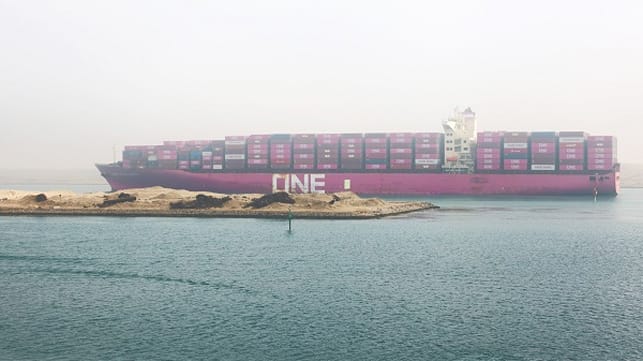
Ocean Network Express (ONE) returned to the Suez Canal route for the first time in nearly three years as it seeks to keep up with its alliance partners and others in the industry. Despite the continued instability in Yemen and dangers as the Houthis work to seize the coastal regions, carriers continue to push forward with their redeployment plans.
ONE had reported in October that it expected to restore its first containerships to Suez Canal routes this month. On November 15. ONE Continuity (8,110 TEU) was the carrier's first vessel to transit the canal. The 320-meter (1,050-foot) long container vessel was part of the northbound convoy coming from Singapore and bound for the Netherlands.
The Suez Canal Authority reports the return was part of a coordinated program by the Premier Alliance, which also includes HMM and Yang Ming. It said that three more routes operated by the Premier Alliance would also be switching back to the Suez Canal instead of rerouting around South Africa.
Adm. Ossama Rabiee, Chairman and Managing Director of the Suez Canal Authority, emphasized, “The Canal is ready to operate at full capacity, receiving the returning mega containerships.”
ONE returned as Maersk and Hapag-Lloyd also announced they would be switching back three of the prime routes of the Gemini Cooperation. Between December and January, it will begin rerouting more large container vessels traveling between Asia and Northern Europe to the Suez Canal. Maersk had been among the first container carriers to switch back to the Canal several months ago and has continued its planned build-up of service on the corridor. The carriers had recently reported that the Gemini route between India and Northern Europe had also resumed Suez Canal transits.
Carriers at this point are feeling peer pressure and are following the pack to maintain the competitive stance. This is despite the news that the Houthis have recaptured sections of the coast along the southern Red Sea. They have more commanding positions along the waterway but have repeatedly said they currently are only restricting Saudi Arabian shipping.
ONE and the Premier Alliance follow the Ocean Alliance, which also restored service just a week ago. The Ever Eon (16,556 TEUs) made Evergreen’s first transit on November 8. It was part of the convoy coming from the north, as the vessel was on a return voyage from the Netherlands to Singapore.
The research firm Drewry calculates that 53 container vessels made the transit during the first week of November. The vessels were operating on the prime routes between Europe and Asia, signaling the carriers' intent to return more services to the route.
The trade group BIMCO reported in October that the Suez Canal was averaging transiting container capacity of approximately 753,000 TEU at the beginning of October, citing data from Clarksons. According to BIMCO, it was the first time since the start of the conflict with the Houthis in late 2023 that more than half the container capacity had returned to the Red Sea routes compared to the reroutings. Before November 2023, it reported the average was 1.45 million TEU per week.

that matters most
Get the latest maritime news delivered to your inbox daily.
BIMCO wrote that volumes had fallen to an average of 141,000 TEU per week from early 2024 to mid-2026. Transit volumes had fallen 90 percent from their peak but are now quickly rebuilding.
Analysts point out that the carriers are trying to lower costs and create additional availability as the segment remains under pressure. They, however, speculate that with strong backlogs in Asian ports, carriers will be challenged to release large amounts of capacity. There has also been a fear that, as the capacity shortages are alleviated by the return to traditional routes, the industry could feel increased pressure from the newbuilds and overall increases in sector capacity. The fear is that the overcapacity could pressure rates, especially spot rates, which have been stronger than anticipated in much of 2026.