
Ohio’s MarineLINE Completes First Application on ATB Barge Conversion
[By: Advanced Polymer Coatings]
Ohio headquartered manufacturer Advanced Polymer Coatings (APC) has completed the first ever application of its MarineLINE coating system on a Jones Act vessel in a US yard.
The project was further the first conversion of an ATB petroleum barge to a chemical barge in the United States including a fully redesigned stainless steel cargo system.
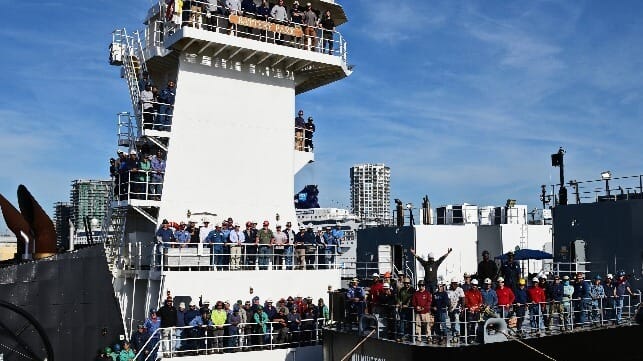
The conversion of the MAM 141 ATB barge took place over 19 months at Gulf Marine Repair shipyard in Tampa in Florida and saw more than 5,000 gallons of MarineLINE applied. Gulf Marine confirmed it is the biggest conversion job the yard has ever undertaken involving more than 200 workers. In total 320 tonnes of steel was installed before the blasting and coating could begin.
The project was managed by Bob Kunkel, President of the vessel construction manager Amtech, who represented the ship owner the New York based investment firm Marathon Asset Management who purchased the vessel from Vane Brothers. Kunkel confirmed the conversion cost was a third of the $150 million cost of building a new ATB.
Mr Kunkel said changing market conditions drove the decision to invest in the vessel conversion along with the cooperation of both Gulf Marine and Anchor Sandblasting & Coating to take on the project with Amtech.
“This was a cargo driven decision,” he said. “There is an increasing volume of chemical cargoes coming into the US and a shortage of tonnage. And those chemicals are difficult to move — like methanol, caustic products and biofuels. The market is changing from traditional fuels. MarineLINE is used in Korean shipyards where I’ve worked for the last 30 years and it was enabling tankers to carry the most highly corrosive cargoes. I just thought, let’s bring that to the U.S.”
Mr Kunkel said MarineLINE has risen above the capabilities of the other coatings.
“MarineLINE brings you as close to stainless steel tanks as possible,” he said. “If I’m carrying methanol tomorrow, I can carry ethanol on Friday without considering coating recovery. That ease of cleaning and turnaround with MarineLINE is paramount — it doesn’t have to recover like a phenolic. An epoxy can take days by comparison or may not even be able to carry the more corrosive chemicals. MarineLINE gives you the ability to take the most aggressive cargoes.”
Advanced Polymer Coatings Global Marine Manager Captain Onur Yildirim, said there is great pride in working on a project which is a first.
“We’d like to thank Marathon, Amtech, Gulf Marine Repair and Anchor Sandblasting & Coating for investing in MarineLINE,” he said. “There is a crunch looming with demand for chemicals rising and a shortage of specialist vessels. As a result we are excited to grow more in the domestic US market. This conversion shows MarineLINE can be applied to coastal and inland marine chemical barges and ATBs here in the US making them more flexible. The key is to help operators improve cargo readiness and compete in more specialized trades.”
Gulf Marine Repair CEO Richard McCreary said the scale of the job saw each piece of machinery on the vessel dismantled, inspected and rebuilt or upgraded.
“I’m proud of the whole team in the yard, our workforce and contractors,” he said. “It was a very complex job with the vast amount of steel installed, while the vessel was afloat, before the application of MarineLINE itself. Gulf Marine is now the only yard in America with expertise in how to apply MarineLINE. As a result, we think Gulf Marine is in pole position to convert more ATBs to chemical carriers, as many of them discharge at the Port of Tampa — the biggest refined product import port in Florida. We also think Gulf Marine could serve the market for applying MarineLINE to the MR tankers the US wants to build.”
Tony Stokes, President of Anchor Sandblasting and Coating, which applied MarineLINE said the job was a first for his team having not used the coating before.
“We received a lot of help from the MarineLINE and Amtech teams,” he said. “They took us out to shipyards in Turkey to see how the coating is applied, then had engineers and inspectors on site to help with the application.”
Captain Yildirim said MarineLINE’s technical differentiation lies in the density of its cured polymer surface. Heat curing creates a tightly knitted molecular structure comprising up to 784 cross-links, forming a chemically inert barrier. In APC studies, MarineLINE has demonstrated resistance to more than 5,000 chemical products. According to APC’s operational modelling, a 25,000 dwt tanker fitted with MarineLINE can earn a considerable premium due to increased availability and cargo flexibility.
The products and services herein described in this press release are not endorsed by The Maritime Executive.
