


Norway Grants Over $120M for Hydrogen and Ammonia Ships and Bunkering
Norway announced a new round of financing grants valued at more than $120 million as it continues to support the conversion to zero—emissions fuels in shipping and other segments. Providing the support through Enova, a state enterprise owned by the Ministry of Climate and Environment, Norway seeks to build new industry and develop leadership in the new segments of the economy while reaching its goals for decarbonization.
The new round focuses on seven ships, which it views as pioneers in their segments and demonstrations of the potential for zero-emission shipping. In total, it awarded approximately $100 million in support for three large bulkers to run on ammonia and four coastal bulkers to run on forms of hydrogen. Enova says these seven vessels will account for a cut of 92,000 tons of CO2 per year, and supporting the entire project are awards to establish the first three ammonia bunkering stations in western Norway.
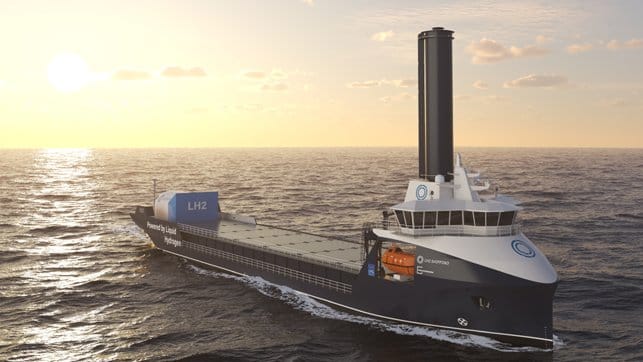
LH2 Shipping, working in partnership with Strand Shipping Bergen, part of the Vertom Group, received additional funding of approximately $29 million for the construction of two liquid hydrogen-powered bulk carriers. The group received a previous round of funding in the spring for the first two vessels, with the latest round making it possible to double to four ships. The two additional vessels will be 7,700 dwt bulk carriers for short sea shipping, carrying bulk/general cargo mainly between northern Norway, the Baltic region, and Europe. The ships will be 108 meters (353 feet).
The onboard hydrogen systems will consist of 17t LH2 storage capacity and 3.5 MW PEM fuel cells. A battery pack of approximately 1.5 MWh will be installed to support the fuel cells, and the ships will be equipped to use shore power where available for loading and unloading operations. A standby diesel generator package will also be installed, where the ships can sail on diesel/biodiesel if the LH2 supply fails, or is not in place in time when the ships are delivered from the shipyard.
GMI Rederi is also receiving a grant as it works to build two coastal bulk carriers. The ships will be equipped with fuel cells with compressed hydrogen, batteries, and wind-assisted propulsion technology. The ships will transport asphalt and construction materials on the Norwegian coast.
Amon Bulk is also receiving approximately $29 million toward the construction of three ammonia-fueled Kamsarmax bulkers with a capacity of approximately 80,000–85,000 dwt. The company highlights that the vessels are tailored to meet the needs of European steel industries and follow two other ships that were announced earlier this year. All five ships are scheduled for delivery between 2029 and 2030, forming part of a new generation of zero-emission bulk carriers.

that matters most
Get the latest maritime news delivered to your inbox daily.
Support these new vessels, Enova also awarded $43 million to support the development of three ammonia bunkering stations along the west coast. Azane Fuel Solutions, a Norwegian technology company, is developing the bunkering stations to be located at Mongstad, Florø, and Risavika. The stations will have a capacity of up to 2,000 cubic meters of refrigerated ammonia and a bunkering speed of more than 100 tons per hour. Azane has one year to make a final decision on the investment in the stations.
Enova highlights the importance of being a first mover in these developing spaces. It believes Norway will be well-positioned as a leader.
