


Navantia's Corvettes for Saudi Arabia are Arriving On Time, On Budget
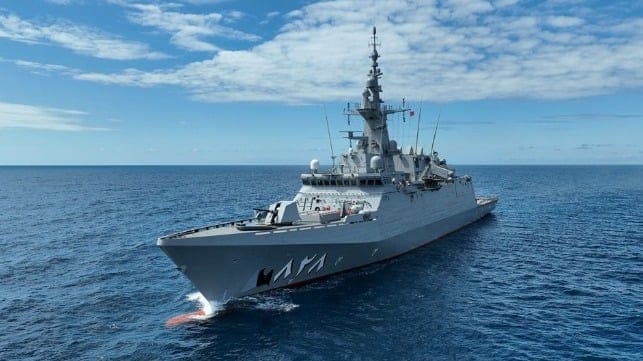
Spain’s Navantia has launched the first of a second batch of three Avante 2200 corvettes for the Royal Saudi Navy (RSNF) at its San Fernando yard in Cadiz Bay. HMS Al Madinah (F838) will be fitted out and commissioned in Spain, whilst the second and third ships of the contract will be completed in Saudi Arabia by SAMINavantia, a joint venture between Navantia and the Saudi sovereign defense company SAMI, with completion by 2029.
The division of work between initial construction in Cadiz, and then the installation of combat systems and fitting out by SAMINavantia in Jeddah, follows the pattern prescribed in the Saudi Vision 2030 strategic plan. This mandates the creation not only of jobs domestically in Saudi Arabia when defense money is spent, but also calls for the fostering of defense manufacturing and development; in the case of the corvettes, in what is known as the Al Sarawat Project, this has entailed the development locally of the Hazem command and control system.
Many Western defense manufacturers have balked at the additional requirement in defense contracts post-Vision 2030, to go beyond sub-contracting work locally to create jobs, but also to share intellectual property – so that in time Saudi manufacturers such as SAMI can then manufacture and market defense equipment independently. In a number of instance, SAMI was able to buy products and intellectual property from companies in financial difficulties. But it met a wall from high-end manufacturers who did not want to lose their intellectual property edge in state-of-the-art equipment. Navantia managed to find a median position, which satisfied both parties, such that the initial order for five Avante 2200 corvettes was extended on similar terms to a second batch of three additional vessels.
A key player in achieving this success may have been Gonzalo Mateo-Guerrero, who in 2022 was appointed to be the Chief Operating Officer of SAMI, which had by then been allocated overall control of the Saudi share of work. Previously, Mateo-Guerrero (as an employee of Navantia) had overseen the Spanish end of the program, setting up the project and overseeing keel laying at Navantia’s shipyard. In his new role for SAMI, for which he was based in Jeddah for two years, Mateo-Guerrero then had oversight of the completion and commissioning of the frigates in Saudi Arabia. He then returned to Navantia in Spain as Director of Operations and Business, and must have had a key role in securing the contract extension for the final three corvettes.
The Navantia contract with the Saudis is a ‘total care’ package, covering the initial training of crews, logistic support, continuation and operational readiness training, and long-term scheduled maintenance visits to the Navantia dry docks in San Fernando.
All eight of the corvettes are likely to end up with the RSNF’s Western Fleet in the Red Sea, in the front line against the threat posed by the Houthis to marine traffic in the southern Red Sea. The new ships represent a substantial step-up in capability. The first ships of the class, HMS Al Diriyah (F830), HMS Hail (F832), HMS Jazan (F834), HMS Unayzah (F836), have been seen regularly in Jeddah’s King Faisal Naval Base, joined later by HMS Al Jubail (F828). They are likely to bear much of the burden carried by the Al Madinah-class frigates, which took some battering in the early days of the prolonged confrontation in the Red Sea with the Houthis.

that matters most
Get the latest maritime news delivered to your inbox daily.
Besides overcoming the potential difficulties of shared and co-production, Navantia is claiming that the corvettes are being "delivered on time, within budget and in full alignment with our localization commitments to the Kingdom."
Navantia is now taking the lead in delivering three solid stores resupply ships for the Royal Fleet Auxiliary from the Harland & Wolff yard in Belfast, which it acquired last year.
