

Indian Navy Demonstrates its Skill in Curbing Pirate Activity
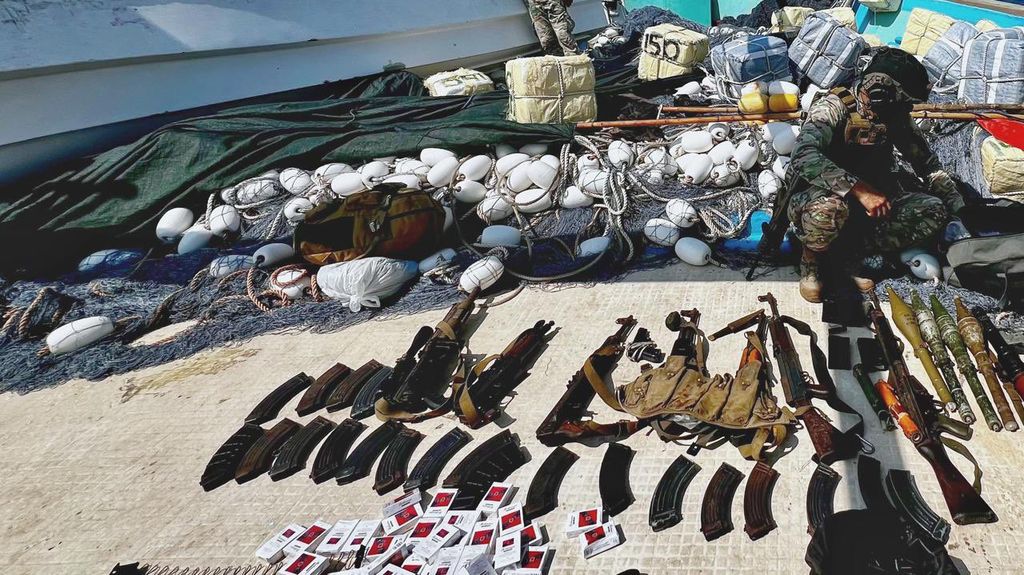
Once again, an efficient joint operation mounted at short notice on November 2 has demonstrated the skill of the Indian Navy in curtailing what appears to be pirate activity.
On October 29, the Iranian fishing vessel Azini (MMSI 422048400) was seized by a group of 12 Somali pirates in the Guardafui Channel, on the coast of the unrecognized Puntland administration in Somalia, offshore from Bandar Bayla and Xaafun.
Piracy emanating from this coastline has been endemic for decades, with the epicenter of the scourge generally considered to be the town of Eyl further south down the coast. Locals complain that with a lack of effective central government, foreign unregulated fishing boats can strip local waters of fish stock, leaving local fishermen unable to take sufficient catch to support themselves. If some locals then resort to piracy, the entire fishing community suffers further, as the Puntland administration - supported by aid programs - seeks to curb piracy by preventing legitimate fishing boats from going out to sea. The Azini was one such foreign fishing vessel harvesting local fishing stocks, and in this instance the seizure of the Azini may have been both an act of piracy and an attempt at direct action by locals targeting foreign fishing.

that matters most
Get the latest maritime news delivered to your inbox daily.
Clearly, notwithstanding the US naval blockade in the Gulf of Aden, if an Iranian dhow apparently homeported in Chabahar can go fishing off the coast of Somalia, it could also be involved in either arms smuggling from Iran to the Houthis, or transporting migrants across the Gulf of Aden to Yemen. If there was any covert purpose to the dhow’s activity, then the Indians would not be inclined to make a spectacle of it. Three Iranian fishing vessels have been seized by pirates off Puntland since July, so this was not an isolated instance. Clearly, Iranian dhows appear to be able to come and go in these waters without hindrance – except by Somali pirates.
The other notable feature of the recapture was the efficiency of the naval operation. The Iranian Navy no longer maintains a presence in the area, which it did without break between 2008 and 2026. Instead, it fell to the Indian Navy to coordinate a response force made up of the helicopter-equipped guided-missile destroyer Kolkata (D63), an Indian Navy P-8 maritime surveillance aircraft and a commando boarding party. In this instance, bold and decisive action, which other forces may have flinched from taking, persuaded the Somali pirates to surrender without a fight, thereby allowing the completion of the operation without casualties being sustained by either side or among the crew of the dhow.