


Iranian Navy Sketches Out Shipbuilding Plans
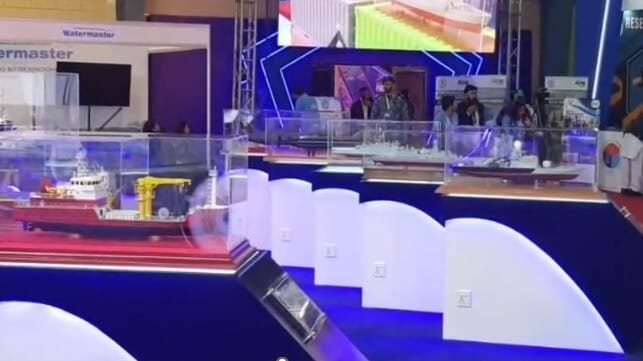
Iranian naval enthusiasts have sketched out an overview of the regular Iranian Navy (Nedaja)’s future ship-building program. Details and drawings of four new classes of ship under design appear to have been taken from the Iranian exhibition stand at the Pakistan International Maritime Expo & Conference (PIMEC), which was held in Karachi November 3-6, but also draw on remarks made by the Nedaja commander Rear Admiral Shahram Irani at Iran’s annual Naval Day celebrations held at the Naval Academy at Nowshahr on the Caspian Sea on November 30.
When interpreting Iranian commentary on their own military, there is often a high degree of hubris and hyperbole in descriptions of future equipment plans and equipment capabilities. Sometimes there is deliberate deception. Shipbuilding in Iran is even more painfully slow in many respects than in some advanced Western countries, albeit Iranian shipbuilders must be given credit for innovative equipment developed to compensate for the effects of international sanctions. A naval architect would have a better perspective, but all the designs make attempts to incorporate stealth features. Nonetheless, the plans outlined recently give an idea of the direction in which Iranian naval thinking is heading.
In terms of immediate deliveries, the last frigate of the Moudge Class, IRINS Toufan (F79?) is still not yet near operational, despite having been laid down in 2014. The Moudge Class was based on the Alvand frigates, which were built for Imperial Iran in the United Kingdom in the 1960s, and of which three vessels are still serving (occasionally), namely IRINS Alvand (F71), Al Borz (F72) and Sabalan (F73).
The Moudge Class has not been without its problems, with the Nedaja having overloaded the vessels with new weapons systems, making them top-heavy and prone to capsize. IRINS Talaiyeh fell over in dry dock while under construction – but was resurrected as the intelligence collection frigate IRINS Zagros (H313). IRINS Sahand (F74) capsized and later sank in Bandar Abbas Naval Harbor on July 9, 2024, but was resurfaced and brought back into service last month, the Nejada claims.
The Moudge vessels, and presumably the two older Bayandor Class frigates, are apparently to be superseded by the Binder Class. At 105m it is longer by 10 meters and at 1700 tons heavier by 200 tons than the Moudge Class. Binder Class ships will still have a 76mm gun and a helicopter hangar. It appears as if they will have 26 Vertical Launch System (VLS) tubes, plus 16 cruise missile tubes for the short to long range Noor/Qader/Ghadir anti-ship cruise missile series derived from the Chinese C-802. Aside from the emphasis on missiles, the new design has a customary-elsewhere integral capability to launch small fast attack craft.
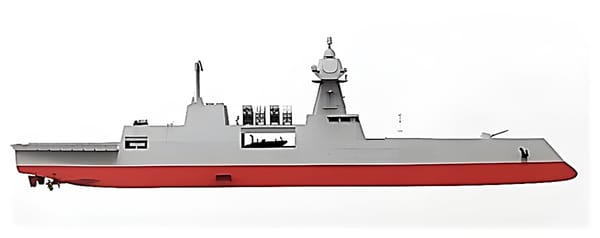
The proposed Binder-class (CJRC)
The Nedaja currently has a substantial fleet of aging fast attack patrol craft. The 15 Sina and Kaman Class boats based on the French La Combattante II Class, almost all of which are between 50 to 20 years old, are equipped with missiles and 76mm guns, albeit Sina Class boats are still being built and the design still looks useful. The six smaller US-built and gun-equipped Kaivan and Parvin Class patrol boats are even older.
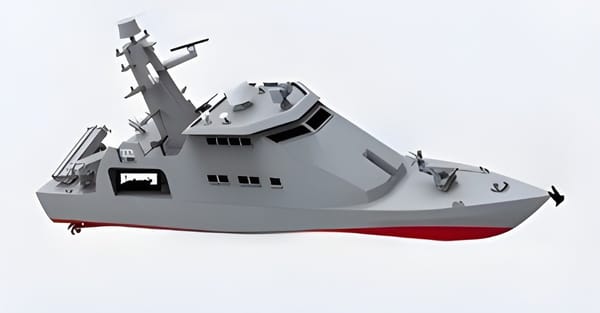
New 33-meter missile patrol boat design (CJRC)
The smaller boats look as if they could be the first to be replaced by a new 33-meter missile patrol boat, class name as yet unknown, designed primarily for coastal patrol. This boat is supposed to be capable of 25 knots, and has a 20mm Oerlikon cannon and tube-launched Noor/Qader/Ghadir anti-ship cruise missiles. The design is said to be capable of adaptation to host a helicopter, but from the images of the design, this might be difficult to achieve.
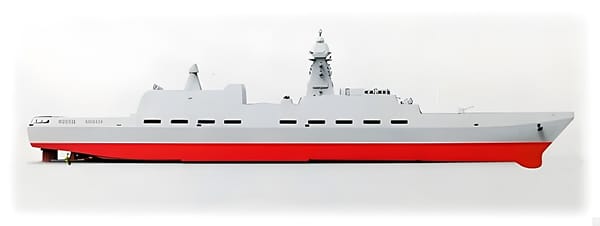
On 2 June 2, 2021, the Nedaja’s flagship IRINS Kharg (K431) sank off Jask in the Gulf of Oman after a suspicious fire on board. The loss of this ship was keenly felt, because in addition to its important long-distance replenishment role, it also served as the major training vessel on which naval cadets gained sea experience. Substitute training cruise ships were the aging Hengam Class landing ships IRINS Tunb (L513) and IRINS Lavan (L514), both 50 years old and in poor shape. To fulfil the long-vacant training role will be the 145m IRINS Luqman, armed with a 76mm gun, 24 VLS canisters and an onboard helicopter. The design is apparently intended to provide a lead-in and a test-bed for a new Negin Class of destroyers.

that matters most
Get the latest maritime news delivered to your inbox daily.
Design of the proposed training ship IRINS Luqman (CJRC)
As any good commander would, Rear Admiral Shahram Irani has recently made much of the ambitions and capabilities of his force, which following the 12-Day War must have taken a dent to its morale. An outline of the Nedaja’s future ship-building program may well form part of his campaign to establish a more optimistic mood. But if these projected missile-heavy newbuilds are to be combat effective, the ultimate test will be whether they will be able to detect targets, and then engage them effectively, at ranges greater than their adversaries.
