


Interview: How Does a Wing Sail Get Installed on a Ship?
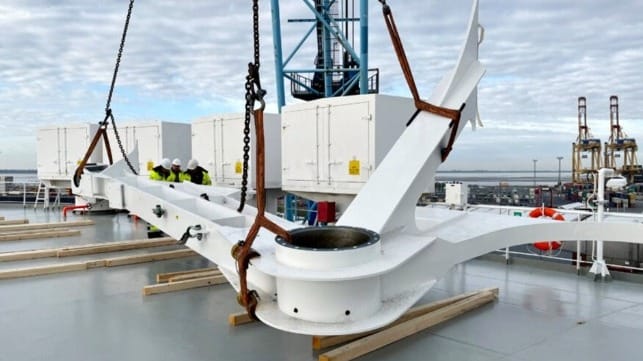
As the IMO debates the best way forward for emissions regulations, more owners are coming to appreciate the value of efficiency improvements that reduce the cost of fuel and the regulatory expenses of carbon emissions. Wind assisted propulsion (WAP) devices have additional advantages for European emissions compliance, and are fast gaining acceptance on the vessel classes and trading routes that work best for wind power. To find out more about how the process of designing and installing these technologically-advanced systems works, TME spoke with the team at Oceanbird, a JV between Wallenius Wilhelmsen and Alfa Laval, about how a WAP system fits onto a merchant vessel.
Can you tell us about the engineering & construction work required to fit Oceanbird onto a newbuild or a retrofit project? How much modification is required?
Emil Kotz (Head of Customer Projects): Our Wing560 is a big piece of equipment, so of course there are things to take into consideration when installing one or several on a vessel. For retrofits, we need to consider the strength of the hull and do potential reinforcements, for example. With newbuilds, the requirements are considered from the design stage. In general, newbuild projects are less about modifications and more about ensuring that the equipment is integrated into the vessel design from the outset — for example, incorporating the generated thrust from the Wing560 into the drivetrain design to ensure high efficiency. But, these modifications are a two-way street- we also need to make adjustments to the Wing560 to accommodate the vessel type, this could come in the form of how we work with a vessel’s operational constraints.
Amrit Bhullar (CEO): You touched on integration. This is a topic that we are becoming more vocal about- in the mid-term, we see wind propelled vessels making a debut on the market and Oceanbird wants to be the enabler. When we talk about wind as primary propulsion, it requires that the vessel is specifically designed for purpose. Additionally, full integration of the systems in the ship as well as outside services need to come together to ensure the best performance. It will be about weather routing, trimming, how the motor and sails work in tandem to keep the energy output from the vessel at a minimum. We think about this integration a lot and how we can be ready to meet the demand.

Amrit Bhullar (Oceanbird)
What kind of support does your team provide to the shipyard and the owner during installation?
Emil: This depends on the requirements of the owners and if the installation will be a retrofit or newbuild. We are developing relationships with shipyards, importantly to get them on board with this technology. We need them to be as enthusiastic as we are.
Amrit: It is also important that the shipowner has a clear understanding of what they can gain from having our wings installed on their vessels. We help them by modeling their vessels and routes to give them a better understanding of their savings. Part of this is to also see how they can take advantage of weather routing. We are open about it- some routes will absolutely perform better than others and they must take this into consideration.
Jonas Alvan (Product Manager): Looking beyond pre-sales, we also have tools that we offer shipowners- one of these is crew training at our land-based prototype- which is less about teaching the crew how to operate the wing (it is just a button to tap on the screen), but more so giving them the confidence to operate the wing in different conditions, as well as basic troubleshooting and repair know-how- all things which increase up time, and therefore value. If the crew are not feeling comfortable using the new type of equipment, they will not use it, and fuel savings will not be realised.
How important is it to select a partner with installation expertise?
Jonas: This is of course important, and all technologies have different designs and requirements- meaning that the installation will also vary. It’s important to have a close collaboration between the vessel’s stakeholders and the equipment supplier. But I would like to approach this question from a different perspective. We believe that going forward, we need to treat wind propulsion as a fully integrated solution rather than just an ‘add-on’ to a vessel. To think in this way means significant collaboration across even more stakeholders. This is where we are going- and this is where it becomes very important to have a partner that can lead the conversations. It should be easy to operate the wind propulsion system and the savings should be visible.
What are the potential fuel savings for a notional vessel (for example a product tanker)?
Emil: I wish this was an easy answer, but nearly everything factors in here- the speed, the routes, the utilization. If we’re forced to give a scenario, we can say that on the North Atlantic trade route, one wing sail installed on a PCTC can save 19 tonnes of fuel per passage. We also have a calculator on our website (www.theoceanbird.com/why-wind) to get some general savings information.
I will highlight that for potential customers that come to us, we make a specific evaluations for their business case.
that matters most
Get the latest maritime news delivered to your inbox daily.
- What kind of feedback are you receiving from owners so far?
Amrit: We are openly working with Wallenius Wilhelmsen - others are undisclosed, but I can say that we have gotten great feedback on our professionalism as well as flexibility in ensuring that their projects can be realized. Shipowners have been very receptive to our land-based-prototype in Landskrona where they can see our solution in action - even demo it themselves. We have also heard quite a bit from the Tirranna crew, who felt that the training was very helpful in dispelling any hesitations or fears of operating the Wing560! -TME
