


Indefinite U.S. Control of Venezuelan Oil Could Benefit Tankers, Traders
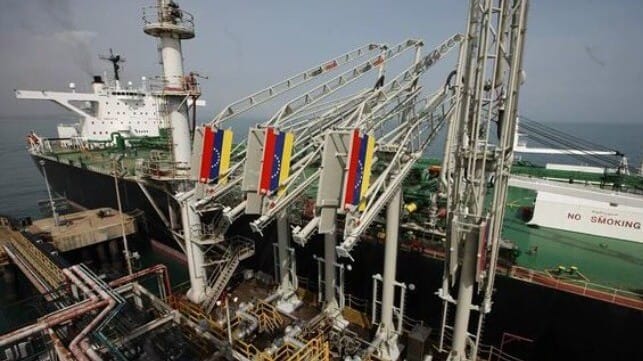
Following the removal of Venezuelan dictator Nicolas Maduro, the Trump administration plans to oversee the country's oil exports, and will take delivery of 30-50 million barrels as a starting point. That initial consignment is just the start, though, and the oil export management arrangement will continue indefinitely, sources at the White House confirmed to CNBC.
"We are going to market the crude coming out of Venezuela, first this backed up stored oil, and then infinitely, going forward, we will sell the production that comes out of Venezuela into the marketplace," energy secretary Chris Wright told an audience at the Goldman Sachs energy conference in Miami, per Bloomberg.
In the long run, the objective is to foster conditions that would be favorable to U.S. energy sector investment, he said. But in the short run, the concept is to stabilize PDVSA's existing state-owned oil production, supply PDVSA with U.S.-produced diluents for reducing the heavy crude's viscosity, reboot imports of spare oilfield parts and services, and take control of all Venezuelan oil exports.
The marketing arrangement will begin with Venezuela's stored crude, including onshore storage tank capacity and floating storage (laden tankers). It will continue indefinitely with ongoing production, Wright said.
In a statement Wednesday, Venezuelan state oil company PDVSA acknowledged that amidst current "challenges," it is negotiating the sale of its oil with the United States "under clear commercial schemes and shared benefits."
Vice President JD Vance told Fox News that the U.S. will also be exerting political control over the Venezuelan government by keeping a grip on its oil exports. "The way that we control Venezuela is we control the purse strings, we control the energy resources, and we tell the regime, 'you’re allowed to sell the oil, so long as you serve America’s national interest,'" Vance said.
Reputable tanker companies stand to benefit from this new arrangement, which will add more ton-miles for reputationally "clean," unsanctioned vessels that are not associated with the shadow fleet. Previously, a large share of Venezuela's long-haul oil exports shipped aboard gray-market vessels with questionable histories, some listed on the U.S. Treasury blacklist. A U.S.-managed Venezuelan oil sector would likely mean the disappearance of shadow fleet tonnage from Venezuela's loading terminals, replaced by new demand for above-board tankers.
Tanker stocks soared on the news, buoyed by the prospect of changing trade patterns and the demonstrated U.S. resolve to seize shadow-fleet tonnage. Scorpio Tankers and CMB.Tech went up eight percent, Teekay and DHT went up nine percent, and Frontline jumped nearly 10 percent.

that matters most
Get the latest maritime news delivered to your inbox daily.
Oil traders are also showing an interest in the prospects of a reshuffle in trade. Trafigura oil chief Ben Luckock told Bloomberg News that his company was interested in the opportunities in Venezuela, and that it would be talking with the U.S. government about cooperation - once a proper legal framework is in place for the work, as well as the appropriate security measures for foreign nationals on the ground.
The work of trading and trade financing has already begun, according to the U.S. Energy Department. In a statement Wednesday, it said that it has "engaged the world’s leading commodity marketers and key banks to execute and provide financial support for these crude oil and crude products sales."
