


Hapag and NCL Win Tender from Major Brands for E-Fuel Container Shipping
A buyers alliance made up of major brands, including Amazon, Patagonia, IKEA, Nike, and others, awarded its second tender for low-emission container shipping to Hapag-Lloyd and North Sea Container Lines. The project aggregates demand from the shippers to help drive the use of new alternative low-emission fuels.
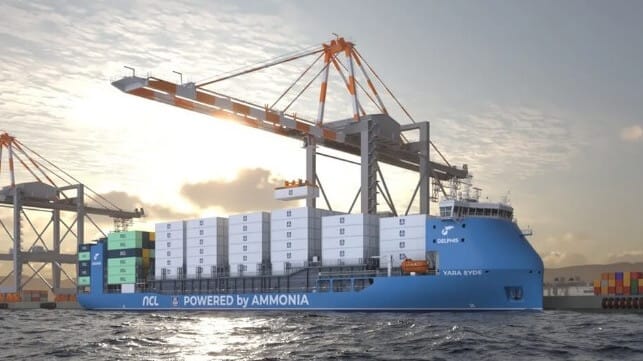
Known as the Zero Emission Maritime Buyers Alliance (ZEMBA), the group launched its second tender in February 2025, focusing specifically on e-fuels. They announced today, December 17, that they decided to split the award to support two new developing fuel types, e-methanol and e-ammonia. Hapag-Lloyd will deploy e-methanol on its large containerships for the trans-oceanic lane, while regional feeder company North Sea Container Line will use its new vessel Yara Eyde, the world’s first ammonia-powered containership, to fulfill the northern European trade lane.
ZEMBA has 50 members, including many well-known international brands. They collectively are committing to 20 billion tonne nautical miles of transport activity over three years starting in 2027. Some members are extending to five-year commitments, while ZEMBA highlights that contracting is ongoing and that additional freight buyers are welcome to join the initiative. Currently, it is expected that at least approximately 120,000 metric tonnes of GHG emissions will be abated starting in 2027 with this contract.
Hapag-Lloyd was also the winner of the first round, which was awarded in 2024, and committed to the use of waste-based biomethane, which would reduce emissions by at least 90 percent. The first round committed to 1 billion TEU container miles of shipping between Singapore and Rotterdam in 2025-2026. Initially, they expected it to run for three years, but shortened the award to two years as they noted the expected first deployment of e-fuels in 2027.
ZEMBA seeks to create a sufficient critical mass of volume for the shippers to encourage the vessel operators to commit to the emerging alternative low-emission fuels. The large volume helps the shipping lines to overcome the cost differential, while ZEMBA says it is also encouraging future development of the new fuels and their deployment. This second procurement, Zemba says, was focused on kickstarting a new market for scalable, low-carbon hydrogen-derived e-fuels.
“At a time when sourcing scalable e-fuels remains a major challenge for the entire industry, winning the second ZEMBA tender is a significant milestone for us,” said Rolf Habben Jansen, CEO of Hapag-Lloyd.
Hapag highlights that at present, it has a total of 37 dual-fuel liquified natural gas vessels either in service or planned. These ships can operate using biomethane as part of the company’s commitment to gradually decarbonize its fleet. Last year, the company also signed an offtake agreement with the Chinese energy producer Goldwin for a supply of 250,000 metric tons of green methanol per year.

that matters most
Get the latest maritime news delivered to your inbox daily.
Reuters reports that Hapag-Lloyd plans to use five large containerships to fulfill its new commitment to ZEMBA and the brands.
North Sea Container Line announced in 2023 a partnership with Yara to build the Yara Elde, a 1,300 TEU ammonia-fueled containership. Work began on the construction of the vessel in China in September 2025. The plan is to operate it on a trade corridor between Oslo and Porsgrunn, Norway, and Hamburg and Bremerhaven, Germany.
