


Greenpeace Activists Confront FPSO Heading to Scotland's Rosebank Oil Field
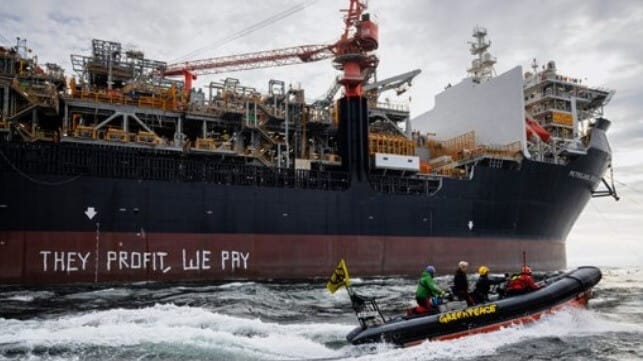
Greenpeace activists are intensifying their protests against a major oil and gas project in the United Kingdom as it also came up for debate in parliament. The activists caught up to a floating production storage and offloading vessel (FPSO) that is en route to the project and defaced the ship by painting a slogan on the hull.
The UK’s Labor government is debating the previous government’s decision to greenlight the Rosebank oil and gas field located off the coast of the Shetland Islands on the UK Continental Shelf. Greenpeace activists used the opportunity, targeting the PetroJarl Rosebank FPSO as it left Walvis Bay in Namibia after refueling, to draw attention to their calls to stop the project.
After sailing close to Rosebank aboard the Greenpeace-owned Rainbow Warrior III ship, four activists used rigid-hulled inflatable boats and kayaks to reach the FPSO and managed to paint ‘they profit, we pay’ on its hull. Six more activists surrounded the FPSO with banners opposing the project while the Warrior displayed a giant banner hung between its masts reading “Stop Rosebank’”
The activists targeted the FPSO that has stopped in Namibia for refueling before proceeding to the Rosebank field, where oil majors Shell, Equinor, and Ithaca are hoping to commence production, subject to being granted the go-ahead by the UK government. The FPSO is being towed to the UK waters by tugs. This was the second time in five days that Greenpeace activists had targeted the FPSO, unfurling their “Stop Rosebank” banner on March 20.
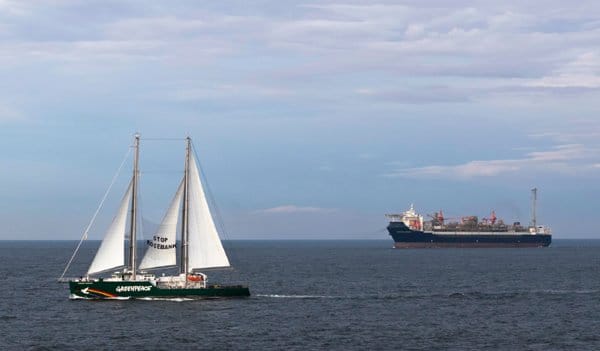
Rainbow Warrior III off the coast of Namibia (© Christian Åslund / Greenpeace)
The 95,000-ton Rosebank is credited as being one of the world’s largest FPSOs that is specifically designed for harsh environments, including in the North Sea. Formerly known as PetroJarl Knarr and sailing under the Bahamas flag, she was built by Samsung Heavy Industries and delivered in 2014. She operated on the Knarr field offshore Norway from 2015 until May 2022.
The FPSO was renamed the Rosebank and reflagged to the UK in January after undergoing an extensive refit in Dubai. The upgrade was designed to ensure the vessel can operate long-term without the need for additional drydocking. She is operated by Adura, a joint venture between Shell and Equinor.
Rosebank is the UK's biggest undeveloped oil and gas field, which is located approximately 80 miles northwest of Shetland in approximately 1,100 meters of water depth. The field, which is being developed at a cost of $3.8 billion, boasts recoverable resources in the region of 300 million to 500 million barrels of oil. The field is designed to be developed with subsea wells tied back to the FPSO, with oil being transported to refineries by shuttle tankers, while gas will be exported through the West of Shetland Pipeline system to mainland Scotland.
First approved in 2023, the project has faced stiff opposition from environmentalists led by Greenpeace and campaign group Uplift. In January last year, a Scottish court ruled that the decision to approve Rosebank was unlawful, with the operators being directed to submit a new environmental impact assessment, which they did in October.

that matters most
Get the latest maritime news delivered to your inbox daily.
“To protect bill payers, as well as the climate, we need to quit our oil and gas addiction as quickly as possible. The government must stick to their guns on Rosebank and refuse to allow these climate vandals to bounce them into making a big, dirty and very expensive mistake,” said Angharad Hopkinson, Greenpeace UK campaigner.
If given the green light by the UK government, which has committed to banning new oil and gas exploration licences, the operators are hoping to commence production with first oil expected later in the year. The field has a projected lifespan of 25 years.
