
First Ammonia Dual-Fuel Vessel Delivered to Exmar
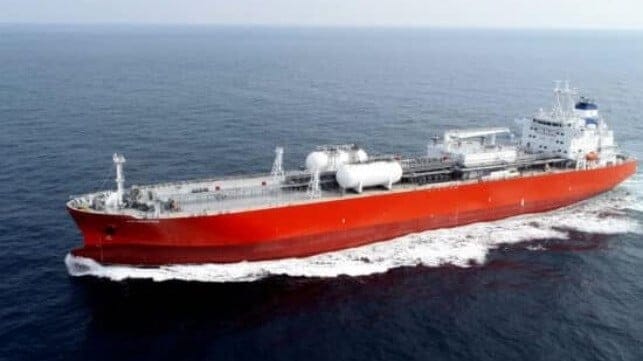
The first newly built dual-fuel ammonia-fueled vessel, Antwerpen, has been officially delivered and went into service today, June 10, for the French division of Exmar. The pioneering ship is the first of a coming wave of deliveries and is seen as a critical step to accelerate the adoption of ammonia as a marine fuel across the wider shipping industry.
Exmar, along with HD Hyundai, heralded the delivery of the vessel, the first of three due this year for Exmar, with a fourth to follow in early 2027. The ships have a total capacity of 46,000 cbm of ammonia, and they are pioneers as the first ammonia gas carriers also capable of using it as a fuel.
The project has been in the works for four years and has pioneered many phases. Exmar points out that it worked closely with the Belgian administration and Lloyd’s Register in establishing the international framework and regulations to allow ammonia’s use as a marine fuel on a gas carrier. While it follows the model of LNG and LPG carriers, regulations did not permit the use of toxic cargoes such as ammonia to be used as a fuel on gas carriers.
While LNG and LPG present challenges related to flammability, Exmar highlights that unique challenges for ammonia primarily center on the concerns over toxicity. It is also highly corrosive. The company reports it drew on its experience of transporting ammonia as a cargo. Ammonia is seen as a key contributor toward decarbonization, as it is the most efficient carrier of hydrogen, which will be used in onshore industrial and other large applications as an alternative fuel.
The development project for the ships began in 2022, working with Hyundai Mipo (which was recently merged with HD Hyundai Heavy Industries in Ulsan), along with WinGD, Nord Gas Solutions (formerly Wartsila Gas Solutions), and Lloyd’s Register.
WinGD developed the 52-bore engine, which was built by HD Hyundai Heavy Industries’ Engine and Machinery Business Unit. It reports the engine, which was installed in the summer of 2025, features high-pressure ammonia injection supplemented by a low, targeted pilot fuel dose of around five percent at full load. The engine delivers load handling, dynamic response, and fuel efficiency on par with WinGD’s equivalent diesel-fueled X Engines in both ammonia and diesel operating modes.
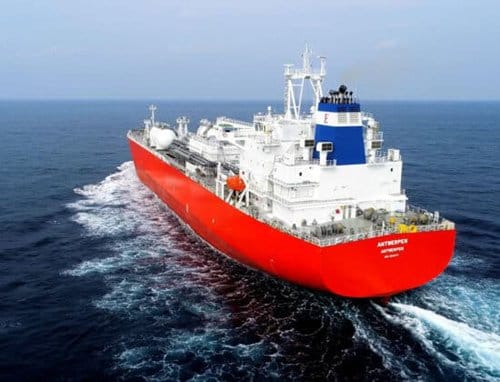
Antwerpen is underway with the experience expected to contribute to future ammonia-fueled vessels (Exmar)
The first two ships, which were named Antwerpen and Arlon in honor of two Belgian cities, each measure 190 meters (623 feet) in length and were specifically designed for the transport of liquefied gas cargoes, including ammonia and LPG. They are 27,000 dwt. Exmar highlights that the vessels were deliberately lengthened 10 meters (approximately 33 feet) in the design stage, along with a slight increase in beam to achieve a meaningfully higher cargo intake compared to the standard design. Hyundai developed the proprietary technology and the three tanks, which provide 45,000 cbm storage below deck, and two 500 cbm deck tanks.
HD Hyundai highlights that ammonia (NH3) can be stored in pressurized tanks at around 8 bar or in refrigerated tanks at -33°C without the need for cryogenic technology. In liquid form, it has about 1.7 times higher storage density than liquefied hydrogen (-253°C) at the same volume, making it suitable for large-scale, long-distance transport and storage of hydrogen. In operation as the vessel’s fuel, they project it will lower emissions by up to 90 percent versus conventional ships.
Exmar is confident that the knowledge, technology, and operational experience from these ships will help to accelerate ammonia as a marine fuel. It believes the lessons that will be learned will be applied to many other vessel types.

that matters most
Get the latest maritime news delivered to your inbox daily.
Antwerpen completed delivery and departed from Ulsan bound for Zhoushan, China. Her sister Arlon will be delivered in the coming months, and the third ship, which has not yet been named, will be delivered before the end of the year.
Data from DNV’s Alternative Fuels Insights database shows that there are only three small, converted vessels, two tugs and an offshore supply vessel, capable of ammonia-fueled operations. However, CMP.TECH’s Bocimar division will soon follow with the first ammonia-fueled bulker. DNV calculates that there are a total of 47 vessels on order for delivery by 2030 that will be capable of ammonia-fueled operations.