


Chinese Ship Completes First Autonomous Docking and Cargo Handling
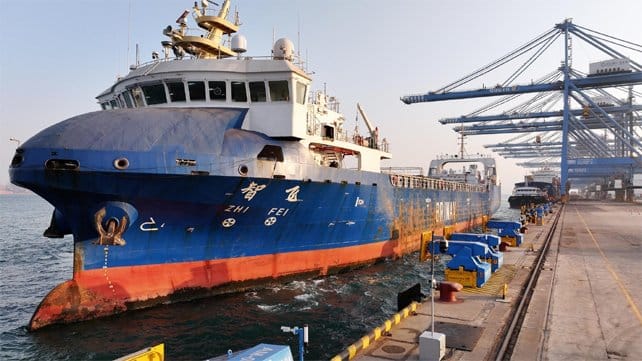
Four years after having put what it said was the world’s first autonomous, electric container feeder ship into commercial service, Chinese officials report the ship successfully completed an autonomous docking procedure. It was the first time the vessel named Zhi Fei completed the autonomous docking procedure, with Chinese officials saying it improves efficiency and reduces the time and manpower needed for berthing.
The Zei Fei is a 300 TEU container feeder ship that entered commercial service in April 2022. It is approximately 110 meters in length. It was designed to operate in three different modes, crew-managed navigation, remote-controlled navigation from a shore station, or unmanned autonomous navigation.
The autonomous berthing took place at the Qingdao Port Terminal in Shandong Province on February 21. The autonomous navigation capability positioned the ship alongside the berth, and a vacuum-type automated mooring system using a form of suction cups adhered to the hull to secure the ship. The report said it took just 30 seconds to dock the ship, reducing the berthing time. The berth is also capable of autonomous loading and offloading with operations coordinated by an autonomous crane and autonomous trucks.
The ship is operated by Navigation Brilliance (BRINAV). It runs between Qingdao Port in Shandong Province and Dongjiakou. According to the reports, its longest single journey distance is 89 nautical miles, and it sails at speeds up to 12 knots.
BRINAV reports the ship completed 353 voyages transporting over 80,800 TEU last year. Since going into service, they report it has traveled more than 48,000 nautical miles, and the systems have made over 1 million independent decisions.
“Intelligent shipping is not merely about replacing human roles but also about making shipping safer and more efficient,” Jiang Haiying, chairman of Navigation Brilliance, told the Chinese media. “This is the essential path for China to transform from a major shipping nation to a strong maritime power.”
The company says the ship has operated with 30 percent fewer crewmembers than a conventional ship and decreased the risk of human error by 80 percent. It says it saves approximately $27,500 each month in operating costs.
To achieve autonomous operations, the company reports it had to overcome several key challenges. Because foreign radar brands are not available to China, it says it had to develop and improve domestic radar systems. This included developing “a series of wave active suppression algorithms to clear out the wrong data caused by its error or electromagnetic interference." It also had to make up for a lack of radar measurement accuracy and improve base station coverage for the 5G signal that connects the ship to the shore station. They worked with China Telecom, China Mobile, and China Unicom to adjust antenna orientation and optimize the network signal.

that matters most
Get the latest maritime news delivered to your inbox daily.
The ship operates on fully electric propulsion, which they noted is better suited for autonomous operations. It shortens response time and improves the accuracy of control. They also reported they were able to improve battery design to increase capacity to 80 to 90 amp hours beyond the traditional 50 amp hours.
The Zhi Fei is seen as a demonstration ship to advance the technology. The company looks to develop more autonomous systems and is also working toward ocean-going ships such as LNG carriers.
