


China Launches a Large Arctic Expedition for a Second Year in a Row
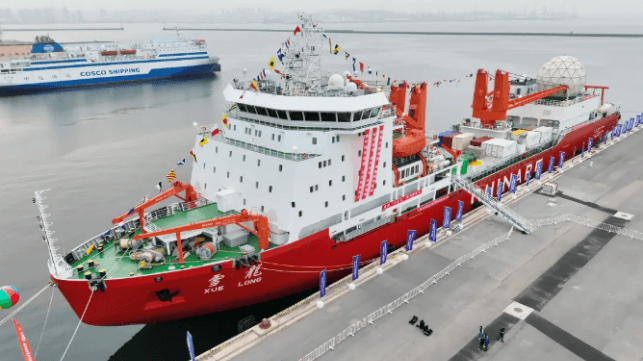
For a second year in a row, China has launched a large expedition to the Arctic involving four research vessels. Last week, three research icebreakers - Xuelong, Xuelong 2 and Jidi - set off from the Northeastern coastal city of Dalian for a four-month mission in the Arctic Ocean. The multifunctional research vessel Tansuo 3 is expected to join the three icebreakers at a later date.
The Ministry of Natural Resources said this year’s expedition will advance on China’s earlier studies on impacts of global climate change in the Arctic Ocean. In addition, the research will focus on seafloor spreading mechanisms around the Gakkel Ridge. China is able to conduct these deep-sea diving operations using its manned submersibles, including the Fendouzhe and the Jiaolong.
Last year, Jiaolong - supported by its mother ship Shenhai-1 and aided by Xuelong-2 - completed China’s first manned dive under the Arctic ice. To add to the milestone, the 15th Arctic mission became China’s largest scientific expedition to the Arctic Ocean. It involved four vessels, including Xuelong 2, Jidi, Shenhai 1 and Tansuo 3, and attracted considerable attention in the United States.
As China’s Arctic interests expand, its scientific expeditions to the regions have also become larger. With Hormuz disruption affecting the LNG trade across the world, China is increasingly diversifying its energy supply, focusing more on the Arctic. Recently, it has emerged that China has built a second LNG terminal in the eastern Shandong province, which will handle LNG cargoes from Russia’s sanctioned Arctic LNG 2 project.
Besides energy investments, Chinese companies have also become trailblazers in Arctic shipping. In 2025, Chinese operators completed 14 container ship voyages through the Russian-controlled Arctic corridor, the Northern Sea Route. The operators have already announced expanded Arctic transits during summer navigation this year.

that matters most
Get the latest maritime news delivered to your inbox daily.
With the Arctic opening up to these economic interests, China’s Ministry of Natural Resources emphasized that scientific expeditions will help to better understand and protect the region. “Sustained comprehensive Arctic expeditions serve as a critical foundation for addressing global climate change and advancing the sustainable development of the Arctic region,” added the ministry.
Most importantly, in this 16th expedition, Chinese researchers will collaborate with Russian and German scientists on joint projects. Besides the Chinese expedition, the EU is also funding another high-profile Arctic expedition, scheduled to set off from Norway next month. The expedition will be carried out onboard a futuristic floating laboratory - the French-built Tara polar station, which will drift with the ice for as long as 18 months.
