


Beyond Web-Based SaaS: The Cloud-Native Advantage

As shipping companies face growing operational complexity, rising cyber risks, and increasing demands for real-time data exchange, a new truth about cloud software is emerging: not all cloud solutions are created equal.
Many 'cloud-based' maritime systems are, in practice, traditional on-premise platforms adapted for hosted environments with browser access layered on top. These web-based systems often retain the limits of legacy architecture such as monolithic infrastructure and integration challenges.
Cloud-native solutions, in contrast, are built from the ground up for scalability, resilience, and distributed operations. Importantly, cloud-native technology enables Software-as-a-Service (SaaS) providers to deliver greater value.
Moving beyond web-based SaaS can therefore profoundly impact a company's financial bottom line and fleet performance long term.
From Cloud-Native Architecture to SaaS Value

Wong Nyuk Lan, VP of Service & Support at BASS Software
Traditional web-based SaaS solutions often require manual infrastructure expansion and complex performance tuning as fleets grow. In comparison, cloud-native solutions such as BASSnet Neo are designed to leverage modern cloud infrastructure from the outset, enabling greater scalability, resilience, and flexibility as operational requirements evolve. They also influence how SaaS providers operate and provide support.
Cloud-native solutions give SaaS providers access to capabilities that are difficult to achieve with traditional web-hosted systems. These include proactive monitoring and more efficient platform management.
For BASSnet SaaS customers, for example, infrastructure, security, monitoring, backups, and platform maintenance are managed centrally by BASS. This reduces the burden on internal IT teams while allowing customers to focus on fleet performance and operational excellence.
Proactive Cloud-Native SaaS
Cloud-native SaaS also enables a more proactive operating model. Through continuous monitoring, automated health checks, and centralised operational oversight, SaaS providers gain greater visibility into infrastructure performance and availability. This helps improve service reliability while reducing operational disruption across global fleets.
"Cloud-native architecture allows SaaS providers to deliver a more secure and well-managed service," notes Wong Nyuk Lan, VP of Service & Support at BASS Software. "BASSnet SaaS is secure by design and continuously validated, so customers do not carry the burden of managing compliance and security risks themselves. They can spend less time managing technology and more time focusing on their operations."
BASSnet Neo SaaS, for example, is a fully managed service where BASS assumes end-to-end operational responsibility. Supported around the clock by dedicated SaaS operations and backed by ISO/IEC 27001:2022 certification, customers benefit from a more consistent service and security experience while reducing internal IT complexity.
In an industry where operational continuity is critical, cloud-native SaaS enables shipping companies to focus on running their fleets while technology providers take greater responsibility for maintaining, securing, and optimising the platform.
Built for Scalability and Resilience

Martin Bjornebye, VP of Research & Development at BASS Software
At BASS, we have invested in cloud-native architecture to support continuous feature delivery and greater operational scalability. Built for distributed operations, most cloud-native systems have abstracted business logic and database transactions via RESTful APIs and leverage modern cloud technologies such as containerisation to create more agile and scalable operational environments.
By decoupling services and leveraging containerised environments, cloud-native solutions like BASSnet Neo evolve with greater flexibility while reducing the operational complexity traditionally associated with large-scale infrastructure management.
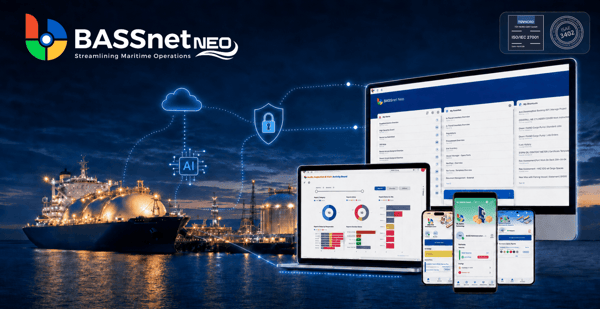
Cloud-native architecture also supports faster innovation cycles. Improvements, security enhancements, and new capabilities can be delivered more efficiently through a managed SaaS environment, helping customers benefit from ongoing platform evolution without the complexity traditionally associated with large-scale software maintenance.
Importantly, cloud-native solutions offered as SaaS (such as BASSnet SaaS) are better positioned to support the industry's next phase of digitalisation, including AI-assisted workflows and real-time operational analytics.
APIs as Strategic Infrastructure
As maritime systems become more interconnected, APIs are evolving from technical features into critical operational infrastructure.
Historically, many integrations relied on direct database access or customer-written SQL queries, creating governance and maintenance challenges over time. Cloud-native platforms instead position APIs as the controlled access layer for both system logic and operational data.
API layers can also scale independently within containerised environments, enabling greater flexibility as fleets and integrations grow. Companies can easily add vessels, users, offices, and integrations without disruptive infrastructure projects or large upgrade cycles.
"With API-driven architecture," says Martin Bjornebye, VP of Research & Development at BASS Software, "transactions become far more surgical and compact compared to traditional web applications that rely on heavier database interactions. APIs also provide a controlled framework for how data and logic are accessed, improving scalability, performance, and long-term maintainability."
This becomes increasingly important as shipping companies expand integrations to finance, IoT, class societies, AI tools, and voyage systems.
Cloud-Native: The Future of Maritime SaaS
For shipping companies operating across increasingly connected environments, the distinction between web-hosted software and cloud-native platforms is no longer simply technical; it is a strategic operational decision that shapes the value SaaS can deliver.
It is the difference between systems simply adapted for the cloud or — more importantly — purpose-built to support the next generation of connected, intelligent, and resilient maritime operations.
Making the right choice is essential to achieve the long-term operational and security benefits of modern SaaS.
This article is sponsored by BASSnet. Learn more about BASSnet Neo's cloud-native approach to ship management and SaaS services.
The opinions expressed herein are the author's and not necessarily those of The Maritime Executive.
