
Beyond the Paint
Hull coatings are now part of a wider system for biofouling control that goes beyond the paint – including inspections, cleaning strategy, monitoring and documentation.
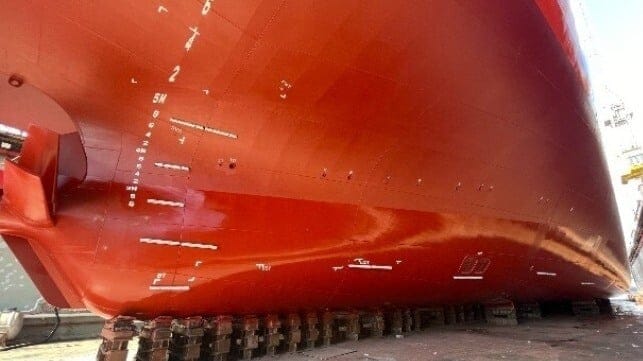
(Article originally published in Mar/Apr 2026 edition.)
Paint technology has come a long way since I was a cadet slapping "red lead" on everything.
While effective, the lead-based primer was both toxic to the environment and hazardous to apply with neurological risks following long-term exposure. This thankfully went largely unnoticed in most seafarers.
Modern coating solutions aim to replicate the effectiveness of red lead while minimizing the environmental impact, increasing ease of application and reducing any exposure-based health concerns. These modern technologies offer full coating systems that achieve these aims while playing a vital role in shipping decarbonization by offering quantifiable improvements in efficiency and fuel burn.
The industry is moving away from reactive cleaning of hull coatings towards proactive management with lower discharge of toxic chemicals and microplastics to the marine environment.
SPCS VS. FRCS
There are two primary coating technologies that must be balanced when considering durability, biofouling resistance and friction through the water.
Self-polishing coatings (SPC) rely on chemistry.
They're formulated with self-polishing copolymers that react with seawater through controlled hydrolysis. This process gradually erodes the coating surface while releasing biocides, typically copper-based, that prevent organisms from settling. As the outer layer wears away, a fresh active layer is exposed. This makes SPC coatings highly effective across a wide range of operating profiles including vessels that spend significant time at low speed or on station.
Fouling-release coatings (FRC) take a physical approach.
Based on silicone or fluoropolymer technology, they create a very smooth, low surface energy finish that reduces the ability of organisms to adhere. Fouling may occur, but it is weakly attached and removed by hydrodynamic forces when the vessel is underway – or active hull cleaning when the vessel reaches port. These coatings contain no biocides and can improve fuel efficiency due to reduced drag. However, their performance depends on regular cleaning, making them less effective for idle or slow operating vessels.
Determining the best coating means understanding your vessel's operations.
QUANTIFIED RESULTS
Ryan Ingham, Lead Performance Advisor at GIT Coatings, presented a one-year operational case study on proactive hull management (PHM) at this year's Hull Performance & Insight Conference (HullPIC).
The study followed an LPG carrier operating with GIT's next-generation, graphene-based hard foul-release coating, XGIT-FORCE™. This biocide-free, hard foul-release coating was combined with onboard robotic proactive cleaning and supported by a ship-specific proactive hull management plan developed through biofouling-risk modelling, port feasibility analysis and continuous in-service advisory. Over 12 months, hull condition and performance were monitored using inspection footage and vessel performance data analysis.
The results:
- ~6% fuel savings out of dock
- <2% added power over the year
- 3–5% fuel savings regained after each cleaning event
Proactive hull management works in real commercial operations when the right coating, technology and advisory support come together to enhance operational efficiency.
With over 600+ applications worldwide, GIT Coatings' products and advisory services division support shipowners and operators in achieving measurable performance and peak operational efficiencies. Its coatings are also environmentally friendly as they offer a zero-leaching solution without shedding toxic chemicals or microplastics into the marine environment.
That's a great foundation for an advanced biofouling program.
GROOMING
Greensea IQ, a pioneer in proactive, in-water hull cleaning technology, is officially approved as a certified hull grooming provider for vessels coated with GIT Coatings' advanced foul-release systems.
Grooming is defined as a proactive measure of periodical removal of microfouling (slime) to prevent the development of macrofouling on ships' hulls. It's an AI-powered robotic solution proven to be incredibly effective.
The approval, granted by Lloyd's Register, confirms that the EverClean program meets the requirements to groom hulls protected by GIT Coatings' sustainable and biocide-free coatings like XGIT-FORCE™.
Delivered as a subscription, the program provides a professionally managed performance plan specific to the vessel that continually evolves to maintain peak performance.
BIG DATA BELOW THE WATERLINE
Another aspect of modern hull-performance solutions involves active monitoring, data collection and analysis and expert advising.
Jotun, whose paint can be found on 25 percent of the global fleet, started its Hull Performance Solutions (HPS) program back in 2011 with a focus on shifting from promised to proven performance. Now in its second iteration, Jotun has launched HPS 2.0 including its HullKeeper program, which is an active condition-monitoring service designed to help identify potential fouling problems before they slow vessels down.
Biofouling begins the moment a freshly painted ship leaves the drydock.
It's a major issue in shipping and quickly leads to significant increases in fuel consumption and greenhouse gas emissions – not to mention the reduction in speed the additional drag causes, which impacts delivery times.
In 2018, the International Maritime Organization set targets to cut the shipping industry's greenhouse gas (GHG) emissions compared to 2008 by 40 percent in 2030 and 50 percent in 2050. In its fourth GHG emissions study, the IMO said shipping emitted around 919 million tons of CO2 in 2018. Of that figure, the IMO suggested nine percent – or 83 million tons – was entirely due to the biofouling loading of ships. Low-hanging fruit for a substantial gain.
In 2025, the company received independent verification by DNV of 11.8 million tons of avoided CO2 emissions across all Jotun-coated vessels. This independent validation strengthens trust and gives owners clear, credible documentation to support both regulatory compliance and sustainability reporting.
Vessel owners are under intense environmental pressure from modern regulations. Navigating them to ensure compliance is a full-time job, best supported by a full-time partner who operates with transparency and brings third party-verified data to the table.
Jotun's focus is on reducing emissions immediately and at scale – part of its Clean Shipping commitment – exactly the kind of commitment you want from a partner you can trust.
PREPPING THE SURFACE
A paint job is only as good as the surface preparation.
Panama-based Marine Metal Coatings has specialized in surface prep, painting and corrosion-control for over 35 years.
Its standard paint-removal techniques include ultra-high-pressure water blasting to 40,000 PSI and grit blasting. The company also has the ability to perform more specialized hydro-jetting coating removal. While not always the fastest, this method provides the most controlled option and avoids damaging the underlying material or over-blasting with abrasives.
MMC also specializes in the removal and disposal of traditional lead-based paints in preparation for a more modern coating application.
INDUSTRY ADVOCACY & PARTNERSHIPS
RightShip is a global maritime risk management organization that uses data, inspections and vetting processes to improve safety, sustainability and operational standards across the shipping industry. As part of the Zero Harm Innovation Partners Program, RightShip supports the evaluation and adoption of technologies and practices that reduce risk and help move the industry toward the goal of zero harm to the marine environment.
Chugoku Marine Paints (CMP Chugoku) has entered into a partnership agreement with RightShip, reinforcing its commitment to sustainability and innovation in the maritime industry.
Through the partnership, CMP Chugoku's high-performance antifouling coatings under the SEAFLO NEO brand, together with its silicone foul-release coatings CMP BIOCLEAN PLUS, are recognized as coating technologies that can deliver energy-efficiency benefits under RightShip's GHG rating methodology.
BEYOND THE PAINT
Through a combination of science, application, hull grooming and advanced analytics, modern hull coatings are designed to support the shipping industry's ongoing efforts to improve operational efficiency and reduce greenhouse gas (GHG) emissions – a crucial and undisputed priority worldwide – with data-backed results.

that matters most
Get the latest maritime news delivered to your inbox daily.
Performance needs to consider many factors. Ultimately, the best performance is the best for the bottom line and best for the environment.
SEAN HOGUE is Executive Vice President of Baker Marine Solutions.
The opinions expressed herein are the author's and not necessarily those of The Maritime Executive.