


As Iran Lays Mines, Two Gulf-Based Minesweepers Moved to Malaysia
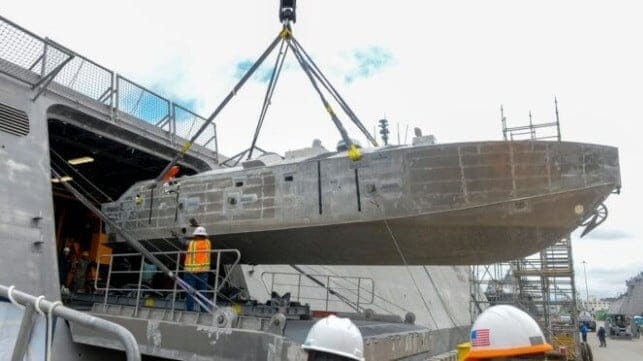
The White House is urging allied navies to commit to a mission to reopen the Strait of Hormuz and bring Iran's blockade to an end, even threatening consequences for NATO allies who do not contribute. But at the same time as the administration asks allies to send assets, it appears that two specialized U.S. Navy mine countermeasures vessels have departed for Malaysia, 3,000 nautical miles away.
The two hulls in question are the Independence-class Littoral Combat Ships USS Tulsa and USS Santa Barbara, both homeported in Bahrain. Along with USS Canberra, USS Tulsa and Santa Barbara account for all of Central Command's mine countermeasures surface assets. Like other vessels at the U.S. Fifth Fleet's base in Manama, they headed out to sea in advance of the U.S. strike on Iran on February 28. On Sunday, Tulsa and Santa Barbara were spotted by a local photographer at the North Butterworth Container Terminal in Penang, Malaysia, on the opposite side of the Indian Ocean from Bahrain.
Last year, the U.S. Navy dispatched three Independence-class Littoral Combat Ships to its base at Bahrain with a specific mission in mind. The aluminum-hulled, high-speed trimarans would take over the mine countermeasures mission from the aging Avenger-class minesweeper fleet, which would retire from service. The Avengers were purpose-built minesweepers with wooden hulls and traditional design, and while lacking the modern sophistication of the LCS' robotics-heavy MCM equipment package, they were proven in field use in the Gulf.
The four outmoded boats were loaded on a heavy lift ship in January and dispatched to Philadelphia for demolition, arriving without fanfare earlier this month. Four hulls remain in commission in Japan, but there are no more Avengers in the Mideast. (Likewise, the Royal Navy decommissioned its last traditional minesweeper in Bahrain this year, and has fully converted over to a robotics-based system.)
USS Canberra, USS Tulsa and Santa Barbara were intended to take over the mission of countering Iran's extensive minelaying capabilities. But two out of the three Gulf-deployed LCS appear to be bunkering and performing maintenance near the entrance to the Strait of Malacca. Photographer Sherwynd Kessler captured images of what appear to be Tulsa and Santa Barbara at Penang, with a bunker barge alongside one of them and crewmembers working on deck.

that matters most
Get the latest maritime news delivered to your inbox daily.
The Independence-class is the Navy's sole replacement for the Avengers, but it is not intrinsically designed for mine countermeasures: it has an certified capability in the form an MCM "mission package." This specialized equipment was originally intended to be swappable with other mission packages, but the concept proved impractical, and the U.S. Navy has permanently assigned the Independence-class to mine countermeasures duty. The LCS MCM package was deployed overseas for the first time in March 2025, and has not yet been tested in combat. USS Tulsa and Santa Barbara were among the first vessels to receive it.
The MCM mission package incorporates a Sea Hawk helicopter with a laser-based detection system and a mine neutralization system; a unmanned boat with a minehunting sonar; and an unmanned minesweeping module, towed by the unmanned boat. The system's initial deployment was delayed for a decade, due in part to reliability issues. Continued challenges have been reported in practice.
