


Surging Social Program Costs Dampen UK's Hopes for a Stronger Royal Navy
In June, hopes rose that the resignation of Defense Minister John Healey over the lack of commitment to raise UK defense spending to 3% of GDP by 2030 would finally bring about a commitment from the UK’s Labour Government to achieve the target. Hopes rose further when Healey was subsequently put in charge of the nation’s finances after new Prime Minister Andy Burnham appointed Healey as Chancellor of the Exchequer.
If anything, the 3% of GDP target by 2030 now seems further away, as the Prime Minister told the UK Parliament last week that he will not cut the priority given to social-benefit spending in order to fund the defense budget. This pushes back any rise in defense spending from early to later years, given that the UK remains signed up for the NATO 3.5% target for defense spending by 2035. Spending on social benefits has risen sharply over the last two years, absorbing the increased tax revenues which might otherwise have gone to defense.
The Ministry of Defence is already struggling to fund its existing programs, leading to in-year cuts to training and ammunition expenditure. But there are also immediate impacts on equipment procurement, particularly for the Royal Navy.
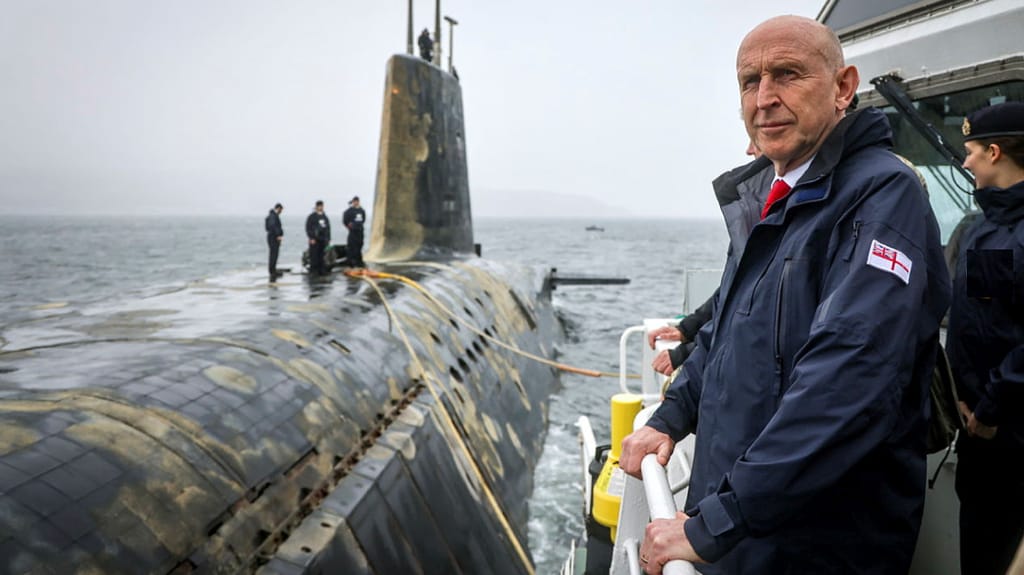
The UK signed up under the trilateral AUKUS agreement to build 12 nuclear attack submarines, but has now further delayed funding decisions on the final numbers of nuclear attack submarines to be acquired. The delay places further pressure on the Royal Navy’s existing Astute-class submarines, which may have to have a service-life extension to accommodate the later arrival of the first AUKUS submarines. This is a high risk strategy, as the Astute-class submarines have proven to be unreliable. Of the seven boats in the Astute Class fleet, as of this week, two (HMS Agamemnon and HMS Achilles) are still with the shipyard, three are non-operational at the Faslane Naval Base (HMS Astute, HMS Ambush and HMS Artful), and the only two boats which possibly could be operational are HMS Audacious and HMS Anson docked in Devonport. The former is working up after maintenance and the latter is believed to be awaiting maintenance after its long-range cruise to Australia and duty in the Arabian Sea. A lack of available submarines is a particular problem in covering the Russian submarine threat in the Greenland-Iceland UK gap, although there are allies who can help cover what used to be a specialized and advanced capability provided by the Royal Navy.
Also likely to be extended in service because of delays in the arrival of successor ships are the Type 45 Daring-class air defense destroyers. Three of the class are in active service, with HMS Duncan (D37) last spotted in escorting Russians through the Channel, HMS Dragon (D35) deployed to the Eastern Mediterranean and Arabian Sea and probably to be rotated with HMS Dauntless (D33) in October. HMS Daring (D32), HMS Diamond (D34) and HMS Defender (D36) are in the upgrade program.

that matters most
Get the latest maritime news delivered to your inbox daily.
With Aster 30 Block 1 missiles and Sampson radars, these ships have a unique anti-ballistic missile capability, which is of particular importance given the growing threat from medium-range Iranian ballistic missiles such as the Qasem Basir and Kheibar Shekan, both of which have warheads which can maneuver in terminal flight phases. But these ships are also needed to protect aircraft carriers HMS Queen Elizabeth (R08) and HMS Prince of Wales (R09) when either deploys. Maintaining sufficient operational capability to fend off growing threats beyond an already over-ambitious 2038 end of service date will be fraught with difficulties.
There is also an increasing threat posed by Russian naval deployments, which for the first time now include a permanent piquet ship in the English Channel, a response to British interceptions of dark fleet tankers starting with the seizure of the Aframax tanker Smyrtos (IMO 9389100) on June 5. To credibly match the target, shadowing duties should be carried out by frigates. But the Type 23 fleet has collapsed down to five operational warships, with even this low number unlikely to be sustained as seaworthy before replacement Type 26 and 31 frigates eventually arrive. There is still doubt about how many of the Type 26 and 31 frigates originally intended are currently costed and accounted for in the current financial plan, with worries that some may be diverted to export customers. Increasingly, Russian warships transiting British territorial waters will be escorted by Royal Fleet Auxiliaries and unarmed patrol craft normally used for training university reserve officers.
The opinions expressed herein are the author's and not necessarily those of The Maritime Executive.
