


A Year of Offshore Oil Spills Prompts Growing Concern in Mexico
Spills by the state oil company Pemex lead to complaints over compensation, oversight and transparency
[By Rodrigo Soberanes]
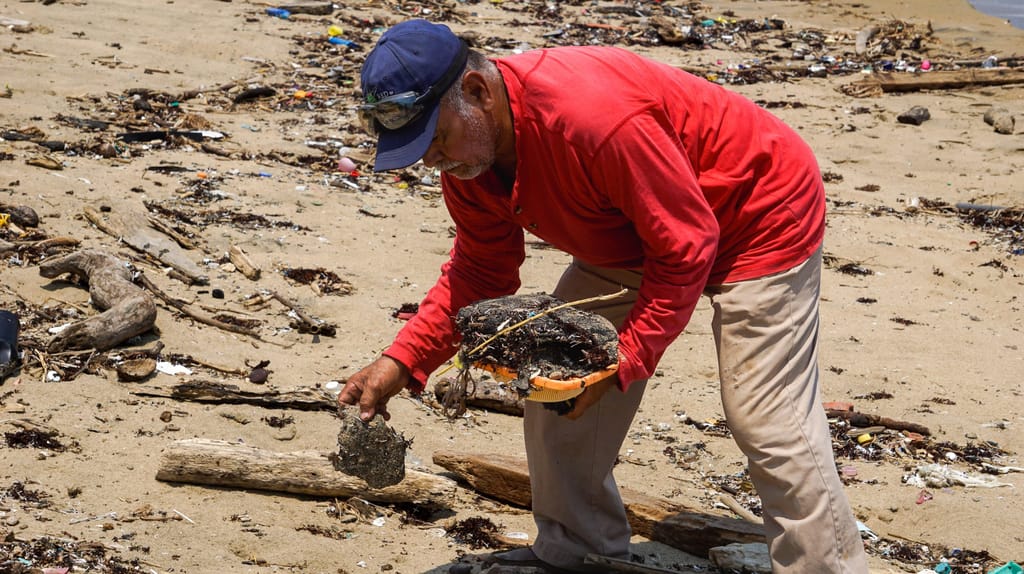
In early March, Andrés Palma was watching his children build a sandcastle on the beach in El Bosque, south-east Mexico. The fisher soon noticed that something was not quite right: his children were playing in sand laced with crude oil residue.
Palma was witnessing the consequences of a huge oil spill that happened in February, which triggered a 30-day fishing ban and has contaminated fishing grounds along the Gulf coast. Its source was initially disputed but in mid-April, the government said the source was a leaking pipeline in the offshore Abkatun oil field, in the Gulf’s south-eastern corner. In the months since the ban has been lifted, fishers like Palma continue to deal with a crashed local market and fish contamination fears.
“Here, if you don’t go out fishing, you don’t eat,” explains the 31-year-old.
The government initially denied any link to the state oil company, Petróleos Mexicanos (Pemex). In its April announcement, however, the government confirmed that three state officials had been removed in relation to alleged failures to contain the spill and communicate with the public.
Palma’s is just one Mexican community to be hit by an oil spill in 2026. Data obtained by Dialogue Earth through public information requests shows Pemex has reported nearly 100 spills a year over the past four years, a sudden and sharp increase. It also reveals a large discrepancy between spills reported to financial regulators and the data in its own sustainability reports.
In the affected communities, residents tell Dialogue Earth of fouled beaches, dead wildlife and devastated livelihoods.
“This data makes us question the viability of continuing with this fossil fuel model that endangers people and the environment,” says Viridiana Lázaro, a senior climate change and oceans campaigner for Greenpeace Mexico.
Inconsistent numbers
Tracking Pemex’s spills is not straightforward, as different numbers are reported to different regulators.
As Pemex has bonds issued in the US, it is required to file reports with the US Securities and Exchange Commission, as well as the National Banking and Securities Commission in Mexico. From the start of 2014 to the end of 2025, Pemex reported 798 pipeline spills and leaks to these financial regulators.
This number is significantly lower than the spill and leak events documented by Pemex in its annual sustainability reports, which amount to 5,517 between 2020 and 2024.
It is also significantly different from the data collected by the Mexican agency for environmental protection in the hydrocarbon sector, which counted 274 events for the period March 2020-May 2026. The agency excluded February’s Gulf spill from this count. The company has been approached for comment.
Different regulators have different reporting, and there is no suggestion the company has failed to comply with reporting requirements. But some feel the company should be doing more monitoring of leaks and spills.
“Pemex is not doing its job [of adequately collecting data on spills],” claims Diana Papoulias, a retired researcher for the US government’s Geological Survey agency. In April she released her report, “The environmental debt of Pemex”, supported by a coalition of environmental NGOs. A long-term series of oil spills in the same areas are also compounding the environmental damage. The Gulf of Mexico Observatory created a group in April to monitor the spill, which then reported another, new spill in the Gulf on 10 September.
“There are leaks every day; there are spills every day of varying sizes,” claims Papoulias. “Pemex has failed to invest money in environmental protection or system improvements.”
Dialogue Earth requested an interview with Pemex to address the differences in data reported in different places and the status of February’s oil spill but has not received a response.
No fishing, no support
Like many of those impacted by the spill earlier this year, Palma continued fishing after the ban was lifted. But due to fears the fish are contaminated with oil, fishmongers now pay him MXN 10 per kg for the sierra fish he brings. Before the spill, he could make MXN 60 per kg.
The spill has been particularly destabilising for the Palma family, whose lives have already been upended in recent years. In November 2023, after years of encroachment, they were one of at least 60 families moved out of El Bosque, where rising sea levels linked to climate change have washed away the coastline, homes and public infrastructure.
The family now lives 10 km from the coast in a new community for displaced inhabitants, also named El Bosque. Palma goes out fishing at four in the afternoon and does not return until the following morning. As well as bringing back fish, these days there is oil, too.
Fishing has been practically paralysed in the affected areas since March. Fishers say the oil has clogged their engines, ruined their boats and destroyed their ability to make a living.
“The pollution is massive,” says Palma. “The fishing nets come back stained, and dirt gets on your clothes.” In March, Pemex announced a fund of MXN 35 million (USD 1.9 million) to support fishers affected by the spill. The company said it had given 3,379 fishers MXN 15,000 each in economic support, which amounts to MXN 50,685,000.
According to fishermen interviewed by Greenpeace Mexico, this has been difficult to access because it has been earmarked for fishers’ cooperatives, which excludes many of them.
Palma asserts that “no fisher receives any resources from the government” in his community.
Luis Alberto Romero Reyes, a 33-year-old fisherman from the municipality of Ángel R Cavada in Veracruz state, does not belong to any cooperatives and has not received compensation from the government. “For most local fishermen, there has been no fishing since the spill,” he says, confirming that “only the cooperatives get help.”
In July, a group of more than 500 fishers from Indigenous Nahua communities in Veracruz announced legal action to force Pemex to recognise them as spill victims. These fishers are not registered under any cooperative or fishing organisation. “We demand fair compensations for the spill’s impacts, health care, restoration of damaged ecosystems and punishment for those [authorities] responsible,” said the fisher Oved Hernández at a press conference on 10 July.
Controversy surrounding government support for fishers and other workers affected by oil spills is common in communities across the country.
Along Oaxaca’s Pacific coast, eight oil spills were registered during June and July of 2026 by that state’s Salina Cruz municipal authorities. These have spurred protests by fishers and salt workers, who demand compensation and temporary employment through beach clean-ups and oil pipeline repairs until their regular work can resume.
Greenpeace’s Lázaro says this type of temporary government support should be minimised, because “it will not serve them in the long run.” The focus should instead be on the remediation of affected areas, he adds.
A dark future
By mid-April, as endangered green and Kemp’s ridley turtles arrived for their nesting season, the oil had reached Agua Dulce – a turtle sanctuary in Veracruz.
Fisherman Romero tells Dialogue Earth he happened upon a washed-up adult green turtle in the area that vultures were feeding on. “[It] was decomposing, covered in tar.”
According to Guadalupe Reyes, Romero’s mother and a volunteer at the sanctuary, the number of turtles arriving on the beaches is lower than previous years. She blames the oil. They have collected the eggs from a single nest for safekeeping; in previous seasons, she says, volunteers would have collected eggs from more than 10 nests over the same period.
“It hurts us a lot,” says Reyes. “We have affection and care for everything that lives in the sea.”
The Gulf of Mexico Reef Corridor Network (RCAGM), comprising 25 community organisations and turtle conservation camps, is behind a civic monitoring map. The map has pinpointed more than 100 oil contamination sites spread across approximately 1,200 km of coastline since March.
The RCAGM fears this oil may be damaging a network of deep reefs. Discovered in 2013, the network stretches for 650 km from northern Veracruz to El Bosque’s state, Tabasco. One of the reefs is located directly underneath an area of water where some of the spill has been spotted.
To date, however, there is no government data on the extent of harm caused to the ocean’s ecosystem. Between the start of the spill and 27 April, the RCAGM recorded the deaths of 22 sea turtles, four dolphins, two pelicans and a manatee. The survey has not been updated since, but some are worried these numbers underplay the likely damage caused.
That damage is complex and will continue to unfurl for more than a decade according to Omar Arellano, an environmental researcher at the National Autonomous University of Mexico (UNAM).
Based on past spills, such as the catastrophe that followed the Deepwater Horizon rig explosion in US waters in the Gulf in 2010, Arellano foresees disruption to the distribution of fish as they avoid contaminated waters. This will add to fishers’ problems, forcing them to seek out new fishing locations potentially further away.
Arellano also anticipates oil compounds accumulating in small organisms, which will then build up in their predators – a process known as biomagnification. “This has probably already begun to happen but it will not be observed until some time has passed.”
Dialogue Earth has contacted the government to request data on the number of litres spilled into the Gulf in February, a description of the actions taken under Mexico’s National Spill Contingency Plan, and the details of its repair, restoration and compensation plans. The request was refused due to ongoing criminal investigations.
The Gulf of Mexico Observatory group is yet to present an in-depth assessment of the harms from the oil spill, nor any updates on its research.
In April, the Mexican government said it had collected 915 tonnes of hydrocarbon residue, from the sea and 48 beaches. It also said “most corals” in the area it had assessed did not display any evidence of residues. No further cleanup or mitigation updates have been shared.
Pemex tells Dialogue Earth it continues to respond to the spill, through activities covering containment, cleanup, environmental monitoring and social assistance; the company did not respond to any direct questions.
Papoulias says she is not clear how Pemex and the government have been identifying, characterising and remediating contaminated sites and this creates “significant uncertainty” for local people and fishers. She fears that, without stricter environmental supervision, there will continue to be a large number of spills and leaks along Mexico’s coast.
“We must avoid spills at sea as much as possible because they are the worst. Any onshore spill can be cleaned up to a certain extent – quite effectively, in fact – but a spill at sea […] has to be dealt with very quickly because it spreads extremely rapidly and reaches the coast,” says Papoulias.

that matters most
Get the latest maritime news delivered to your inbox daily.
In Tabasco, Palma remains at sea until dawn. He hopes to no longer find the black stains on his net, and to return home to oil-free coastline. He wants his children to be able to play there safely, “because they are used to a life spent going to the beach”. He wants their sandcastles to be free of oil.
Rodrigo Soberanes is a Mexican journalist specialising in the environment, communities and human mobility. He has reported from various Latin American countries and written for media outlets including CIPER Chile, Anfibia and El Faro. He is the founder of La Marea Veracruz.
The opinions expressed herein are the author's and not necessarily those of The Maritime Executive.
