


Iran Battles to Beat the Blockade
The conflict between Iran and the United States has settled into a tit-for-tat battle in which the United States seeks to deplete the Iranian regime’s financial resources, which the regime depends upon to maintain control. If the money runs out, the regime will not be able to purchase imports of essential goods, nor to subsidize the costs of food and essential services, and a hungry population poses more of a threat to stability than one which is politically discontent.
For the Iranian leadership, the economic pressure is already building. No oil or gas is being exported, from which the government obtained much of its revenue in the past. Revenue from sales from the emergency reserve of crude held afloat off China and Malaysia are likely to dry up completely before the end of the year. Meanwhile, the US blockade remains tight. To escape the trap, the Iranians have to break through - explaining the attempts by the IRGC to attack U.S. Fifth Fleet’s task force in the Gulf of Oman with what appears to be an improved ballistic missile capability.
Central Command have announced that the IRGC attempted to strike a US carrier and a destroyer on September 6, tried again on September 8, and claimed to have targeted two further US warships during the night of September 8-9. These three waves of Iranian attacks have all been repulsed, but have been innovative and of sufficient intensity to provoke an intensified (if still calibrated) US response.
The Iranian Secretary to the National Security Council Mohsen Rezaei told Press TV that ‘for the first time, we have tested a new anti-ship missile above a US warship.” It is not yet clear what this new capability is, but it is likely to be a derivative and an improvement to an existing system, and the WANA news agency has described it as the Qasem Basir ballistic missile. The Qasem Basir made its first appearance in May 2025, and is itself a development of the Haj Qasem missile. It is described as a 650nm-range two-stage missile, using an exo-atmospheric trajectory to generate hypersonic speed in its terminal phase. The Iranian Ministry of Defense claims that the Qasem Basir has a thermal imaging sensor to close on targets by homing in on heat sources.
Also as part of the attempt to beat the blockade, the Iranians have launched attacks on US bases in neighboring countries, and they claim to have attacked or deterred more ships in the Strait of Hormuz. They also claim to have agreed a new joint ‘middle corridor’ route for merchant traffic through the Strait in cooperation with Oman, repeating claims made previously, which is unlikely to be implemented if its introduction is dependent on a lifting of the US naval blockade.

that matters most
Get the latest maritime news delivered to your inbox daily.
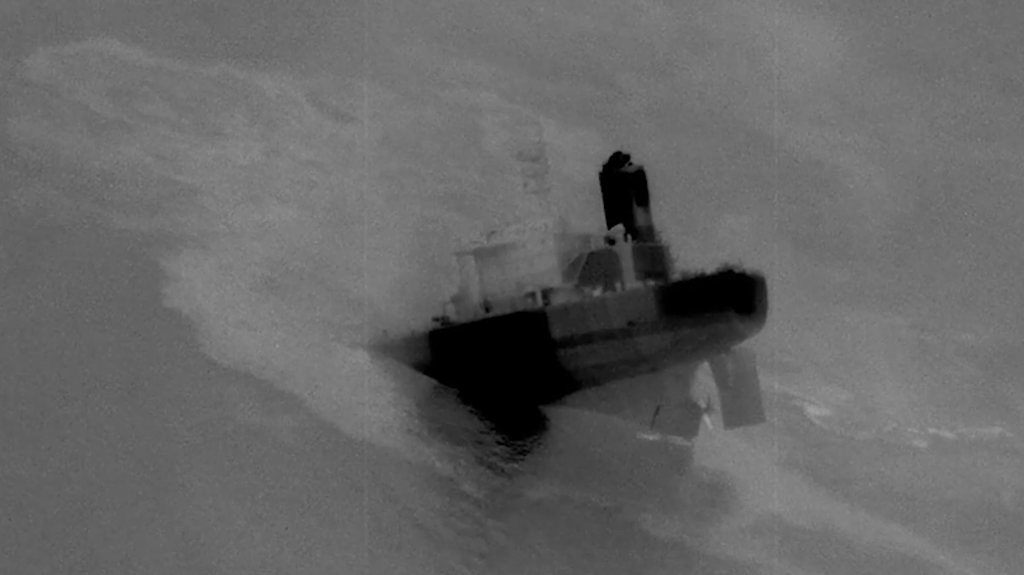
As part of its third round of retaliatory action on September 8, Central Command attacked five sanctioned Iranian tankers, after having issued warnings to crews to evacuate. The Iranian-flagged Derya (IMO 9569700) was located off Kharg Island. The Comoros-flagged Kaviz (IMO 9282041), Comoros-flagged Charminar (IMO 9318022) and the Zimbabwe-flagged Riesco (IMO 9251822) were attacked in the Gulf of Oman. The Turkish or possibly unflagged bulk carrier Horizon-1 (IMO 7625732) was also attacked in the Gulf of Oman. CENTCOM video shows four ships being attacked with smaller missiles to the stern, near the engine room, while the Riesco was attacked amidships, set on fire and sunk.
Notwithstanding the attack and counter-attack cycle, both sides appear to be acting still with some restraint, restricting the conflict for the moment to their respective attempts to neutralize blockade operations (and associated retaliatory action) – the Iranians against shipping in the southern channel of the Strait of Hormuz, and the US operation targeting Iranian ships and ships seeking to visit Iranian ports. For the Iranians, there is some urgency to escaping the effects of the US blockade, so they will likely make further attacks on US ships at sea and on vessels seeking to transit the Strait, while at the same time seeking to avoid a resumption of all-out warfare.
The opinions expressed herein are the author's and not necessarily those of The Maritime Executive.
