
Undercover Reporters Confirm Russian Paramilitary Presence on Tankers
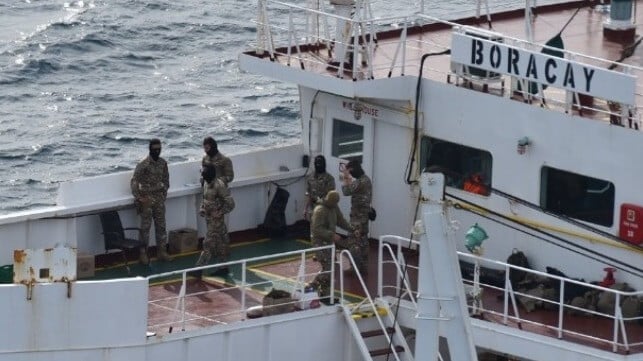
The Danish pilots who guide merchant ships through the Oresund have often reported the presence of strange uniformed men aboard Russia-linked tankers that pass through the waterway. Not apparently burdened with seafaring duties, these supernumeraries nonetheless seem to have a degree of authority on board - raising suspicions of paramilitary or intelligence ties to the Russian government. In a new study, the Organized Crime and Corruption Reporting Project has taken a deep dive into the system of Russian security operations on board the shadow fleet - and found that these Russian "technicians" are on board to control the crew's actions.
The Russian shadow fleet's inner workings are deliberately opaque, and not susceptible to ordinary research techniques. Instead, OCCRP used methods more familiar to intelligence services: its reporters went undercover and posed as security-guard recruiters in order to solicit comments from unwary Russian personnel. As is widely suspected, these are former military men, OCCRP found.
OCCRP and its media partners used the crew rosters of sanctioned tankers to pull a list of dozens of Russian "supernumeraries" to talk to. Drawing on this list, they managed to conduct fake "job interviews" with four unsuspecting subjects. One man - a Chechnya War veteran who had worked in a tanker security role - said that his job on board was "let's say, to not allow the vessel to deviate from its course." This meant overriding the foreign master and crew if the circumstances require - for example, preventing them from complying with the directives of NATO maritime authorities. The guard was explicit on this point: if the vessel's master "gave in," he was there to "ensure that such incorrect actions did not take place."
It was also his job to report on the vessel and crew, twice per day. A second guard - a former Russian paratrooper and private security contractor with Syrian experience - confirmed to OCCRP's reporters that his job included "monitoring" the crew to find out what they were saying, and to whom.
Several insisted to reporters that they were on board without armaments - a key point, as shipboard firearms are generally prohibited by most port states during calls, with strict criminal penalties for noncompliance.

that matters most
Get the latest maritime news delivered to your inbox daily.
While OCCRP's data suggests that Russia is slowing or halting the practice, the "riding gang" system suggests a creative way for maritime sealift and blockade-running to be done with foreign ships and foreign mariners, even with crewmembers who have no patriotic ties to the nation involved in the conflict. In the middle of a hot war, Russia (through commercial partners) has attracted seafarers of all nationalities and put them to work on high-risk voyages that are vital to its national interests - merely by paying them sufficient wages, and placing a handful of citizens on board to influence their decisionmaking.
While it is a regulatory violation to place a supernumerary's judgement above the master's - an offense occasionally prosecuted in U.S. Pacific fisheries, where under-licensed "fish captains" are sometimes caught overriding a captain - it would not be a departure from form for Russia-linked tankers. Shadow fleet vessels are often found to be in violation of multiple regulations, from maintenance standards to flag registration to P&I insurance.