
EU Commences Mediterranean Dark Fleet Stop and Search Operations
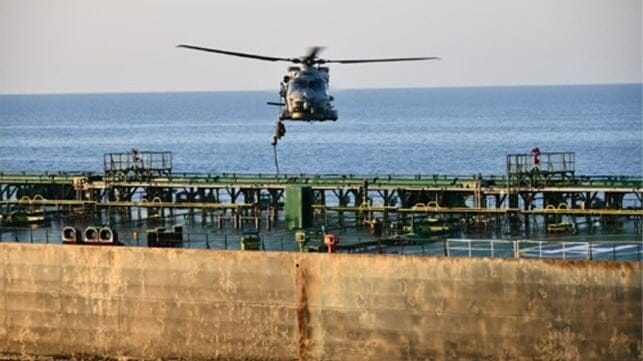
The European Union has launched a coordinated campaign to crack down on vessels that are false-flagged, fraudulently certified, or are in breach of maritime safety and labor laws.
The move, announced after an agreement between EU defense ministers at a meeting in Nicosia on June 8, utilizes the pre-existing mandate for Operation Irini, which was originally established in 2020 under a UN mandate to enforce an arms embargo on Libya in the Mediterranean. It is not clear how or whether the refreshed operation announced by EU Foreign Policy chief Kaja Kallas has also inherited the same UN mandate, but it has explicitly been relaunched with the aim of supporting Ukraine by cracking down on Russian dark fleet activities. It nonetheless gives member nations the authority of an EU mandate to board suspicious ships.
Operation Irini suffered initially in 2020 from a weak mandate. Tasked with monitoring and interdicting arms supplies to the different warring factions in Libya, whenever it sought to board and inspect a ship, it was initially required to secure the permission of the ship’s flag nation in accordance with UNCLOS. When the ship was Turkish, with arms destined for the faction it was supporting, permission was invariably refused. Operation Irini nonetheless has continued.

Irini reports stopping three tankers since the effort began in May (Irini)
Currently, the naval forces committed to Operation Irini are headquartered in Rome and under the command of Italian RAdm RADM (UH) Marco Casapieri. The force consists of the Italian Thaon di Revel Class offshore patrol vessel ITS Francesco Morosini (P431), the Greek Elli Class frigate HS Kanaris (F-464). The force is supported by a Beechcraft B300 King Air 350 maritime surveillance aircraft provided by Luxembourg, which is forward-based in Malta, and a PZL M28B Bryza maritime surveillance aircraft provided by Poland.
The new, expanded anti-dark fleet mandate does not appear to have gotten off to a good start, suffering as others have done from the limited justifications in UNCLOS for intercepting ships at sea, even if they are sanctioned, and there are registration irregularities.

(Irini)
Since the launch of the expanded mission, Irini reports it has stopped three vessels. It conducted a flag verification boarding of EU and UK-sanctioned Sandhya (37,159 dwt), an Indian-owned, Cameroon-flagged product tanker, on June 7. According to its AIS signal, the vessel was coming from Brazil bound for Turkey.
On June 1, an inspection team boarded the Cameroon-flagged and EU-sanctioned Aframax Oneiroi (105,585 dwt) in international waters in the Mediterranean. The 244-meter (800-foot) Oneiroi has a capacity of about 100,000 barrels of oil. It had loaded at Primorsk on May 11. Notwithstanding the stop and search, the Oneiroi still managed to reach Port Said on June 5 and is expected to unload at Vadinar in Gujarat on June 16.

that matters most
Get the latest maritime news delivered to your inbox daily.
A second Cameroon-flagged Suezmax, Nelsa (156,760 dwt), reportedly owned by a company in Azerbaijan and sanctioned by the EU and UK, was the first vessel stopped by Irini on May 11. The 274-meter (899-foot) Nelsa loaded at Novorossiysk, came through the Bosporus on June 2. Notwithstanding its interception, it is also now through the Suez Canal and heading for India.
It is not clear what the Irini inspections found or why the vessels were allowed to proceed.
