Tentative Date Set for Reefing Historic Liner SS United States
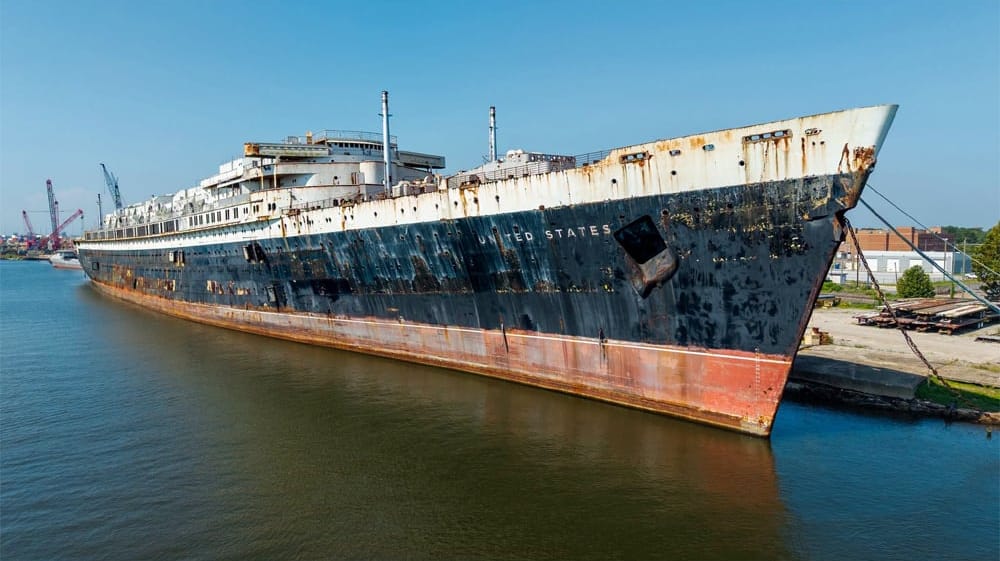
Plans for the reefing of the historic ocean liner S.S. United States continue to progress, and now a tentative date has been announced for the operation. It comes after 19 months of remediation efforts to prepare the ship for the reefing operation.
The Okaloosa Board of County Commissioners in Florida announced the planned schedule, as it appears they have obtained the final state and federal approvals for the operation. They said the reefing operation is scheduled to begin at 10:00 a.m. local time on November 12 (weather permitting).
They are planning a series of lead-up activities, noting that the hull would be moved from the pier in Mobile, Alabama, to the deployment site “days in advance.” The U.S. Coast Guard reports the anticipated departure date is November 9 from Pier 4 on the Mobile River. The Coast Guard will be enforcing a 100-yard moving safety zone around the ship and the vessels supporting the dead-ship tow.
The final destination is approximately 22 nautical miles southwest of Florida’s Destin-Fort Walton Beach (proposed deployment location: 30° 07.148' N, 86° 46.755' W). Once the hull arrives at the location, USCG advises vessels to remain at least one nautical mile away until the sinking is completed.
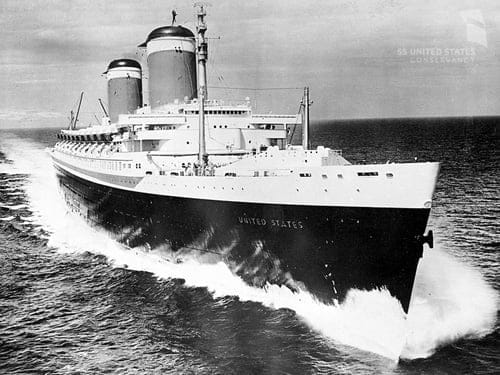
United States on her 1952 speed trials (Photo courtesy of Charles Anderson and the SS United States Conservancy)
The Okaloosa Board of County Commissioners announced it plans a “sendoff ceremony” and celebration at the Destin-Fort Walton Convention Center on November 11. It is planning a viewing party on November 12 while the S.S. United States Conservancy plans to broadcast the reefing online.
Over the past 19 months, they have focused on clearing the ship of materials, including the remaining electrical wiring that contained toxic material as well as removing loose paint and other loose material from the decks. All the windows and portholes have been removed. They removed material that was viewed as potentially dangerous to divers, such as the elevator cars, while also cutting holes for diver access.
Preservation efforts also saved some material from the ship, ranging from the ship’s iconic funnels to the radar mast and the last surviving propeller that was stored on the ship. (Four other props were placed on display years ago at various locations onshore.) Days ago, they removed the last of the original anchors. The ship’s builder’s plaque that was displayed below the bridge was removed, as well as some other historic elements. The plans called for incorporating some of these elements into the proposed shoreside visitors center and museum.
What remains is largely a stripped 990-foot hull. Even still, it continues to stir deep emotions among the ship’s supporters. Environmentalists also continue to protest the plan, saying that the chemicals used to prime the steel in the 1950s will become toxic in the water as the ship begins to decay.
Okaloosa promotes the ship as the largest man-made reef. They hope its history and reputation will create a tourist attraction.
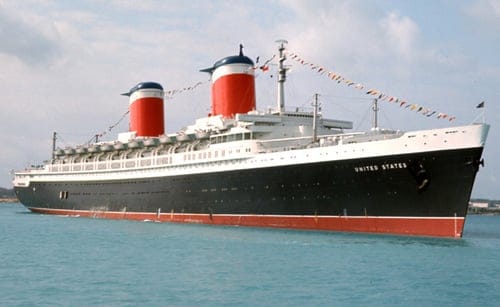
The liner was in commercial service for just 17 years but still holds the title as the fastest passenger liner (SS United States Conservancy)
The ship is one of the last survivors of an era when ocean liners were the means of travel. Built to maintain the trans-Atlantic run between New York and the English Channel ports, the ship smashed the speed records on her maiden voyage in 1952 and continues to hold the title of the fastest passenger liner. She was the pride of the U.S. merchant marine and maintained the Atlantic service for 17 years, although she also began to offer a limited number of cruises in the last years of her career. High operating costs, competition from jet airplanes, and changes to the U.S. government subsidy and travel policies in the late 1960s doomed her operations.
S.S. United States was retired in 1969 and never sailed again. She spent the next 57 years awaiting a future use.

that matters most
Get the latest maritime news delivered to your inbox daily.
The government acquired the ship and considered plans such as using her as a hospital ship, but she returned to private ownership, and a series of owners each had a plan to restore the famed ship. The Conservancy finally acquired the vessel in 2011 and spent a decade trying to come up with a plan and financial partners to repurpose the ship. The plans never proceeded, and the Conservancy was forced to sell the ship in October 2024 after getting into a dispute with the operator of the pier she was berthed at in Philadelphia.
Supporters and environmentalists have continued to object to the plan to reef the ship. It appears that time has run out as the reefing plan receives its final approvals from the federal and state authorities.