

Russian Trawlers Go Fishing for Cables
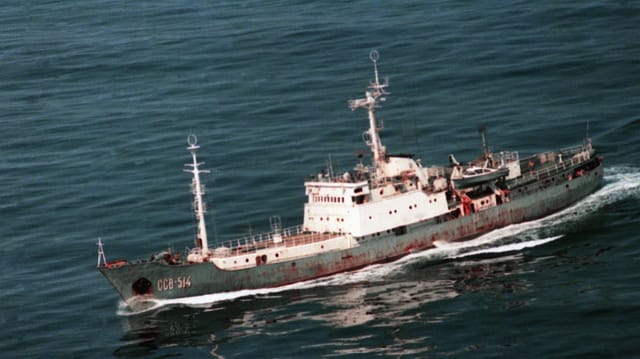
London’s Daily Telegraph has published a lead story outlining how a Russian fleet of trawlers has been surveying and loitering over cables in the waters around the United Kingdom. There is nothing new in Russian trawlers being tasked with non-fishing duties, with some never having been seen to have landed any fish; the novel element of the story is the scale on which the Russians are carrying out this operation.
The Telegraph has logged more than 500 separate incidents where Russian trawlers have either loitered above cables linking Britain with the United States to the West of to Europe to the East, or have precisely followed their routes over long distances. The data was gathered by Global Fishing Watch since 2021, and identified 17 trawlers in particular involved in the activity.
The assessment in the report is that the trawlers are precisely mapping the routes of the cables, so that at a later stage unmanned submarine vehicles will autonomously be able to interfere with these cables, either by cutting them or by placing sleeves around the cables for the purpose of interrupting the cable’s data flow.
The problem is compounded because the Royal Navy does not have the resources to identify where the trawlers are operating, and then does not have capability to intervene or to monitor the activity, a task often undertaken by submarines.
At present, the Royal Navy is believed not to have a single operational attack submarine available. Of the seven boats in the Astute Class nuclear attack submarine fleet, HMS Achilles is still being built, three are non-operational at the Faslane Naval Base (HMS Astute, HMS Ambush and HMS Artful), two boats are under maintenance in Devonport (HMS Audacious and HMS Anson), and HMS Agamemnon is on pre-delivery sea trials.
The shortage of Astute Class boats is so critical that the Royal Navy had to ask for assistance from a French Navy Suffren Class nuclear attack submarine to escort the ballistic missile submarine HMS Vanguard (S28) out of its base in Faslane when Vanguard began its current patrol in April.

that matters most
Get the latest maritime news delivered to your inbox daily.
When the Royal Navy has been able to mount effective surveillance, often using sensors towed behind Type 23 frigates, in tandem with maritime patrol aircraft, and with assistance from allies, then the nature of Russian activity has been evident. An operation in British waters by two Kola Bay-based submarines operated by the Russian Navy’s Main Directorate of Deep-Sea Research (GUGI), accompanied by an Akula Class attack submarine, was disrupted earlier this year. A GUGI trial of an offensive underwater robot designed to sabotage undersea cables was disrupted in March, in a joint US, UK and Norwegian Navy operation conducted in waters around Svalbard.
Monitoring this threat will be a high priority both for the UK and NATO. But a lack of British capability to take the lead on these operations in UK waters means that much of the Russian activity is either not being detected or is being executed without hindrance. The threat posed is both serious and very real, as cables could be cut unattributably in a period of tension prior to armed conflict breaking out. Such a covert attack could effectively sever communications linking critical essential services with the data centers supporting them, and might take months to repair.