
Red Sea Coastal Battles Intensify Raising New Concerns for Shipping
Fighting has intensified on most of the border between Houthi forces in Yemen and the areas held by the internationally recognized government (IRG). The scale of fighting is much worse since an informal ceasefire came into force in March 2022, but has not yet returned to full-scale warfare, largely because the Saudi-led coalition has not fully engaged – although most parties are preparing for the worst.
Probably the principal focus of the current fighting is the coastal strip bordering the eastern side of the Red Sea. To the north and south of Hodeida, the coast is held by the Houthis, including Yemen’s second biggest port in Hodeida itself, plus Ras Isa, and Salif further north – through which aid reaches the country, but also the arms and munitions which the Houthis need to arm their war machine. The IRG holds a small stretch of the coastline leading up to the Saudi border, and then the coastline south of Hodeida down to the Bab el Mandeb and the entrance to the Red Sea. Most of the islands in the Red Sea remain in the hands of the IRG, save those close-in to the Houthi-held coastal strip. By hanging on to the coast south of Hodeida, the IRG makes smuggling of arms to the Houthis difficult, and also inhibits attacks on ships where the Red Sea, at its southern end, is at its narrowest.
In the current clashes, the Houthis seek to expand their coastal strip – to make it easier to smuggle in goods and attack shipping. The IRG, in contrast, led in this area by the murdered President Ali Saleh’s nephew, Major General Tariq Saleh, is intent on regaining Hodeida, to reduce the Houthis’ access to the outside world.
From the number of funerals being held in the Tihama coastal strip from both sides of the conflict, the fighting appears to have been heavy, with large numbers of casualties attributed to the novel use by both sides of camera- and bomb-equipped drones. But as yet, there appears to have been no substantial change to front-line positions or territory held.
The importance to the Houthis of gaining ground in this area has been demonstrated in recent days by the Houthi’s firing of at least six high-value Fateh-110 ballistic missiles from the Ibb and Ta’izz areas at targets in the IRG territory being defended by General Tariq and his National Resistance Forces (NRF), most notably at the harbor facilities in Mocha, Khawkah, and on the Hanish Islands, as well as front-line positions further inland. General Tariq’s forces claim to have fended off an attack by five Houthi speedboats that were aiming to make a landing on Zuqar Island off Khawkah. The Emiratis built an airfield on this island before they left earlier this year precisely because Red Sea commercial traffic could be interdicted by any force holding the island, using speedboats, mines or missiles. The NRF also on August 22 apparently recovered a very clean (hence only recently sown) Iranian Maham-1 sea mine in the Bab-el Mandeb area, together with a bobby-trapped boat.
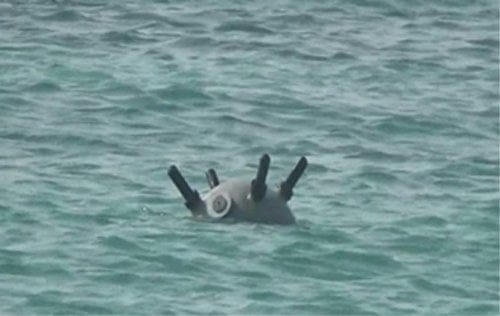
The Maham-1 sea mine swept by NRF marine forces in the Bab el Mandeb (NRF)
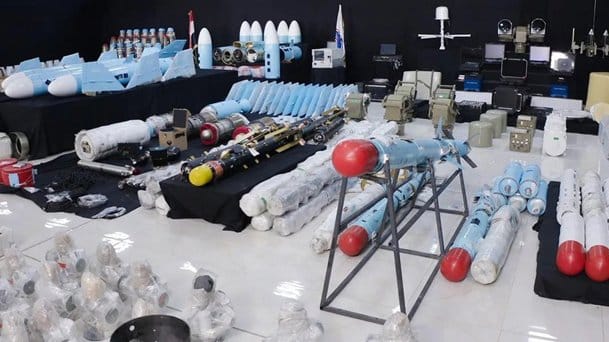
In an alarming development, the NRF reports that on the same busy day, they intercepted a large consignment of Iranian arms destined for the Houthis on board a dhow in the Red Sea. If this is verified, it suggests that the IRGC arms smugglers of Unit 190 can still slip past the US naval blockade in the Gulf of Aden in small dhows. Or more likely, that they have employed their well-practiced flexibility and use of drug-smuggling routes to find arms shipment corridors to the Horn of Africa, and thence by dhow across the Red Sea.
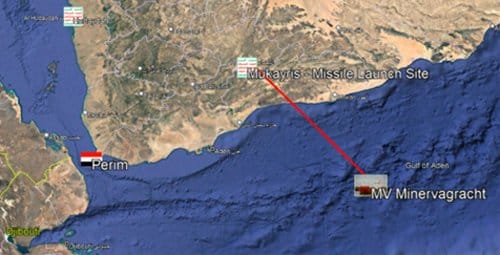
If the pictures published by the NRF are to be believed, the consignment included complete assemblies and components for at least 25 Mandab-2 anti-ship cruise missiles, which are based on the Iranian Noor/Ghadir missile and in turn upon the Chinese C-802. This is a missile with a range of about 180nm, and was probably the missile used by the Houthis to attack the MV Minervagracht (IMO 9571521) in September 2025.

that matters most
Get the latest maritime news delivered to your inbox daily.
Having such range as well as its own independent active radar terminal guidance, a Mandab-2 missile can be fired from high ground inland, threatening both ships in the lower Red Sea and on the Maritime Security Transit Corridor in the Gulf of Aden, needing only a cue from a Chinese or Russian imagery satellite.
Warfare between tribes and different parties has been endemic in Yemen for centuries. It becomes relevant for the international maritime community when one side appears intent on improving their ability to attack the shipping of external parties in the Red Sea and Gulf of Aden, hoping to exploit political leverage out of such attacks as the IRGC is attempting to do in the Strait of Hormuz. As yet, general warfare has still not quite resumed, but when and if it does so, the Saudis are well prepared, lessons having been learned from the last round of the contest. While reluctant to get involved in fighting yet again in Yemen, the Saudis know that with the Strait of Hormuz blocked, their gateway to Asia through the Red Sea must at all costs be kept open.
