
Northern Europe Ports Brace for Labor Strikes This Week
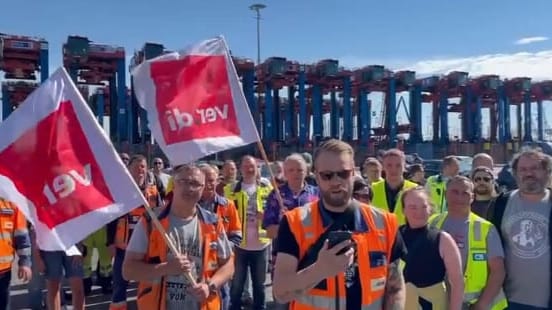
Labor unrest is promising to disrupt operations across several of Northern Europe’s largest ports. Dockworkers at Germany’s major ports are commencing a rolling strike that will run till Friday, ending just as a strike is due to begin in the Netherlands.
It comes as concerns are already growing over port congestion and delays, with only a little over half of containerships currently on schedule. Analysts at Sea-Intelligence calculated that currently a total of 5.0 percent of all global deep-sea capacity – 1.7 million TEU – is tied up, due to the delays, congestion, and other factors. The ports of Rotterdam, Hamburg, and Bremerhaven are already in the top 10 on Linerlytica’s list of the top ports for congestion. As of the end of last week, Linerlytica calculated that over 160,000 TEU was waiting at anchor in the three ports.
Germany’s Ver.di union is starting so-called warning strikes beginning with the night shift on September 2. The warning strike is scheduled to last 48 hours, until Friday, September 4, 2026, after the late shift. On Friday, the union Ver.di is calling for a large demonstration by members in the Hamburg port. At issue is the collective bargaining agreement covering some 11,000 union members at the ports in Hamburg, Bremen, Bremerhaven, Emden, Brake, and Wilhelmshaven.
The members have rejected a proposed 5.1 percent wage increase. They are waiting for the employers to agree to a new round of negotiations.
As the warning strike in Germany concludes, operations across major ports in the Netherlands, including Europe’s busiest port, Rotterdam, are set to be paralyzed on September 4 after trade unions called for industrial action to protest against social security reforms.
Early this year, the Dutch government unveiled plans to undertake drastic cuts in social security, including unemployment and disability benefits, as well as increasing the state pension age. Though plans for pension age increase have been shelved, the government has remained adamant on plans to reform the Unemployment Insurance Act (WW) and the Work and Income (Capacity for Work) Act (WIA).
The plans have ignited unprecedented opposition, with trade unions asserting that a cut of €6.5 billion ($7.5 billion) in social security will affect thousands of workers and their families. Since the reforms were unveiled, trade unions have been organizing demonstrations, actions and strikes, the largest demonstration having been organized in Rotterdam in June.
The government’s refusal to yield has forced two of the country’s largest trade unions, FNV Havens and CNV, led to call for strikes across the Netherlands ports of Rotterdam, Amsterdam and Zeeland. On September 4, workers across the ports will down their tools, a move that is expected to paralyze operations across the facilities.
Critical operations like vessel schedules, mooring, loading, unloading, lashing, towing, cargo inspections, among others, are expected to be severely affected. The strike is expected to have knock-on effects on road, rail and inland transport operations. The affected ports and terminal operators are already sending alerts that the strike could badly affect operations.
“Svitzer towing service has indicated that their employees are heeding the call of the union and will strike that day. This means that there is less available tugboat capacity. This will potentially lead to delays in ship handling and thus also affect terminal operations,” said the Port of Amsterdam in a statement.
The strike is bound to add to the woes that have been afflicting Dutch ports in recent months. Rotterdam has been grappling with growing uncertainties, including the Middle East crisis that continues to impact cargo throughput. In the first half of the year, the port posted flat growth with total throughput standing at 212 million tonnes compared to 211 million tonnes in the same period last year.

that matters most
Get the latest maritime news delivered to your inbox daily.
Apart from paralyzing port operations, the unions also intend to disrupt rail transport with a nationwide strike organized by FNV slated for September 9.
Port operations are already being impacted by low water levels, which have hit the inland river operations in particular. The carriers are now bracing for the added impact of strikes and labor unrest at Northern Europe’s largest ports.
