

Norway Awards $44M in Grants to Advance Battery-Powered Ships
The Norwegian government is continuing its efforts to support the transition of shipping to green technology, reporting on November 5 that it will award an additional $44.4 million to projects for battery-powered ships and charging projects. The awards are being made through the Ministry of Climate and the Environment’s Enova fund, which highlights the strong progress that has been made in the transition to battery-powered shipping over the past decade.
Between 2015 and today, Enova reports that the number of fully or partially battery-powered ships in operation in Norway has grown from one to 561. Enova provided support for 378 of these vessels, with many more currently under construction. Nearly one in every three battery-powered ships globally is Norwegian.
"The goal of Enova’s support is to help these solutions become competitive enough that more parties will choose them without the need for subsidies. Consequently, developments are moving in the right direction, as less and less support from Enova is required to encourage shipping companies to invest in battery-powered vessels," says Andreas Forsnes Jahn, head of maritime electrification at Enova.
Compared to two years ago, Enova reports applicants are now requesting, on average, less than half the amount of support from Enova relative to the vessels' battery capacity.
The next round of grants is focusing on enabling cargo ships to run entirely on battery power, rather than just partially. To eliminate the wait for charging, the projects will be based on swappable batteries.
“The Norwegian shipping industry is at the forefront of developing battery-powered vessels,” says Minister of Climate and Environment Sigrun Aasland. “We are now taking a further step—moving from using batteries to reduce fuel consumption to powering entire vessels solely on battery power. With support from Enova, we are helping to bring forward new solutions that can cut emissions from the maritime sector and make this technology accessible to more operators.”
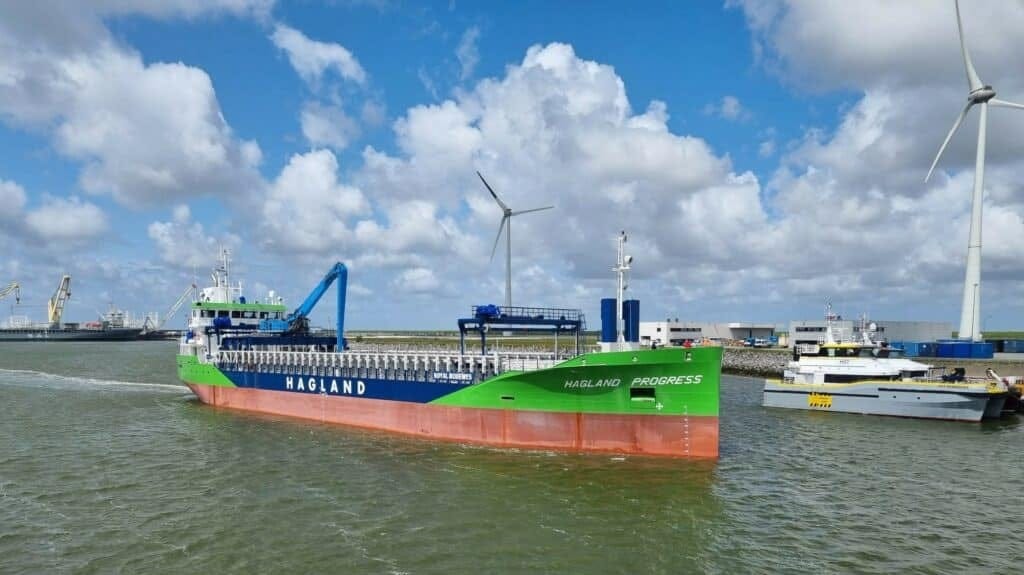
The largest award goes to Haugesund-based Hagland Shipping, which will receive approximately $24.9 million to convert four cargo ships to battery power. The vessels will operate along the Norwegian coast and throughout Northern Europe, becoming the first bulk carriers to run on battery power between Norway and other countries.
Hagland currently operates a fleet of self-discharging general cargo vessels ranging from 3,700 to 5,000 dwt. The Hagland Progress (4,900 dwt), built in 2023 by Royal Bodewes, will lead the project. The ship is already fitted with a plug-in battery hybrid M/E 1,800 kW Tier III main engine with a pitch propeller and shore power capabilities.
Each of Hagland’s four ships will be outfitted with a battery capacity of 40 megawatt-hours, equivalent to more than 500 large electric cars. The company Zen will manage battery swapping and charging. The ships will be capable of operating solely on battery power and will also be equipped with energy-saving wing sails.
“If the project succeeds, it could pave the way for zero-emission operations on many more routes along the Norwegian coast and toward Europe,” says Jørgen Laake, head of the Service Office for Green Fleet Renewal.
Hagland highlights that important work still needs to be done regarding infrastructure, operational aspects, and regulations, which it looks to address as part of the project.
Oslo-based Bulk Loaders AS was also granted $9.4 million in support to build a new, battery-powered cargo ship. The vessel will transport various types of cargo for the oil industry along the Norwegian coast, primarily between Stavanger and Kristiansund. With flexible solutions for loading and unloading both dry cargo and liquid products, Enova highlights that the vessel will be able to take over transport tasks currently handled by trucks. The ship will have a battery capacity of 15 megawatt-hours and will primarily be charged using shore power during loading and unloading.
Enova highlights that this project combines the electrification of shipping with the shift of freight transport from road to sea, representing a significant contribution toward a more sustainable transport solution along the Norwegian coast. The new ship will replace an older vessel, and it will reduce heavy-duty road transport, cut greenhouse gas emissions, and contribute to more efficient and environmentally friendly logistics for the oil industry.

that matters most
Get the latest maritime news delivered to your inbox daily.
Grieg New Electric is receiving $6.8 million for two new battery-powered service vessels for the aquaculture sector as well as for one shoreside charging station. Steinarbo Invest is also receiving $1.6 million for five new battery-powered workboats for the aquaculture industry.
Additionally, Kristiansand Havn IKS has received $1.6 million for a charging and battery-swapping facility in Mandal, with operations scheduled to begin toward the end of 2028.