

Sanctioned Russian Merchant Vessels Are Underway
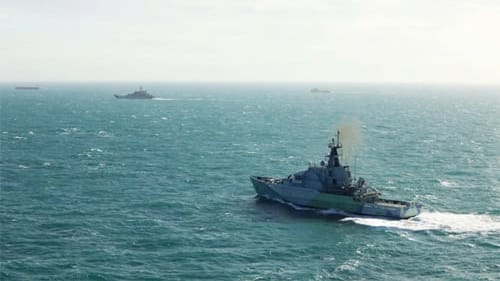
The military cargo convoy of sanctioned Russian-flagged vessels which had been observed forming up in the Russian port of Baltiysk in the Kaliningrad has set sail. It formed into two separate packets, likely one headed for the Mediterranean and the other for West Africa.
Two ships, the Ascalon (IMO 9198226) and Anastasiia (IMO 9349291) set off together on October 31. Sailing in company, the ships passed through the Langeland Belt, escorted first by the German Coastguard vessel Bamburg (IMO 9830020) and the Danish Coastguard vessel Merkur (MMSI 219167000), and then by the Danish naval patrol vessel HDMS Rota (P525). On November 6, the two vessels were making their way through the English Channel, with no surface naval escort visible, and appear to be heading southwest.
Meanwhile, the Lady R (IMO 9161003) and the Lady D (IMO 9349289) set off together from Baltiysk on November 5, and early on November 6 were between Rügen and Bornholm, heading west and being escorted by the Danish naval patrol vessel HDMS Najaden (P523). The Sparta (IMO 9268710) appears to be engaged separately on a regular resupply run between Baltiysk and St. Petersburg.
All four of the ships travelling to warmer waters are moving with their AIS systems activated.
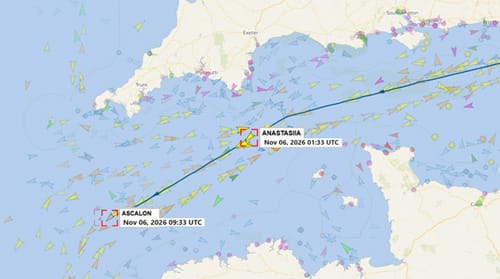
Two Russian military cargo vessels convoying through the English Channel November 6 (VesselFinder)
At the same time, Russia’s shipments of diesel to the United States remain in disarray, with four product tankers having initially been identified as leaving Baltic terminals and as being en route to the East Coast. Owners and managers appear to have heeded the warning of civil and criminal prosecutions issued to port operators should they handle the cargos.
As of November 6, three of the product tankers, each operating under sanctions, are underway, but none appears bound for the United States. The Russia-flagged Talisman (IMO 9292060) has just passed north of Malta, heading eastwards, and is displaying “For Orders,” possibly destined for Turkey. The Sierra Leone-flagged Leruo (IMO 9385831) is west of the Azores heading for Brazil, showing “For Orders” on its AIS. They had loaded at Primorsk. The Sierra Leone-flagged product tanker Beast (IMO 9290921), sanctioned by the EU and UK, left Ust Luga on October 30, indicating that she was heading for “Brazil For Orders.” Currently, southwest of the Faroe Islands, and probably as a consequence of her sanctioned status, she avoided UK territorial waters and took the long route to the Atlantic by sailing north around the Shetland Islands.
The only product tank that still appears to be approaching the United States is the Maltese-flagged Agioi Fanendes (IMO 9798375). This vessel, not sanctioned, passed through the Pentland Firth in UK territorial waters displaying “For Orders,” and is now south of Newfoundland, still heading towards the U.S. East Coast ports.

that matters most
Get the latest maritime news delivered to your inbox daily.
Dmitry Peskov, the Kremlin spokesperson, when questioned about the diesel tankers altering course has said that all the diesel will find buyers. However, in the interim, Ukraine has resumed its attacks on refineries producing diesel, exacerbating the shortages which previously had resulted in Russia voluntarily limiting its own exports.
Early on November 5, Ukrainian drones once again attacked Rosneft’s refinery complex at Ryazan, one of Russia’s largest petroleum processing facilities and serving Moscow and Central Russian regions. The complex was again set ablaze, and diesel and petrol stocks will need to be diverted within Russia to keep the politically-sensitive capital region well supplied. The attack on Ryazan follows a huge attack on November 3 mounted against the Slavneft-Yanos refinery in Yaroslavl, which also services the Moscow region.