


New Zealand Opens First Round for Offshore Energy Feasibility Permits

New Zealand has moved quickly to open its first round for offshore renewable energy feasibility permit applications just weeks after it completed the enabling legislation. Government officials highlight that the country already has a high level of renewable electricity generation, while saying that offshore renewable energy has the potential to contribute to that while also helping New Zealand meet increasing demand for power.
The notice for the round went into force on October 19 and runs until April 19, 2027. It opens two offshore areas, one near Taranaki and the other near Waikato/South Auckland, for proposals. Both zones are south of Auckland on the west coast of New Zealand, off the North Island. The process envisions a single permit in each area and requires the recipients to commence the ORE feasibility activities and provide annual update reports.
“The winds off the South Taranaki coast are on a par with those of the North Sea, the most productive offshore wind region in the world, and because they blow so steadily, offshore turbines are expected to run at higher capacity than turbines on land,” said Energy Minister Simeon Brown earlier this year when the regulatory framework was adopted.
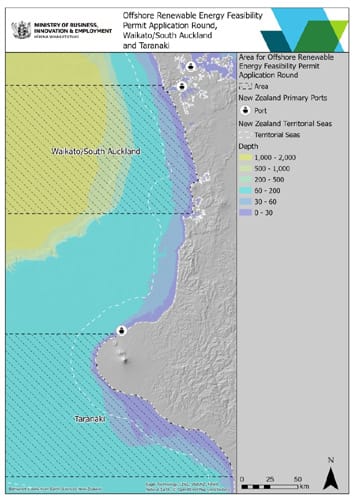
Government map showing the outline of the two proposed zones
New Zealand began the process in 2024 with the minister emphasizing that the absence of a regulatory framework had created uncertainty for potential developers of wind power as well as solar, wave, or tidal power.
Parliament passed the Offshore Renewable Energy Bill on July 1, 2026, addressing the need for the regulatory framework. The legislation governing the construction, operation, and decommissioning of offshore renewable energy developments officially became law in early August.
It established a two-stage permitting regime, which the government asserted would give potential developers greater certainty. It established the requirements for consultation, as well as requirements for decommissioning at the cost of the permit holder and transmission owners, and the safety rules.
The legislation enables the government to commence rounds for feasibility permits. It was anticipated that further relations to feasibility permits and cost recovery would also be established.
The notice for the first round sets out the terms, requirements, limitations, and mandatory conditions. The feasibility licenses will run for up to seven years, and after completing studies, companies can apply for a commercial construction permit with a 40-year duration.
It remains to be seen if New Zealand will be able to generate excitement and momentum for its offshore renewable energy industry. Anticipation is high, but neighboring Australia has struggled to move forward after passing its framework legislation several years ago. Permits were awarded, but many of the industry’s major developers have walked away, citing issues with the execution and the broader pressures that have emerged in the industry.

that matters most
Get the latest maritime news delivered to your inbox daily.
Top photo of Auckland West Coast by Phillip Capper - CC BY 2.0)
