


New Container Terminal for Wilmington Moves Forward Despite Challenges
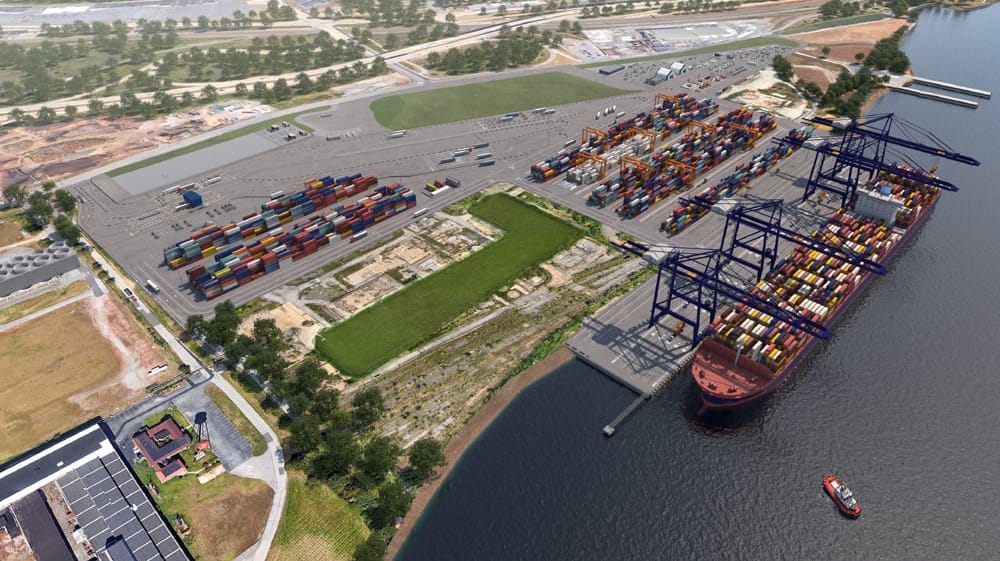
Delaware and the operator of the Port of Wilmington, Enstructure, marked the groundbreaking for the long-planned new container terminal. State officials called the project one of the largest economic development projects in Delaware’s history, arguing it will be an economic engine and create thousands of new jobs, while opponents question the need for the terminal.
The terminal is being developed in a public-private partnership between Enstructure, which has operated the Port of Wilmington since 2023, and the Diamond State Port Corporation, a state entity. The project represents a total investment of $669 million, including $225 million invested by Enstructure, $325 million from Delaware, and $119 million in federal grants. It is scheduled to be developed in phases and on track to open in early 2029, according to Enstructure.
Located at a former industrial site north of the city and about three miles from the current port, Enstructure says it will provide “transformative infrastructure that will strengthen supply chains, expand capacity, and create new opportunities for customers across North America.” It cites improved access to regional, national, and international supply chains while saying the project more than doubles the port’s capacity.
The Port of Wilmington, Delaware, is a full-service deepwater port and marine terminal handling more than 400 vessels and six million tons of cargo annually, including containers, perishables, bulk, Ro-Ro, and various project cargoes. Among its largest operators is Chiquita Brands, which consolidated its mid-Atlantic supply chain operations at the Port of Wilmington in 1988. Last year, Chiquita entered into a new long-term agreement with the port as its mid-Atlantic distribution hub.
When it is completed, the new Delaware Container Terminal will increase the physical capacity of the port to accommodate larger vessels with a quay length of 2,700 feet and a depth of 45 feet. DCT is designed to accommodate container vessels with capacities of up to 16,000 TEUs, allowing 1.2 million TEUs to move through the terminal each year. DCT will have seven electric ship-to-shore gantry cranes and 24 electric rubber-tired gantry cranes, while the developers highlight will incorporate state-of-the-art technology and lower-emission operating practices. DCT will have electric cargo-handling equipment and supporting charging infrastructure, which will eliminate diesel exhaust, greenhouse-gas emissions, and operating noise compared with conventional diesel-powered equipment.
Further, they assert the project will expand opportunities extending well beyond the terminal's 137-acre footprint. By increasing the state's marine terminal capacity and ability to accommodate larger vessels, they said DCT will strengthen Delaware's competitiveness and create lasting value for the state's workers, families, businesses, and surrounding communities.

that matters most
Get the latest maritime news delivered to your inbox daily.
The project has been challenged in the courts and last year lost a key federal license. Opponents argue that it is too large and unneeded. Neighboring ports in New Jersey and Pennsylvania have also challenged the plan and its impact on the Delaware River, while opponents highlight that the capacity of DCT would be more than all the containers handled last year, a record year, at the neighboring Port of Philadelphia, which is located further north on the Delaware. New legal complaints were filed in July challenging the validity of the construction permits.
State officials said they were confident that the legal challenges would be resolved and that they felt confident in their strategy. Officials from the state and local government and the port argue it is critical for the port to expand its capabilities to remain competitive. They point out that the project will be the largest shipping terminal built in Delaware since the current Port of Wilmington opened in 1923.
