Key Senate Committee Casts Doubt on White House "Battleship" Plans
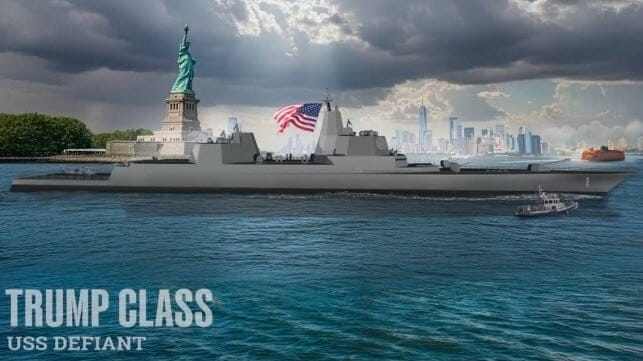
The White House's plans for growing the U.S. Navy's fleet appear to be headed for some swift changes on Capitol Hill, starting with a proposed cut to the early steps of the "battleship" program.
Tucked into the budget tables for shipbuilding & conversion, the Senate Appropriations Committee's Defense subcommittee has proposed to zero out the administration's request for $1 billion for long-lead-time procurement for the first Trump-class battleship, USS Defiant (BBG-1). The committee described the line item as "early to need" and recommended it be cut, potentially pushing back the timeline for the lengthy and costly BBG project. It also cut about $585 million out of the ship preliminary design and feasibility study budget for the BBG in a proposed "program decrease," leaving the Navy with only $80 million to study the design.
The change was first reported by USNI News.
Overall, the committee's response to the budget proposal keeps the president's unprecedented $1 trillion topline for defense, but cuts his shipbuilding request and pushes the funds elsewhere in the armed forces. The White House's $60.1 billion request for Navy shipbuilding - double last year's appropriation - would be reduced by about $18.5 billion, and funds would be increased instead for missile procurement programs in the Army and the Air Force. Those boosts would include an extra $10 billion to buy THAAD antiballistic missile munitions and $11 billion for PAC-3 surface-to-air missiles - an investment in rebuilding a depleted arsenal.
In justifying its less ambitious shipbuilding budget, the committee said that the defense industrial base wasn't well-placed absorb that much extra order volume.
"Merely increasing the number of ships in the shipbuilding plan has not resulted in meaningful improvement to ship schedules or production rates. Longstanding problems still exist with production capacity limitations, workforce challenges, inflation, supply chain fragility, and outdated production tools and technologies," the committee wrote.
Though domestic yard capacity to fuel fleet growth is limited, the committee firmly ruled out the idea of building warships overseas, as the White House would like to do. Drawing on the "Finland model" for icebreaker construction, the Office of Management and Budget (OMB) has pushed to set up warship construction contracts with East Asian allies. This would see the first two hulls in each series built overseas, then the remainder built in the U.S.
"The Committee supports limited use of allied shipyards to address significant shortfalls in certain auxiliary vessels but is unconvinced that foreign shipyards are an appropriate solution for combatant vessels," the SASC wrote.

that matters most
Get the latest maritime news delivered to your inbox daily.
All three of the other House and Senate committees that oversee defense spending apper likely to approve language in the FY2027 NDAA to limit the president's ability to authorize foreign procurement of warships or major components, according to USNI. If enacted as proposed, it would have serious implications for the structure of the "MASGA" Korean shipyard investment program, removing the potential for foreign partners to win combatant vessel orders for their preexisting overseas facilities.