


IMO Concludes Next Round of Net-Zero Discussions Still Divided
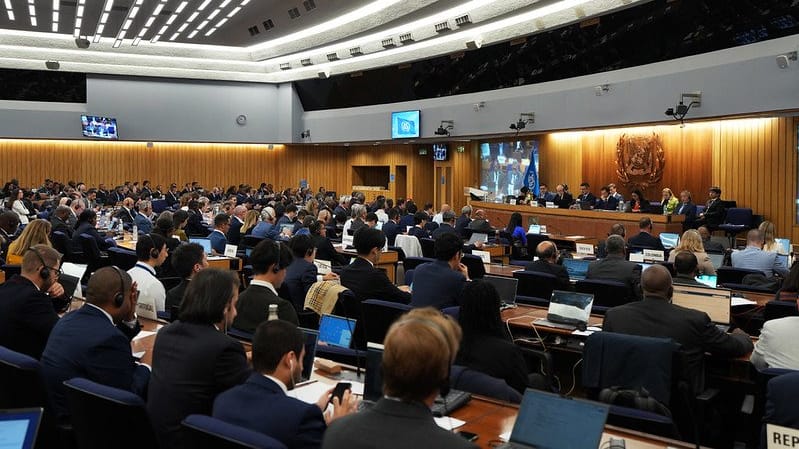
The International Maritime Organization completed its next working group session discussing efforts to reach a decarbonization approach still largely divided, and is now aiming for a potential resolution by the end of 2026. Optimists are noticing a productive discussion and less political maneuvering and backstabbing, but the United States and others continued their opposition to the Net Zero Framework, and key issues were deferred to more intersessional discussions or a consequential series of three sessions in late November and early December 2026.
The session came against a backdrop where climate scientists assert that the evidence of the consequences of greenhouse gas emissions is building. Europe and many other parts of the world suffered through a blistering summer of heatwaves, and Nepal is still reeling from what appears to have been a major glacier collapse leading to catastrophic flooding. The United Nations released scientific reports saying the globe would exceed the previously ascribed goal to limit the increase to 1.5 Celsius (2.7 Fahrenheit) above mid-19th century temperatures, and likely more harsh consequences.
The United States, Saudi Arabia, and primarily other oil-producing states, continued their opposition in the IMO discussions that emerged and led to the deferral of adoption votes. They continue to push to scrap key elements of the Net Zero Framework or call for additions such as different fuels and more pathways. The proposed GCG Fund remains one element of strong opposition even with proposed changes and a renaming.
Other states put forward yet different approaches, such as Liberia, which wants to tie in the availability and affordability of cleaner fuels to the structure. Japan proposed replacing the pricing structure with shipowner-directed contributions, but according to observers in the closed-door sessions, that was “robustly rejected.”
Smaller and island nations continue to push for stricter requirements while many of the individual issues remained open to discussion. Researchers at UCL Energy Institute noted likely efforts to soften the initial Global Fuel Intensity pathway in the NZF as well as broad debate on issues such as pooling and transfer of credits. China put forward a proposal that includes reward payments and could form a single transaction, which was reported to receive broad support.
Observers are saying that it appears at least two-thirds of the states are supporting the approach of a centralized pricing and collection system that also rewards early adopters. At the end of the four days of meetings, it seemed that despite the continued block of opposition, overall, there is no significant support for an alternative to adopting the Net-Zero Framework.
“Whilst there are many positives to take away,” Dr. Tristan Smith, Professor of Energy and Transport at UCL Shipping and Oceans Research Group, said, “there remains high uncertainty in the extent that both industry’s transition and low-income countries' transitions will be supported. There remains high risk that in the effort to find a creative way forwards, the equilibrium between these two aspects, that enabled the NZF in the first place, is lost to the detriment of the outcome overall.”
The IMO in its official summary also seeks to highlight that there was strong participation, over 1,200 registered for the intersessional working group, and that there was a “genuine willingness within the group to make concrete further progress.” However, while there might have been a hope to come toward a finalized text, they instead spent the four days debating and discussing and were also forced to defer some elements to the next sessions. The lifecycle framework, for example, was not considered and was delayed to the next session.

that matters most
Get the latest maritime news delivered to your inbox daily.
Summarizing where things stand, UCL concludes that “several key aspects of the negotiation are wide-open and didn’t narrow this week.” It sees as a core question the level of the early transition, how soft it is, and the regulatory tools and support for businesses to manage the changes. It expects the draft documents will evolve more informally and warns, “There could well be twists to come as different concepts are merged together to find common ground.”
The official IMO timeline calls for the intersessional working group to reconvene November 23 for a week of discussions. The following week, MEPC 85 runs from November 30 to December 4, and the extraordinary sessions adjourned in October 2025 resumes on Dember 4, assuming MEPC 85 produces conclusions.
