
Fincantieri Delivers Hybrid Hydrogen-Powered Cruise Ship to Viking
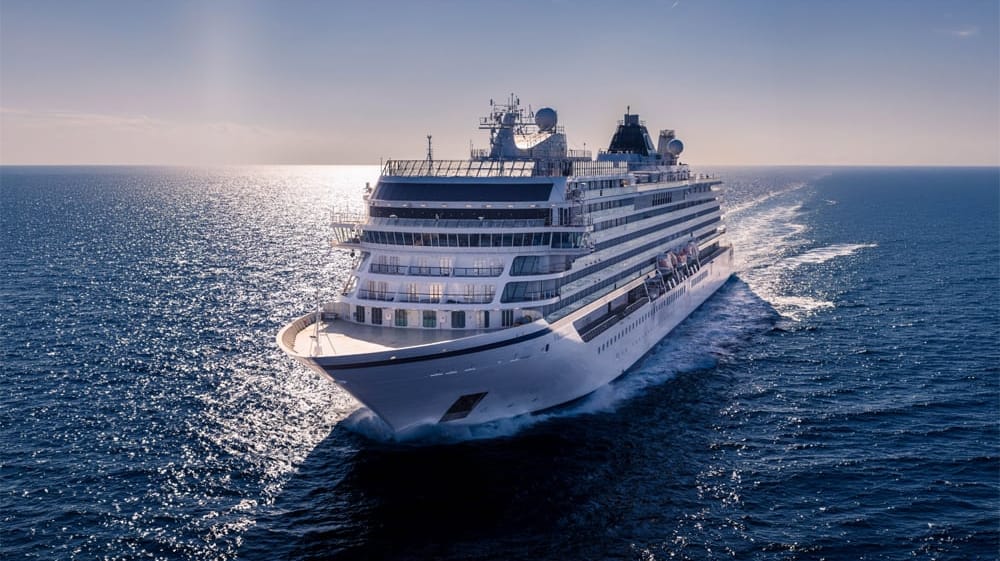
Fincantieri delivered the first of two new cruise ships to Viking that are outfitted with the latest advancements in hydrogen propulsion. While the ships are built on the same platform as the other Viking cruise ships, they also incorporate a liquefied hydrogen fuel cell system, with the cruise line reporting it expects both ships to be operating on hydrogen in2027.
“The delivery of the Viking Libra is a proud moment for Viking and an important milestone in our growing ocean fleet,” said Leah Talactac, President and Chief Executive Officer of Viking. “Together with the Viking Astrea, she will set a new standard for innovation as we bring this technology into operation in 2027.”
Viking and Fincantieri first announced their intention to outfit these two ships with the hydrogen propulsion system in 2025, building on earlier tests of the technology. It fulfills a longtime ambition of Viking’s founder, Torstein Hagen.
Fincantieri is calling the Viking Libra a “new milestone” in its longstanding partnership with Viking, which dates back to 2012, as well as part of its broader commitment to developing solutions that support the energy transition of the maritime industry. Fincantieri has now delivered 14 ocean cruise ships to Viking, and the cruise line expects to add 10 additional ocean cruise ships built by Fincantieri by 2032.
Isotta Fraschini Motori, a Fincantieri company, led the effort to develop the cruise ships powered by fuel cells and onboard-stored hydrogen. The company highlighted that it was developing solutions for the Viking Libra, which would feature innovative systems for hydrogen loading and storage directly onboard, using a containerized solution designed to overcome current supply chain challenges. The hydrogen will power a PEM (Polymer Electrolyte Membrane) fuel cell system, specifically optimized for cruise operations, designed and manufactured by IFM.
The fuel cells were expected to produce up to six megawatts of power, equivalent to roughly 8,000 horsepower of generator capacity. The ship, according to Fincantieri, will be capable of navigating and operating with zero emissions. Viking said in 2025 that price is an issue for H2-powered operation, but they believe that the price will come down in the future, and they want to illustrate a path forward for the industry.
The new system advances on earlier tests of hydrogen systems. Fincantieri delivered the Viking Neptune in 2022, equipped with a small hydrogen fuel system for on-board power. They said the small system was a test to determine how hydrogen fuel could be developed at a larger scale in future newbuilds. Fincantieri reported that the experimental hydrogen fuel cell module would provide a nominal power of 100 kW. At the time, Fincantieri said it was working toward the development of a hydrogen generation system with a total power of approximately six to seven MW.
Viking Libra is built on the second-generation cruise ship platform developed by Fincantieri for Viking. The newer class of ships is 54,300 gross tons with a length of 239 meters (784 feet). The newer cruise ships are slightly enlarged from the first class also built by Fincantieri. Viking Libra has accommodations for up to 998 passengers.
The cruise ship was floated at the Ancona shipyard in March 2026, followed by her sister ship Viking Astrea, which was floated out on September 11, 2026. The second ship with the hydrogen capability is scheduled for delivery in May 2027. Both ships are scheduled to sail in the Mediterranean and Northern Europe.
that matters most
Get the latest maritime news delivered to your inbox daily.
MSC Cruises has also been testing hydrogen systems. MSC World Europa, which was delivered in October 2022 by its builders Chantiers de l’Atlantique, was fitted with a small prototype solid oxide fuel cell (SOFC) system. It is based on technology from Bloom Energy and produces electricity generated by electrochemical reactions with LNG. The two modules each can produce up to 75kW.
Royal Caribbean Group’s Silver Nova for Silversea Cruises, delivered in 2023, was designed around a hybrid energy concept featuring a 4-megawatt fuel cell system paired with liquefied natural gas engines and batteries. It uses hydrogen generated via a reformer that converts onboard LNG to hydrogen and is capable of powering hotel operations while the ship is in port.