


Car Carrier to Get Two Wing Sails in First Commercial Application
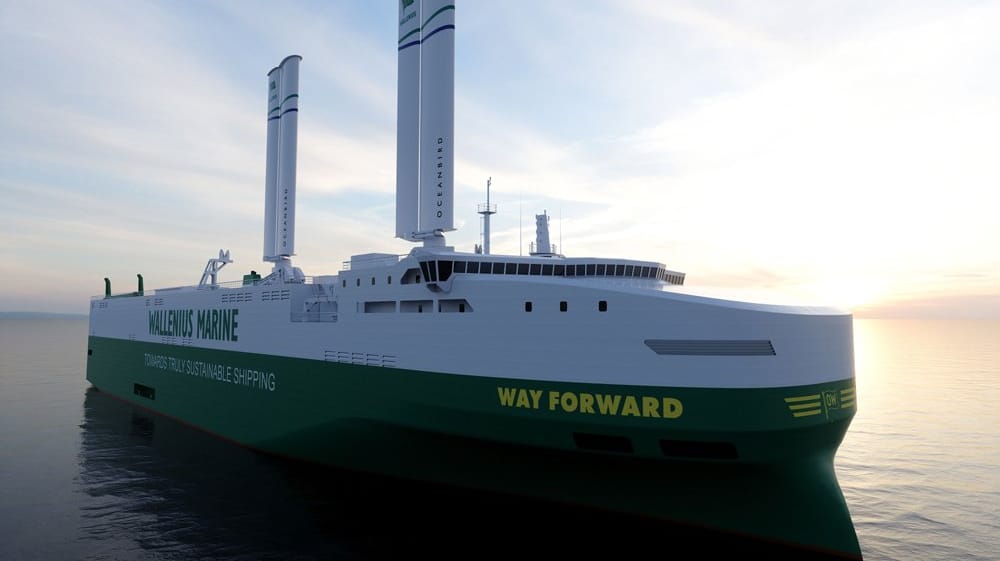
Wallenius Marine, a pioneer in car carriers, is pursuing its first commercial use of wind-assisted propulsion with a scheduled 2027 retrofit of the technology to one of its newest car carriers. Working with Oceanbird, a Swedish joint venture that Wallenius Lines established with Alfa Laval, they plan to add two wing sails to the car carrier Way Forward (18,565 dwt).
“We are convinced that wind propulsion will play an important role in the future of shipping,” said Johan Mattsson, CEO of Wallenius Marine. “By fitting wing sails to the Way Forward, we can gain practical experience whilst taking another step towards reducing emissions from our fleet.”
Built in China at Yantai CIMC Raffles and introduced in 2024, Way Forward and her sister ship Future Way were designed by Knud E. Hansen to be among the most efficient vessels to operate. The vehicle carriers, which are 62.432 gross tons and 200 meters (656 feet) in length each, have a capacity of 6,500 cars. The Way Forward operates under charter to the logistics company Volkswagen Konzernlogistik.
The design features a hydrodynamically optimized hull for reduced water resistance and low fuel consumption. In addition, the superstructure was streamlined, with a low profile and integrated ventilation that reduces air resistance. The ships also have an optimized, lightweight steel structure that improves performance and an optimized cargo configuration enabling efficient loading/unloading and minimizing the need for ballast water. They are equipped with dual?fuel machinery capable of using LNG/LBG and diesel/biodiesel.

Oceanibird's wing sails tilt to reduce the air draft in port (Oceanbird)
“The installation will provide valuable insights into how wind propulsion can be integrated into future vessel designs and day-to-day operations. The lessons learned will support the development of even more energy-efficient ships,” said Mattsson.
Oceanbird reports work is already underway at its site in Landskrona, Sweden, to assemble the two wing sails. It did not report the dimensions of the sails that will be used aboard the ship, but they will have the company’s tilting technology to permit them to be lowered to increase maneuverability and limit the impact to air draft. The addition of wing sails is expected to further improve the vessel’s energy efficiency while generating valuable operational data on wind-assisted propulsion in commercial service.
“It is our first multi-wing installation and an important step towards our vision of a primary wind-powered vessel,” said Oceanbird CEO Amrit Kaur Bhullar.

that matters most
Get the latest maritime news delivered to your inbox daily.
After years of development and testing, the first Oceanbird wing sail was installed on the Wallenius Wilhelmsen vessel Tirranna (30,000 dwt) in June 2026. The vessel, which was built in 2009 and has a capacity of 7,650 cars, was fitted with a single wing sail that stands 46 meters (approximately 150 feet) tall and is 14 meters (46 feet) wide.
Oceanbird reports the first installation is working as intended. The company said performance data will be verified by a third-party provider this fall.
