


President Xi Continues His Purge of Senior Chinese Officers
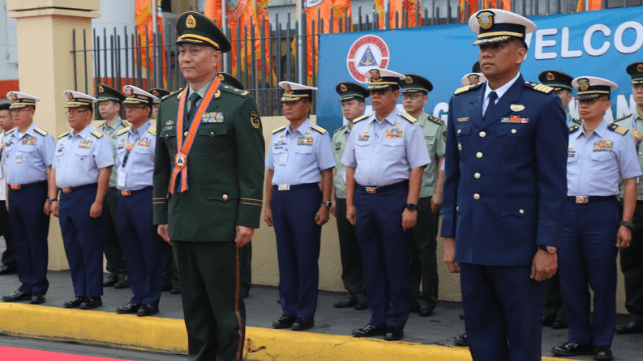
President X Jinping appears to have completed his purge of senior officer in the People’s Liberation Army (PLA), with a disproportionate number coming from the PLA Navy (PLAN). In what appears to be a culmination of a series of dismissals over the last 12 months, General Zhang Youxia, as Vice Chairman of the Central Military Commission (CMC) its most senior serving officer, was placed under investigation for “serious violations of discipline and law violations”. This phraseology is a common euphemism for corruption, but corruption itself is often used as euphemism for political deviancy.
General Zhang was also dismissed as a member of the Politburo. Hitherto, the general has been seen as secure in his position, being a childhood friend of President Xi and having overseen earlier phases of the purge which has now claimed him. He is also the last Chinese senior leader to have had combat experience, albeit on the losing side in the Sino-Vietnamese war of 1979, and had overseen widespread reforms of the military designed to improve its operational effectiveness.
Also dismissed on the same grounds was General Liu Zhenli, likewise a Sino-Vietnamese war veteran and a lesser member of the CMC. General Liu had been Chief of Staff for Joint Operations, in charge therefore of directing joint operations such as any potential invasion of Taiwan. He too was a thoroughbred military man, with hands-on experience as a previous commander of the PLA Ground Forces.
Speculation regarding the dismissal of these two senior officers spread last week when both failed to appear as expected at a CMC plenum on January 20. At the meeting, General Zhang’s seat was taken by General Zhang Shengmin, the PLA Rocket Force officer who has now succeeded him. General Zhang Shengmin has spent most of his career specializing in imposing party discipline within the military hierarchy. Official confirmation of the two dismissals came in an announcement on the Chin Military website.
Back last November, the Maritime Executive summarized what was then known about a purge amongst the senior ranks. Nine officers of Four Star rank were identified then as having been purged, including three senior officers from the PLA Navy (PLAN). Our assumption was that the purge had been much deeper, extending from the four-star level dismissals which were publicly announced down into the lower ranks of the military hierarchy.
The purge remains something of a mystery. The phased way it has been conducted demonstrates President Xi’s grip on power; there was no need for a sudden night of the long knives, nor fear of resistance. Many of those dismissed had only recently been promoted, and indeed had supervised the early phases of the purge. Most were considered to be members of the Fujian clique, a group considered to be closely aligned and loyal to President Xi Jinping personally.
Speculation for its purpose is two-fold: President Xi clearly felt a need to strengthen his personal authority, and there may have been professional military disagreements over whether his blunt force invasion plan was the best way to go about capturing Taiwan. A high percentage of those dismissed had previous command and staff appointments in the Eastern Theater Command, which being adjacent to Taiwan, would lead on any invasion. President Xi Jinping has consistently pushed a hardline military solution to the "Taiwan problem," investing particularly in an expansion of the PLAN's operational capability, while a group of military officers opposed to this policy is believed to have advocated instead a more nuanced approach.
Of the nine four-star officers dismissed last November, the most senior was General He Weidong, a second CMC Vice Chairman who had been a member of the 24-strong Politburo and is thought to have been the lead strategic planner for operations against Taiwan. Admiral Miao Hua had been head of the CMC's Political Work Department, the organization within the PLA responsible for upholding conformity to CPC doctrine. His deputy, General He Hongjun, unusually a senior officer from Tibet, managed to commit suicide before his dismissal was announced.
Also dismissed was Admiral Yuan Huazhi, a naval infantry officer, until recently head of the PLAN Political Works Department. Admiral Wang Houbin was dismissed from his post as commander of the PLA Rocket Force, but had been the PLAN Deputy Commander from 2019-23 and had held a senior operational post previously in the East Sea Fleet. Vice Admiral Li Hanjun, PLAN Chief of Staff, had been purged earlier in June. Perhaps the casualty of greatest significance was Lieutenant General Lin Xiangyang, commander of the Eastern Theater. The East Seas Fleet commander Vice Admiral Wang Zhongcai, was also dismissed, along with Major General Ding Laifu, commander of the 73rd Army Group, one of three such ground force formations in the Eastern Theater Command.
What is the likely impact of this deep purge, in particular its consequences for the maritime community?

that matters most
Get the latest maritime news delivered to your inbox daily.
Most US naval officers would conclude that such widespread changes in senior command appointments must have immediate operational impact. Historically, multiple changes in command can happen in wartime, but that is when there are plenty of proven battle-hardened replacements close at hand. In this purge, the military professionals are being replaced by officers appointed for their political loyalty.
The result is likely to be a PLA more willing to obey political directives – but less able, from a leadership and command perspective, to carry them out. ‘Wolf warriors’, as anyone who seen these ideologically committed officers and diplomats up close, are doctrinaire and inflexible, opposed to all forms of critical thinking – a faculty generally considered necessary when plans begin to go wrong, as they inevitably do once battle commences. These developments increase the likelihood of more aggressive action in the South China Sea, and the chances of an invasion of Taiwan. But they lessen the chances of such action being successful.
The opinions expressed herein are the author's and not necessarily those of The Maritime Executive.
