


Analysts Question Whether Trump-Class Battleship Will be Built
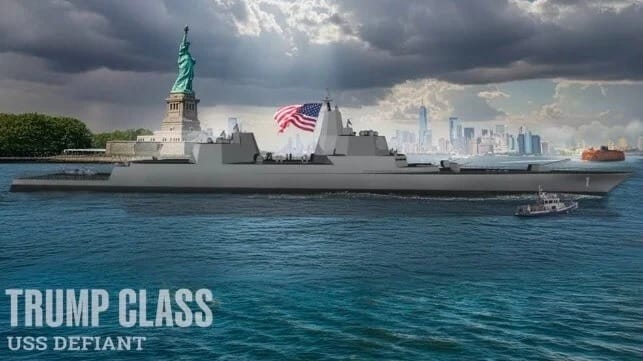
The announcement of a new Trump-class battleship design last week prompted considerable commentary about its equipment, capabilities and exceptional size. At 35,000 tonnes, it would rival a small amphibious assault ship for displacement. Amidst the discussion of the merits of such a large combatant, key questions about its survivability loom in the procurement process: where could it be built, when would it deliver, how much would it cost, and what would be the tradeoffs made in order to build it?
The Navy has resolved the "where" question, at least for the first two hulls. Initial design awards are going to Bath Iron Works, Huntington Ingalls Industries, and Leidos' Gibbs & Cox. In a single-source solicitation notice, the Navy said that "only BIW and HII Ingalls possess the unique and highly specialized capabilities necessary to meet the Navy’s requirements," and that design work was expected to take six years - putting the project in a ready-to-build state in 2032.
Design timeline and shipyard selection feed into the question of when delivery would occur. BIW and HII are both busy with existing programs, and have had challenges in competing for skilled workers. Given the labor and supply chain issues across the sector, all current naval shipbuilding programs are behind schedule, according to Navy Secretary John Phelan.
The Navy confirmed to The War Zone that steel-cutting for the first Trump-class hull is going to begin in the early 2030s, which would be in the second half of a proposed third term for President Trump, the longest scenario for the administration's time in office. [Please see editor's note below.] After construction starts, the timetable for delivery of a large first-in-class combatant vessel would likely be in the mid- to late-2030s. The most comparable recent U.S. Navy shipbuilding project, first-in-class USS Zumwalt, took five years to build from keel laying to commissioning at Bath Iron Works. Assuming a construction start in 2032, as suggested by the Navy's solicitation, and completion of the lead ship on the same timeline as the much-smaller Zumwalt, the commissioning date for USS Defiant would be in 2037 - more than a decade away, and within the remit of a future administration.
Cost would be substantial. Assuming the Congressional Budget Office's estimate of about $300,000 per tonne for a destroyer, plus the added cost of a first-in-class hull, the future USS Defiant would be priced well in excess of $10 billion for the lead ship, calculates CSIS analyst Mark Cancian - before inflation, which is higher in shipbuilding than in the rest of the economy. This price range is roughly comparable to one Ford-class aircraft carrier, three Virginia-class attack subs or five Arleigh Burke Flight III destroyers. An even larger number of future medium-sized unmanned combatant vessels could be purchased for this price.
In the 2030s, other presidential administrations will be making the decision on whether to build Trump-class battleships or to focus on other budgetary options, Cancian noted. Funding pressures may be key: Defiant would deliver at the same time as a planned jump in other U.S. Navy fleet expenditures in the mid-2030s. From an annual budget of about $255 billion today, the Navy's spending is on track to rise by $45 billion a year by the end of the next decade, the Congressional Budget Office estimates - before adding the cost of the new Trump-class battleship program.

that matters most
Get the latest maritime news delivered to your inbox daily.
While USS Defiant is in planning and construction, the nature of naval warfare is expected to evolve as more nations field unmanned platforms and hypersonic missiles. Many of these emerging weapons systems are designed for attacking larger, higher-cost vessels, and the threat picture faced by a warship like Defiant will be different in the mid-2030s than it is today. "The size and the prestige value of [the Trump-class] make it an even more tempting target, potentially for your adversary," suggested Bernard Loo, senior fellow at Singapore’s S. Rajaratnam School of International Studies, in conversation with CNBC.
[Editor's note: TME takes no position on the published proposals for the administration to remain in office for the 2028-2032 election cycle, a concept the president has endorsed in the past but has recently ruled out.]
The opinions expressed herein are the author's and not necessarily those of The Maritime Executive.
