


Svitzer: Better Towage Can Unlock Productivity for Ports
Svitzer's new white paper highlights the advantages of the TRAnsverse tug in addressing port congestion challenges.
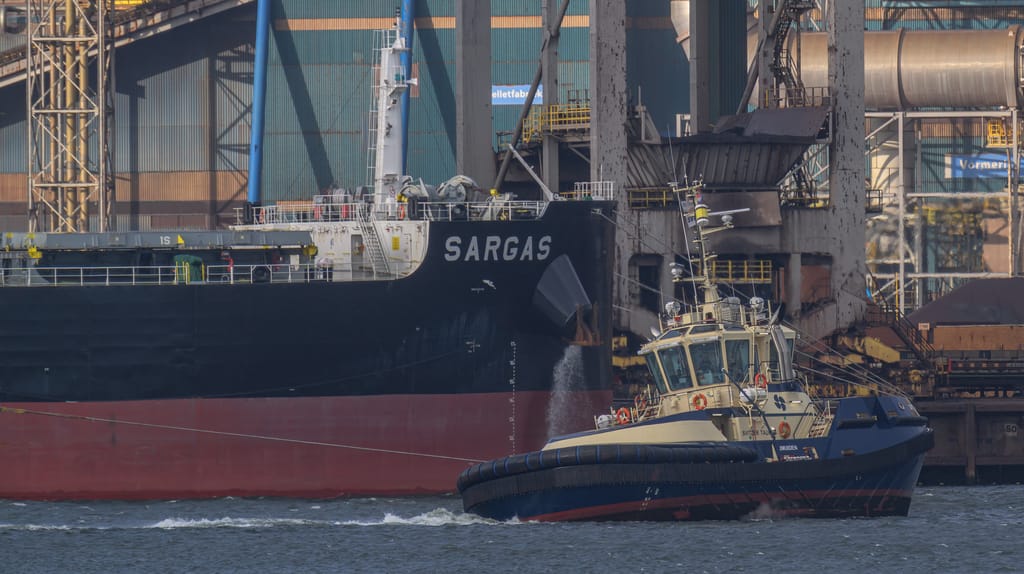
[By Svitzer]
The TRAnsverse tug can save port and terminal operators valuable minutes in berthing and arrival times according to Svitzer’s new white paper on the TRAnsverse tug, released today.
The release of the paper comes as ports face a wave of constraints including congestion at record levels; trade, conflict and climate-related disruptions; and a growing global shipping order book of both larger and more complex vessel-types.
In the document, Svitzer explores how the TRAnsverse tug can ease some of these pressures through its versatile and powerful design. It provides insights based on simulation studies, sea trials and more than 5,000 commercial towage jobs now completed by the tug class in the Netherlands and Australia.
In one example, the white paper explores how the TRAnsverse tug offers faster, more predictable shipping movements – factors essential to protecting berth and port call productivity. Using AIS data as a baseline, the white paper shows a TRAnsverse tug could save time of between 5 and 14 minutes for a single vessel arrival segment at a large mediterranean container port (modelled study).
“It’s not an easy task for ports today facing maritime gridlock while also trying to build resilience for the future. The good news is our TRAnsverse tug offers a new tool to ease some of these pressures by getting more out of existing infrastructure,” Svitzer CEO Kasper Friis Nilaus said.
Recent industry data highlights the scale of the challenge. Global container port congestion reached a record 4.31 million TEU waiting to berth in August 2026, surpassing the previous pandemic-era peak. Around 12.6% of the global container fleet was waiting for a berth during the period.
At the same time, schedule reliability remains under pressure. In August 2026, fewer than half of container vessels globally arrived on time, while late vessels arrived at an average of 6.81 days behind schedule. These disruptions create increasingly compressed and unpredictable arrival and departure windows.
Climate and weather factors are an additional factor, with nearly 90% of the world's major ports exposed to damaging climate hazards. The incoming “super” El Niño weather event forecast will only intensify these hazards on global trade routes into early 2027. Weather, wind and climate combined with larger and more varied vessel types will demand more of marine assets in ports and corresponding risk mitigations.
The white paper shows how two TRAnsverse tugs provide the optimal balance of power and precision for both harbour and escort towage requirements at one of Australia’s largest bulk ports, the Port of Newcastle.
The 32m tugs, Svitzer Nobbys and Svitzer Barrington, have recorded 124 tonnes of escort steering force and 186 tonnes of escort braking force at 10 knots in operations. This consistent force at speed is essential when managing larger, more complex vessel designs that have deeper drafts or are more wind exposed. Importantly, the port loses no harbour towage capability, and the TRAnsverse tug is still able to provide delicate vessel handling capability that larger escort tugs cannot.
“Trade flowing as smoothly and reliably as possible through our maritime supply chains is good for communities, economies and the world,” Mr Friis Nilaus said.
“The final connection between sea and shore that towage provides is essential to keeping this link strong and the TRAnsverse tug is demonstrating a modern solution to today’s challenges by unlocking more value from every vessel movement.”
The TRAnsverse design, developed with Robert Allan Ltd, includes a double-ended hull, inline fore-and-aft thrusters and a patented half-circle staple. Together, these features support highly responsive control and the generation of usable hydrodynamic force in applications not possible with other tugs.
Svitzer currently has 24 TRAnsverse tugs under build in 26m, 29m and 32m variants – in both electric and conventional diesel (biofuel ready) propulsion options.
The products and services herein described in this press release are not endorsed by The Maritime Executive.
