


USS Ford Likely to Set Post-Vietnam Deployment Record, Delaying Maintenance
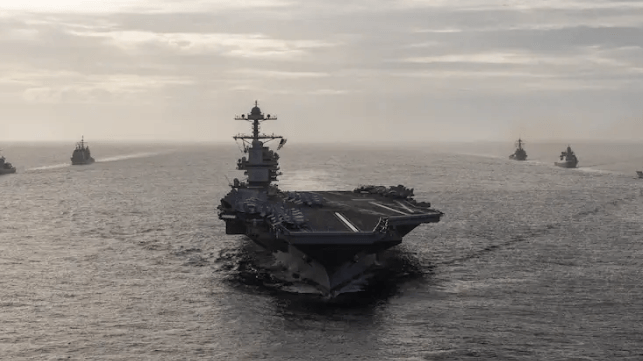
The carrier USS Gerald R. Ford has been redeployed from Venezuela to the Mideast to join a growing accumulation of forces aimed at persuading the government of Iran to give up its nuclear program. Ford is under way and about two weeks out from the Eastern Mediterranean, according to Fox News.
At present, Ford has been deployed and on tasking for 237 days; by the time that she arrives in theater, it will be about 250. Adding as little as 20 days on station and two weeks returning to Norfolk, and Ford could beat the post-Vietnam deployment record set by USS Harry S. Truman in 2021 (285 days). If her time in theater extends for months - as it plausibly could, if negotiations are as protracted as they were during the Venezuelan campaign - she could surpass the all-time record set by USS Midway in 1972-3, during the peak of Operation Linebacker.
The Navy has repeatedly warned that extra-long, extended deployments take a toll on readiness, starting with maintenance. Yard period schedules get deferred; equipment gets worn down, adding to the repair scope when the ship returns; and the crew have to put off plans for reuniting with their families.
Maintenance cost and timetable are the most significantly affected: during the yard period after a long deployment, unexpected and unscheduled repair issues typically crop up because of the extra wear and tear. This triggers unplanned work and last-minute parts orders, which take lead time to procure, pushing back the schedule.
Unexpected scope of work can add a year or more to a carrier's time in shipyard - an unplanned year that the vessel is not available for tasking. Multiplied across hulls, a fleet maintenance deficit adds up to limited fleet-wide availability. Coupled with delayed delivery of new tonnage, this means that fewer available carriers have to be stretched further to cover the gap, leading to more extended deployments - leading to further maintenance delays. This cycle is at top of mind for Navy leadership, as they have to think about the long-term readiness of the service - not just the overseas contingency at hand.
"If [Ford] requires an extension, it’s going to get some pushback from the CNO. And I will see if there is something else I can do," Chief of Naval Operations Adm. Daryl Caudle told TWZ last month.

that matters most
Get the latest maritime news delivered to your inbox daily.
Caudle has promoted the idea of differently-sized force packages for different taskings, with a mix of lower-end surface combatants for South American / Caribbean counternarcotics and policing operations. The concept is to free up more capable assets for other needs - including training and maintenance.
Force planning aside, Ford is set to join a growing "massive armada" in U.S. Central Command and Europe. Nearly 30 ships are under way or forward-deployed in the general region, including auxiliaries, in a count provided by analyst Ian Ellis.
