USCG Highlights Varied Missions for Storis During 133-Day Arctic Deployment
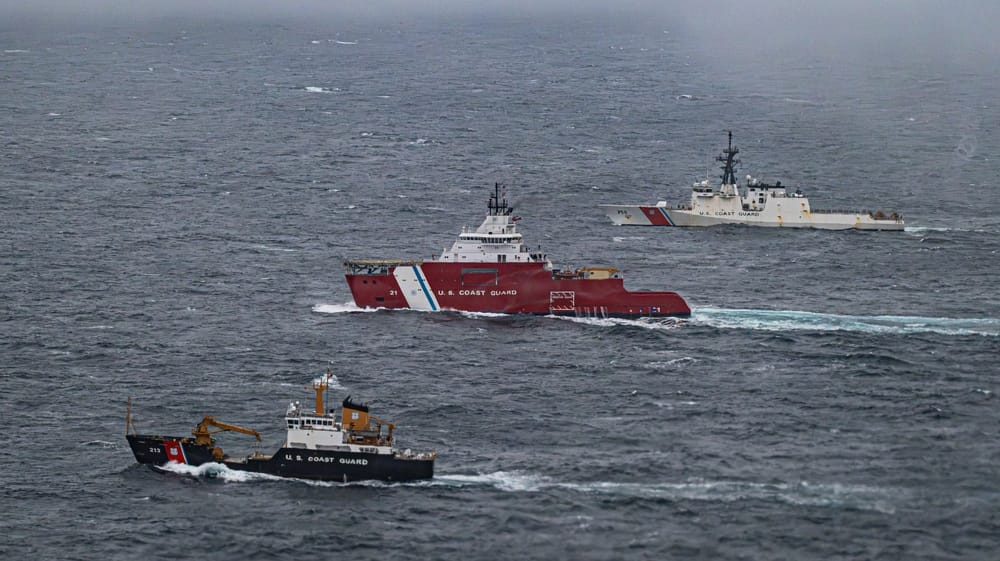
The United States Coast Guard is reporting that the commercial icebreaker converted into the cutter Storis (WAGB 21) completed a 133?day deployment to the Arctic Ocean and Alaska. The vessel returned to Seattle, where it is currently homeported after an active season in the Arctic as it worked to complete training and commissioning.
Storis, a 360?foot medium icebreaker with a displacement of nearly 15,000 tons, was acquired in December 2024 from Edison Chouset. Powered by four diesel engines producing 22,500 horsepower, the cutter is capable of navigating through three feet of ice at five knots. It began its first deployments in August 2025, and this year saw it travel more than 17,000 nautical miles across the Arctic and in the Alaska region.
“The crew’s hard work exceeded expectations in turning Storis into an actionable, multi?mission military vessel,” said Capt. Corey Kerns, commanding officer of Storis. “Through their steadfast dedication and operational expertise, Storis has set the definitive precedent for the Coast Guard’s future operations in the Arctic region and Alaska theater of operations.”
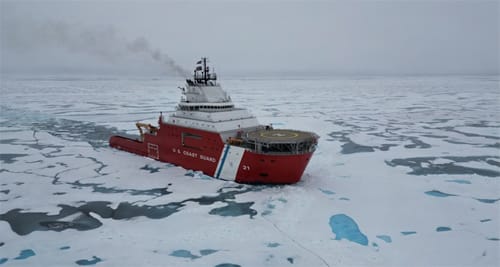
USCGC Storis conducts icebreaking operations in the Arctic Ocean (USCG)
The U.S. Coast Guard Cutter highlights Storis as the “sole U.S. surface asset in the High Arctic,” conducting maritime safety, security, border control, and sovereignty missions. USCGC Healy, the older medium icebreaker, which would normally also have been in the Arctic, suffered a significant “engineering casualty” in July, forcing it to return to base.
During the patrol, Storis operated alongside Coast Guard Cutters Munro (WMSL 755) and Fir (WLB 213), as well as the Royal Canadian Navy’s HMCS Max Bernays (AOPV 432), during Operation Tundra Merlin. The vessels completed a long list of missions during the Arctic season.
As part of Operation Frontier Sentinel, Storis spent more than 300 hours monitoring foreign-flagged research vessels across the Arctic. The cutter monitored four Chinese?flagged research vessels operating over the U.S. extended continental shelf.
The patrol also marked the first designated law enforcement mission by a polar icebreaker in more than 20 years, according to the USCG. Storis completed multiple fishing vessel inspections in the Bering Sea, including a joint boarding and fisheries plant inspection with the National Oceanic and Atmospheric Administration Office of Law Enforcement.
The crew completed the first live?fire gunnery exercise by a Coast Guard surface vessel operating in ice?covered Arctic waters in decades. The exercise familiarized the crew with weapons employment in extreme conditions and produced data expected to inform how future Coast Guard surface assets train, maintain, and conduct weapons exercises and national defense missions in the high north.
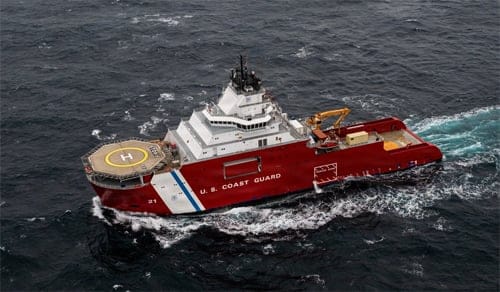
USCG Storis completed her first full season as she converts from commercial use to the Coast Guard (USCG)
Storis also conducted a simulated replenishment?at?sea exercise with Coast Guard Cutter Stratton (WMSL 752) near Unalaska, Alaska. The cutter also responded to the grounded fishing vessel Aleutian Dream, providing initial assistance and escorting the vessel back to Dutch Harbor, Alaska.

that matters most
Get the latest maritime news delivered to your inbox daily.
While in the Bering Sea, Storis partnered with the Coast Guard Research and Development Center and the Defense Innovation Unit to evaluate unmanned aircraft systems in extreme?cold conditions. Research teams conducted five sorties totaling nine flight hours to assess aircraft performance in high?latitude environments. Storis additionally assisted scientific research efforts with the International Arctic Buoy Program, the U.S. National Ice Center and Johns Hopkins Applied Physics Laboratory.
The USCG plans to shift Storis to a homeport in Juneau, Alaska, once the port facilities are upgraded for the vessel. The United States has also ordered a total of 11 new Arctic security cutters to be built in Finland and the United States. The first of the vessels is expected to be commissioned in 2028 to expand the U.S. presence in the region.