


U.S. Invests $17 Million in Colombo Port's Digital Upgrades
As Sri Lanka's Colombo Port continues to expand its booming transshipment business in South Asia, the U.S. government has pledged a small investment of $17 million to help digitize terminal operations. The news came on the same day that state-owned China Merchants Port Holdings (CM Ports) announced its decision to abandon a far larger $350 million investment in a logistics hub for the growing harbor.
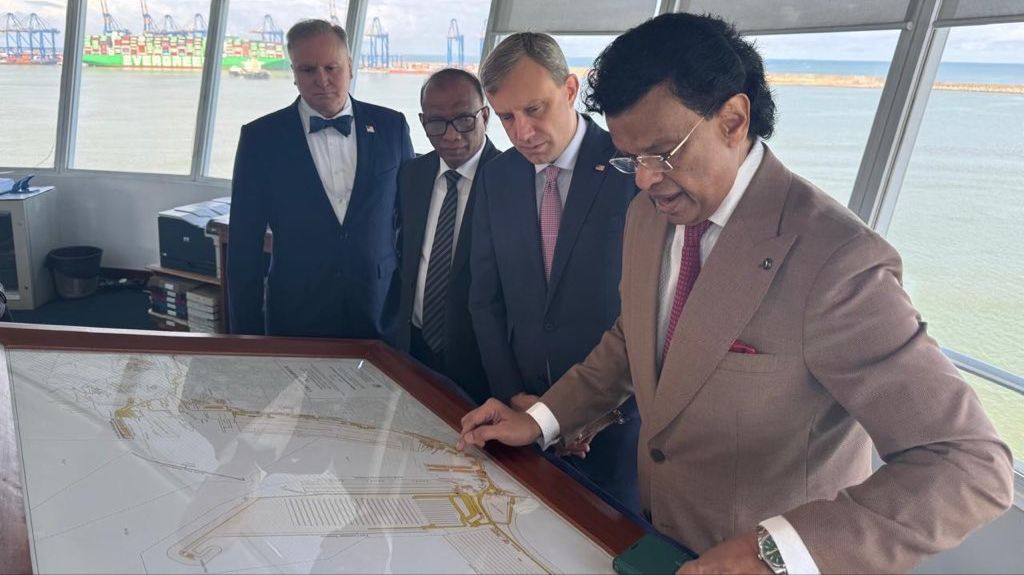
Last week, U.S. Ambassador to Sri Lanka Eric Meyer toured the facility and announced an American investment in port digital systems, implemented in partnership with the Sri Lanka Ports Authority (SLPA). The aim is to introduce American technology to streamline port operations in Colombo. The project will develop two connected digital systems: the Maritime Single Window and the Port Community System.
Upgrades to the port's digital infrastructure are much needed in Sri Lanka as the country moves ahead with massive expansion efforts in its maritime sector. In the past year, two expansion phases have been completed at the Colombo West International Terminal (CWIT), bringing its capacity to 3.2 million TEU annually. CWIT is positioned to handle about 25 percent of the Port of Colombo's targeted volume of 13 million TEU by 2028.
The port's investments are paying off, and its transshipment volume has been expanding swiftly. Colombo is perfectly positioned on the east-west trade lanes to handle cargo destined to and from India, and its popularity propelled it into the ranks of the world's top 20 ports by TEU as of this year. Performance in the first half of 2026 was up 12 percent year-on-year.
As a major transshipment hub in South Asia, the Port of Colombo carries huge significance for U.S. trade interests in the region. The port is estimated to handle $30 billion in U.S.-related cargo. In addition, the U.S. is the single largest market for Sri Lanka's apparel and textile exports, with that trade reaching $1.95 billion last year.
"More than half a million containers of U.S. inbound and outbound cargo move through the Port of Colombo each year. When goods move faster and shipping costs come down, American companies are better positioned to compete and American consumers save money. This $17 million investment will strengthen the supply chains our economies depend on and support commercial opportunities for American technology companies," said Ambassador Meyer.
In addition, the U.S. has been equipping and training the Sri Lanka Navy in support of maritime security in the Indian Ocean. In July, the U.S. and Sri Lanka held the sixth iteration of the Cooperation Afloat Readiness and Training (CARAT) exercise. The exercise series started in 2017, and it brings together personnel from the U.S. Navy, U.S. Coast Guard, Sri Lanka Air Force and Sri Lanka Navy.
On Friday, Chinese port infrastructure giant CM Ports announced that it would be pulling out of a joint venture with the Sri Lankan Port Authority for a massive logistics hub at Colombo, despite the rapid growth in cargo volume at the port. The port authority has agreed to pay out $22 million to its private partners settle the termination of the agreement, CM Ports said.
If built, the project would have created a five million square foot logistics hub within Colombo Port with a total storage capacity of about 530,000 cubic meters. It was intended to provide space for LCL consolidation, stuffing/unstuffing and general warehousing, creating about 1,800 permanent jobs on site and supporting another 10,000 around the country. Work was supposed to begin in 2023 for completion in 2025, but it was ultimately not built.
The partners did not disclose the reason for the delay, but local outlet Ceylon Today reported in January that the project was beset by a series of court challenges, land-use issues, timeline disagreements and regulatory hurdles, and predicted that CM Ports would likely exit to allow a new tender under a different governing structure.
"In view of changes in external circumstances, including adjustments to the SACLH Project’s implementation environment and timetable as well as the respective commercial considerations of the parties, the Company has reassessed the SACLH Project and concluded that terminating the project would be in the best interests of the parties," CM Ports said Friday in a stock exchange filing.

that matters most
Get the latest maritime news delivered to your inbox daily.
CM Ports has played a critical role in Colombo's rapid expansion. It is the developer and operator of the brand new Colombo South Container Terminal, the first and only in South Asia able to handle ships with a draft of up to 18 meters. The new terminal was funded by China Development Bank and built by CHEC, a subsidiary of state-owned China Communications Construction Corporation.
Not all are comfortable with the heavy Chinese presence in Colombo. India, which supplies the bulk of the cargo volume for Colombo's growth and has multiple simmering border conflicts with China, is suspicious of a Chinese presence on its doorstep. The U.S. has helped to install a counterbalance: in 2023, the Biden administration approved a $550 million loan to build a container terminal adjacent to Colombo South, funded with American development assistance and operated by Indian conglomerate APSEZ. "It’s high priority for the United States to be active in the Indo-Pacific region," Development Finance Corporation Chief Executive Officer Scott Nathan told AP at the time.
