


U.S. Intercepts Ship Carrying Chinese Missile Components to Iran
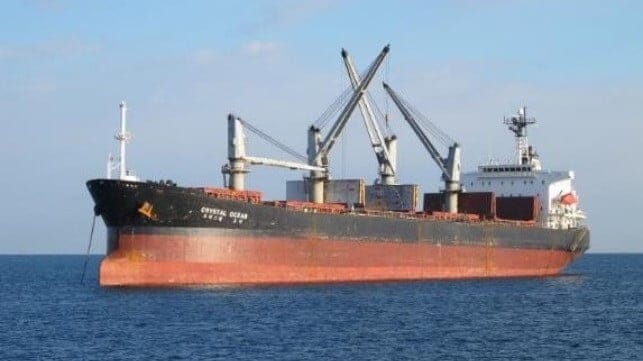
Reports originating in the United States and based on briefings from officials suggest that several weeks ago, a US special operations team intercepted a ship off Sri Lanka and confiscated part of its cargo. The ship was not named in these reports.
The cargo seized is said to have consisted of dual-use components manufactured in China, such as spectrometers and gyroscopes, which can be used to improve the precision of guided missiles. The components were en route to Iran.
On November 12, the US Treasury sanctioned a widespread network of companies based in China, Iran, Turkey and the UAE involved in the supply and delivery of dual-use components used for Iranian ballistic missile and drone production. The sanctions notice detailed supply, shipping routes, and one specific ship. The Panama-flagged bulk carrier Shun Kai Xing, this week known as the Honestar (IMO 9187368), was sanctioned in the US Treasury notice for shipping "a computer numerical control machine used to produce fiber optic gyroscopes, guidance and control systems for weapons systems including ballistic missiles and UAVs."
Iranian-manufactured ballistic missiles and drones have been used both by Iran and its proxies to attack Israeli and American targets, as in the attacks on the Al Udeid airbase on June 23, 2025 and Al Asad, the latest occurring in August 2024. Exported to Russia, the same systems have been used in attacks on Ukraine.
Dual-use products - and specifically if they were being conveyed on a ship belonging to the UN-sanctioned Islamic Republic of Iran Shipping Lines (IRISL) - should fall under the provisions of UN Security Resolution 1929, which cautions states to be aware of IRISL’s sanctions-breaking activities and its role in supporting Iran’s missile development, manufacture and maintenance activities. UNSCR 1929 specifically covers weapons systems related (or dual-use) materials. It calls on "States to inspect any vessel on their territory suspected of carrying prohibited cargo, including banned conventional arms or sensitive nuclear or missile items. States are also expected to cooperate in such inspections on the high seas and are obligated to seize and dispose of the prohibited items when they are found." These sanctions have been strengthened since snap-back sanctions were re-imposed by the UN Security Council on September 28 this year.
The American action in conformity with UNSCR 1929 is not only defensive in character. It may have been designed to obviate the need for other parties to take direct action once the materials arrived in Iran, which in turn could have led to an escalatory Iranian counter-attack and thus a restarting of open warfare in the region.
The Maritime Executive has tracked numerous dual-use cargoes on their passage from China to Iran, and specifically the deliveries from Shanghai to Bandar Abbas made by IRISL cargo ships MVs Golbon and Jairan. These vessels brought in a total of 58 containers of sodium perchlorate used for manufacturing solid fuel for ballistic missiles, a consignment widely believed to have precipitated the explosion in Bandar Abbas which devastated the commercial port area on April 26.
Sodium perchlorate is the primary material used to manufacture ammonium perchlorate, which in turn makes up 70% of the standard fuel load of most of Iran’s solid-fueled ballistic missiles.
The Bandar Abbas explosion did not however deter further dual-use shipments from China. Post the MVs Golbon and Jairan shipments, the Wall Street Journal (WSJ) noted that a further 185 20-foot containers of sodium perchlorate had been ordered by Iran, sufficient to fuel a further 800 ballistic missiles. Three sanctioned medium-sized container ships owned by IRISL were identified in the CMK/K14 anchorage off Shanghai, namely MVs Barzin (IMO 9820269), Rayen (IMO 9820245) and Behta (IMO 9349590), ready to take the cargo on board.
European intelligence sources named a further four sanctioned ships, carrying a total of 2,000 tons of sodium perchlorate, that made the journey between China and Bandar Abbas in September and October. The ships involved in the latest shipments are believed to be MV Basht (IMO 9346536, ex Zhuhai on September 15, arrived Bandar Abbas September 29), MV Barzin (IMO 9820269, ex Gaolan on October 2, arrived in Bandar Abbas October 16), MV Artavand (IMO 9193214, ex Liuheng, arrived in Bandar Abbas October 12) and MV Elyana (IMO: 9165827, ex Changjiangkou September 18, arrived Bandar Abbas October 12). CNN reported that these ships carried sufficient material to fuel about 500 ballistic missiles.
Some of the ships involved in these deliveries then went back to China, presumably to carry further consignments. Hence there was a need for more resolute action if further such shipments were to be curtailed, along with the risk of escalation.

that matters most
Get the latest maritime news delivered to your inbox daily.
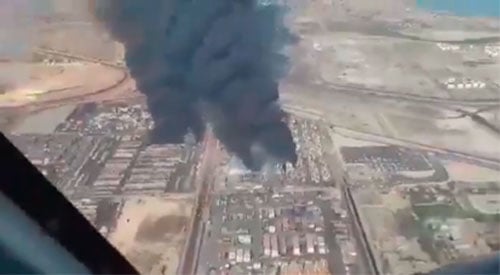
Fires burning in the Rajaei Port container park days after the explosion on April 26 (https://x.com/i/status/1930786589665267956)
