


Rheinmetall, MBDA to Build Laser Weapon for Germany's Navy
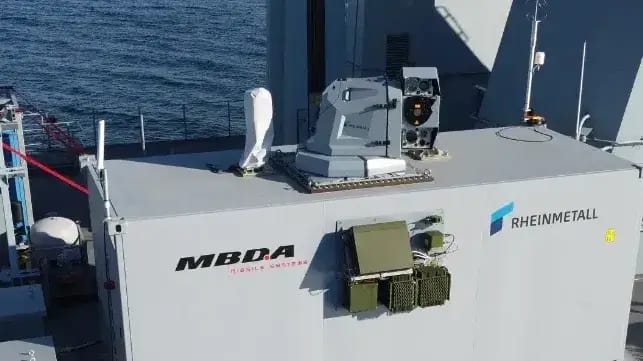
Facing increasing threats from unmanned systems and an ongoing "hybrid warfare" security environment in Europe, Germany's navy is joining the rush to develop a laser weapons system for close-in defensive use. A newly-signed agreement between European air defense company MBDA and German conglomerate Rheinmetall is setting up a new joint venture for laser weaponry with the objective of producing an operational, uniquely German system.
"This step demonstrates the potential of determined industrial and technological cooperation in Germany in order to produce cutting-edge technology," said Roman Köhne, Head of Rheinmetall’s Weapons and Munitions division. "From the beginning, nationalizing the technology was the main object. One of the goals is to maintain, create and expand jobs in Germany in the long term, as well as ensuring national sovereignty and security of supply in times of crisis."
The agreement draws on a partnership that has been running since 2019. The MBDA-Rheinmetall engineering team built and tested a demonstrator unit, which was installed aboard the frigate Sachsen and trialed for about one year of service. The system worked in an operational setting and practical applications, "precisely, quickly and with minimal collateral damage," Rheinmetall said in a statement.
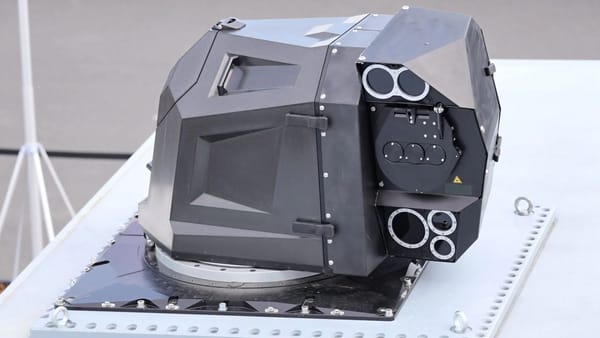
A close-up view of the latest demonstrator (Rheinmetall)

An earlier developmental model (Rheinmetall)
Its naval laser is capable of tracking a target measuring the size of a small coin, without slipping off the focus area and striking something behind it - a higher safety standard than that applied to Phalanx and other CIWS gun systems, which are inherently dangerous to objects behind the target. (In a live-fire exercise in the Phalanx system's early years, excess rounds killed an officer when a gun system engaged a target and overshot, hitting the bridge of amphib USS Iwo Jima.)
The demonstrator was removed and taken ashore for more testing, Rheinmetall said. It has since "been taken back into operation" for further land-based application tests. The company has previously said that a production version could be fielded as early as 2029.

that matters most
Get the latest maritime news delivered to your inbox daily.
Potentially threatening drone sightings near airports and military bases have become commonplace in Europe over the past two years, paralleling the timeline on which the EU has ramped up its defense commitments to Ukraine. The "hybrid warfare" drone threat comes with plausible deniability, but it is widely attributed to Russia.
Rheinmetall has itself become a target. In 2024, U.S. intelligence uncovered a Russian plot to kill CEO Armin Papperger, and officials tipped off German security services in time to thwart it. Rheinmetall is a leading supplier of artillery, air defense and fighting vehicle systems to Ukraine, where its equipment is used against Russian forces.
