


U.S. Expands Sanctions Against Iran as Trump Delays New Round of Attacks
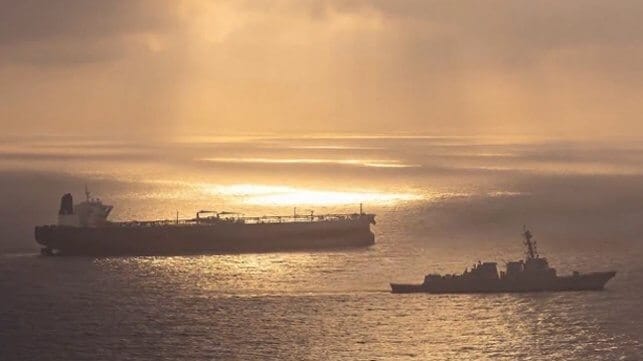
The United States continues to use economic sanctions in an effort to strangle the Iranian economy and bring about a settlement to the war. The Treasury’s Office of Foreign Asset Control announced sweeping new sanctions on May 19, going after foreign currency exchange and listing an additional 19 tankers, while Donald Trump said he was delaying a planned resumption of attacks on Iran.
Posting on social media and speaking at a gathering, Trump said he had been asked by the Emir of Qatar, the Crown Prince of Saudi Arabia, and the President of the United Arab Emirates to hold off on planned military attacks on Iran scheduled to start on May 19. He cited “serious negotiations” while saying he had also told the U.S. military to be prepared to go forward “on a moment’s notice.”
The focus remains for the moment on the economic pressures and the ongoing blockade. CENTCOM said on Monday that a total of 88 commercial vessels have now been redirected, as well as the four that were disabled. The number of redirected vessels continues to rise by a few ships a day, while sources, including TankerTrackers.com, cite that Iran, as of May 16, had 22 tankers inside the anchorage of Kharg Island. TankerTrackers.com reports that 16 of the tankers were empty and six were loaded, providing floating storage.
OFAC today blocked an additional 19 tankers and the associated companies operating the vessels. According to the listing, all the vessels were involved in Iranian petroleum and petrochemical shipments. Six of the vessels cited are described as crude oil tankers, while the other 13 are either product tankers or gas carriers. They range in flags from Panama (six vessels) to Barbados, Palau, Hong Kong, San Marino, Cameroon, Comoros, Gabon, Vanuatu, the Cook Islands, and Sierra Leone.
Treasury said with the latest action as it continues to vigorously target both traditional sanctions evasion schemes as well as the exploitation of digital assets. Coordinated with its efforts, the U.S. State Department also announced its Rewards for Justice program is offering a reward of up to $15 million for information leading to the disruption of the financial mechanisms of Iran’s Islamic Revolutionary Guard Corps.
“Iran’s shadow banking system facilitates the illicit transfer of funding for terrorist purposes,” said Secretary of the Treasury Scott Bessent. “As Treasury systematically dismantles Tehran’s shadow banking system and shadow fleet under Economic Fury, financial institutions must be alert to how the regime manipulates the international financial system to wreak havoc.”

that matters most
Get the latest maritime news delivered to your inbox daily.
Treasury asserts that a currency exchange network headed by the Iran-based Ebrahimi and Associates Partnership Company, commonly known as Amin Exchange, has facilitated hundreds of millions of dollars in foreign transactions. OFAC also listed a series of reported front companies ranging from China and Hong Kong to the United Arab Emirates.
These moves were the latest steps in a program Treasury calls “Economic Fury.” They report having disrupted billions in projected oil revenue, taken actions that have led to the freezing of nearly half a billion dollars in regime-linked cryptocurrency, and cracked down on Tehran’s shadow banking networks. Treasury says it is aggressively advancing Economic Fury and has vigorously targeted both traditional sanctions evasion schemes and the exploitation of digital assets.
