


U.S. Coast Guard Seizes Fugitive Tanker After Transatlantic Chase
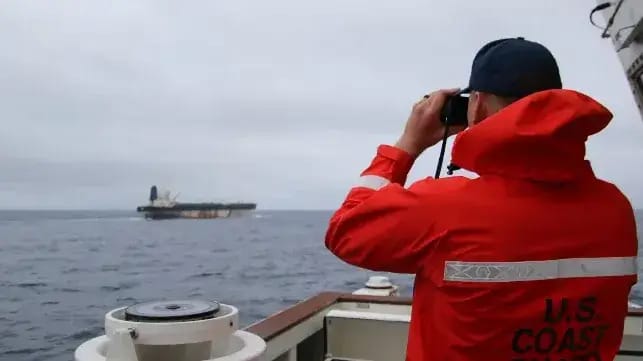
After a protracted low-speed chase across the North Atlantic, the U.S. Coast Guard has seized the sanctioned shadow fleet tanker Bella 1 in international waters near the Faroe Islands. It was the second tanker seizure of the day for U.S. forces, and the fourth since the pressure campaign on Venezuelan oil exports began.
In late December, American forces began chasing Bella 1 (Marinera, IMO 9230880), a sanctioned VLCC with a past in the Iranian oil trade. The vessel was in ballast and approaching Venezuela on a voyage from Iran. As U.S. forces closed in to carry out an interdiction, Bella 1 refused to permit boarding and reversed course. She headed out into the North Atlantic, making for the gap between the UK and Iceland. Mid-voyage, the anonymous shipowner of Bella 1 attempted to transfer the ship to the Russian register and renamed her the Marinera. Nonetheless, U.S. authorities regard the ship as stateless and subject to sanctions.
According to Russian state media, the U.S. Coast Guard conducted a previous boarding attempt during the "pursuit," but was unsuccessful because of the often-rough winter weather of the North Atlantic.
The cutter USCGC Munro was on scene, and other military assets assisted the operation, according to the Wall Street Journal and ABC. Russian state-owned station RT released a photo appearing to show a black MH-6 "Little Bird" helicopter - a favorite tool of U.S. special operations forces - just off the Bella 1's bridge wing.
Air assets suitable for supporting the interception at sea have been noted arriving at US airbases in the UK in recent days, including two AC-130J gunship aircraft. At the beginning of the week, a US Osprey tiltrotor aircraft was seen conducting a training exercise, dropping divers into the sea off the coast of Felixstowe. Felixstowe is close to the base at RAF Mildenhall, where the Osprey-equipped 7th Special Operations Squadron is based. Additionally, three of the small Pilatus surveillance turboprops operated by USAF Special Operations Command conducted a flight over the area on the same day.
USAF C-17 aircraft may have also delivered heavily-armed U.S. Army MH-60M Black Hawk helicopters to RAF Fairford in the west of England, based on flight records showing the cargo planes' point of departure.
On Wednesday afternoon, UK Defense Minister John Healey confirmed that there was British involvement in the seizure. The fleet auxiliary RFA Tideforce provided support for the operation, along with RAF Rivet Joint and Poseidon surveillance aircraft.
Russian connection
While the U.S. government view is that the vessel remained stateless at the time of the boarding, Moscow asserts that the vessel was properly transferred onto the Russian flag registry days beforehand, and that the seizure was a violation of international law. Russia's embassy in Washington had previously asked the Trump administration to call off the chase, according to the New York Times.
"In accordance with the 1982 UN Convention on the Law of the Sea, freedom of navigation applies in the high seas, and no state has the right to use force against vessels duly registered in the jurisdictions of other states," the Russian Transport Ministry said in a statement.
US officials told Reuters that Russian ships and a submarine were in the “general vicinity” when the seizure took place, but these assets did not apparently intervene.
The Russian government has confirmed that there were Russian citizens aboard the vessel, and called for their "humane and proper treatment" and prompt repatriation. The ministry did not make a public demand for the vessel's release and return.
Charges against crew possible
In a briefing Wednesday, White House Press Secretary Karoline Leavitt said that the tanker has been seized, and the crew will face criminal charges for their involvement in the chase.
"The crew is now subject to prosecution for any applicable violation of federal law, and they will be brought to the United States for such prosecution, if necessary," Leavitt said. "The vessel had a judicial seizure order."
Attorney General Pam Bondi added that the same standard would be applied to other mariners in similar pursuit situations.

that matters most
Get the latest maritime news delivered to your inbox daily.
"As a consequence of failing to obey the Coast Guard’s orders, members of this vessel are under full investigation and criminal charges will be pursued against all culpable actors," Bondi said in a statement. "The Department of Justice is monitoring several other vessels for similar enforcement action - anyone on any vessel who fails to obey instructions of the Coast Guard or other federal officials will be investigated and prosecuted to the fullest extent of the law."
Bella 1's AIS signal has gone dark, making her movements more difficult to track. Previous tanker seizures during the pressure campaign have ended in diversion to U.S. waters under U.S. Coast Guard escort - in this case, a long transatlantic voyage.
