


Trump Takes Aim at IMO and the Net Zero Framework at the UN
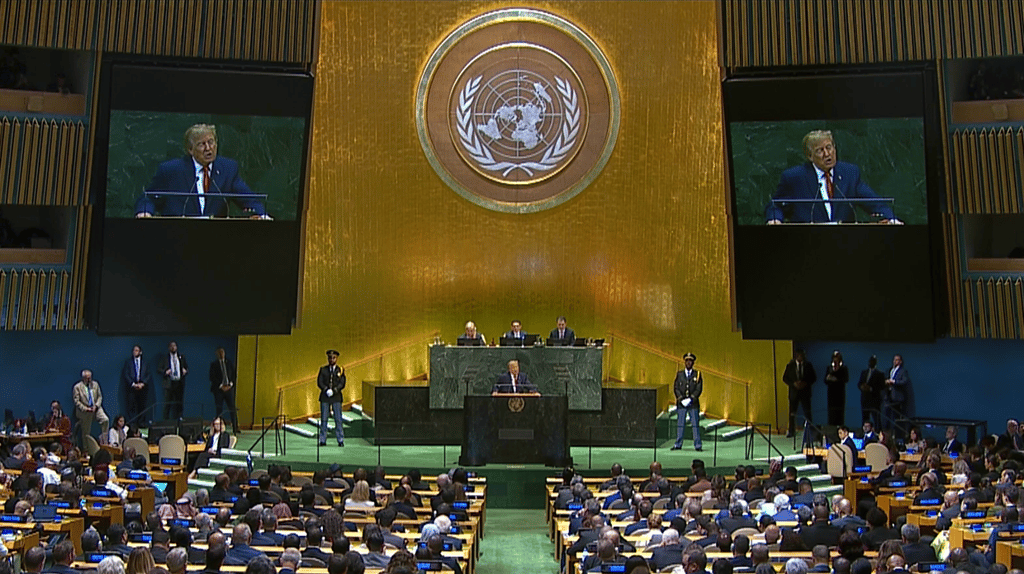
As the first global carbon price mechanism of any kind, the IMO Net Zero Framework's "economic measures" system has had its critics, and has attracted particular scrutiny from the Trump administration. The industry's proposed carbon agreement has even risen to the attention of the president, who used it in an address at the UN General Assembly as an example of the form of international regulation that he opposes.
"Last year, my administration was forced to intervene to stop an obscure UN body, the International Maritime Organization, from secretly establishing a first-ever global carbon tax - very expensive tax - to raise international shipping costs by 10 to 20 percent, and maybe even more than that," Trump claimed. "There is no global government, and while I'm president, there will be no global taxes."
Though it may be little-known outside of shipping circles, IMO has been working on CO2 for a long time. Member states first voted on a resolution to address CO2 emissions in 1997, and IMO has been implementing carbon regulations since the 2011 adoption of the Energy Efficiency Design Index (EEDI) standard. Though not a stringent regulation in itself, the EEDI demonstrated an industry consensus that ships should burn less fuel if possible, and that IMO could make rules designed to reduce carbon emissions.
IMO's member states followed up with their first "initial strategy" to regulate greenhouse gases in 2018, during the first Trump administration. After careful diplomacy, they agreed on an "ambition" to reduce emissions by 50% by midcentury.
Member states doubled that ambition five years later, adopting the 2023 IMO GHG Strategy, which calls for net-zero emissions by 2050. The 2023 strategy added interim targets for 2030 and 2040. While not universally supported, it passed MEPC, setting the stage for debates on implementation - the real challenge, as achieving the ambition involves very real costs. Zero-carbon fuels are prohibitively expensive for market adoption, and as a practical matter, charterers and cargo interests have not shown a willingness to pay extra for green transport at scale. To truly scale up, bunker fuel prices would have to be forced upwards to level the playing field, create a market, and incentivize green-fuel producers and green-fueled shipowners to invest.
After considerable negotiation, in April 2025, member states tentatively agreed upon a "Net Zero Framework" with a set of "economic measures" at its core. This system is designed to achieve an economic goal: to collect revenue from ships that use more bunker fuel, raise the effective price of carbon-based bunkers, and use the collected funds to subsidize green fuel. Though the NZF is not categorized as a tax - it is a system of penalty fees based on fuel efficiency - it is expected to have a tax-like effect, creating a net IMO revenue stream of $10-15 billion per year.
That system has not yet been formally adopted, thanks in no small part to American opposition. The Trump administration views the NZF not as a narrow sectoral policy for shipowners, but as an initial step towards global carbon regulation for multiple industries. In October 2025, U.S. Secretary of State Marco Rubio and Secretary of Transportation Sean Duffy warned foreign governments that promoting the "activist-driven climate policies" in the IMO Net Zero Framework could result in sanctions, tariffs, new port fees or crew visa restrictions for states that backed the NZF. In a joint letter, they threatened to impose U.S. sanctions on individual foreign officials who supported the plan as well.

that matters most
Get the latest maritime news delivered to your inbox daily.
"This will be the first time that a UN organization levies a global carbon tax on the world," wrote Duffy and Rubio at the time. "We will fight hard to protect our economic interests by imposing costs on countries if they support the NZF. Our fellow IMO members should be on notice."
Days later, in a contentious meeting, member states at MEPC failed to reach the majority needed to adopt the NZF, though they had previously done so in April 2025. Instead, they voted to adjourn the process and will next take it up again this December.
The delay in adopting the NZF is already having a direct effect on the industry's planning for a much-discussed green transition for shipping. "Surveys conducted since the decision in [October 2025] have revealed adverse impacts of the delay . . . most notably in company-level decisions that were paused or canceled when the NZF did not proceed as expected," the pro-decarbonization Global Maritime Forum said in a progress update this week. "Reversing this trend through the adoption of the NZF in 2026 is therefore also the single most important step . . . to provide the confidence the industry needs to take the actions that will drive the sector’s transition forward."
