


Suez Canal Highlights Continued Return of Containerships
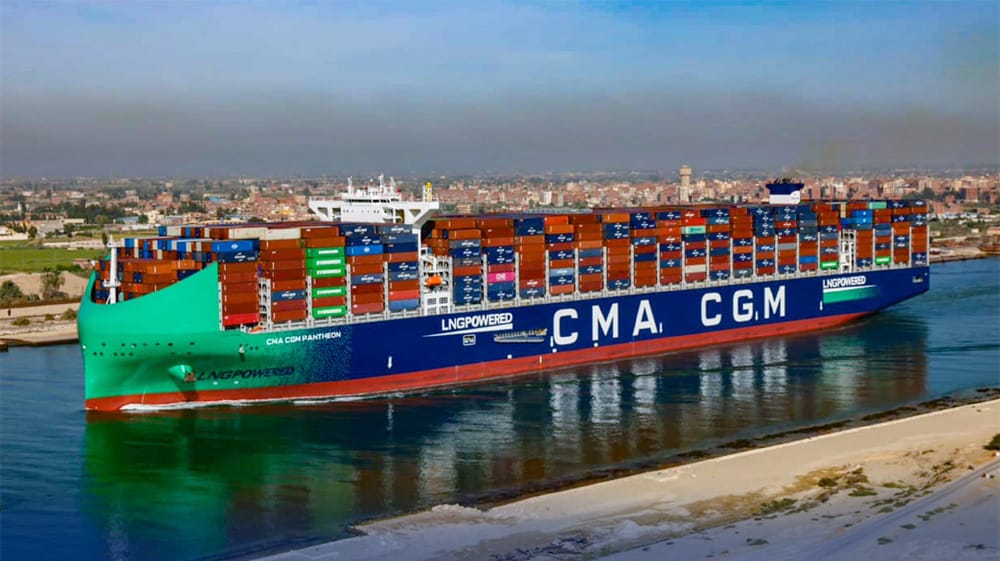
The Suez Canal Authority reports it hit a new milestone in rebuilding volumes following the disruptions due to Red Sea security concerns. Despite the persistent concerns, volume continues to build with more carriers switching vessels back to their planned routes.
Transits of containerships increased dramatically during the third quarter of 2026 versus 2025. The Suez Canal Authority released data reporting that 166 medium (over 130,000 net tons) and ultra-large container vessels made the transit between July and September. That is versus just 16 container vessels in that size range in the third quarter of 2025.
Tonnage figures showed an equally large increase. The total for large container vessels reached 29 million net tons during the most recent quarter. That compared to just a total of 2.4 million net tons a year ago.
"The Suez Canal holds a strategic significance for containerized trade due to the operational savings it achieves and its promotion of the concept of economies of scale,” said SCA Chairman Admiral Ossama Rabiee. He noted the mounting pressure on container lines, citing increasing fuel prices, while shippers have to contend with rising freight rates. He highlighted the Suez Canal for its ability to provide reduced transit times and shorter voyage distances, saying it contributes to enhancing economies of scale for container vessels.
The authority continues its efforts to attract more vessels, and it expects to continue to see volumes rise. CMA CGM was at the forefront, but Maersk, Hapag-Lloyd, MSC Mediterranean Shipping Company, and OOCL have returned vessels to the routes through the Suez Canal and the Red Sea. COSCO has also restored some of its vessels, and the Premier Alliance, including Ocean Network Express (ONE), HMM, and Yang Ming, are set to return to the Suez Canal routes in the coming days.
Today, October 13, two large CMA CGM vessels were making the transit, as the Suez Canal Authority reported its results. The brand-new CMA CGM Pantheon (233,559 dwt), which entered service in July, was part of the convoy coming from the north. The vessel, which has a capacity of 24,212 TEU and is registered in France, was making her first-ever transit while traveling between Tangier Med and Port Klang, Malaysia.
Also in the southbound convoy was the CMA CGM Monte Cristo (158,064 dwt), also a new ship having entered service at the beginning of the year. Registered in Malta, the ship, which has a capacity of 16,204 TEU, was also bound for Port Klang.
The analysts at Drewry issued a new analysis of the Suez Canal at the beginning of the month, exploring what they saw as the reason so many carriers are rushing back to the route. They noted the fundamental threat that caused carriers to abandon the route has not disappeared. In fact, they noted that with the Houthis' recent offensive and the fierce fighting near the Bab al-Mandeb, the dangers may have increased.
Drewry’s analysis highlighted only a small financial benefit from the return to the Suez Canal route. They noted the advantage could be just $43 per slot, approximately $1 million per round trip, and that does not factor in the war-risk insurance premiums.
“The apparent eagerness of container lines to return to the Suez Canal is difficult to explain if the calculation is reduced to a simple voyage-cost comparison between Suez and the Cape,” writes Drewry.
It points to four factors in the calculation. It starts with the potential cost savings on a round voyage, as well as the time consideration and ability to perform more voyages because of the shorter transit times and distances. Furthermore, it also points to network schedule integrity and the pressure from competitors.

that matters most
Get the latest maritime news delivered to your inbox daily.
“The more convincing explanation for why carriers are so keen to return to Suez is that they are not really making a binary Suez versus Cape voyage decision based on economics alone. They are making a network, capacity and customer-service decision in which the value of time, vessel utilization, and network integrity are all taken into consideration,” write the analysts at Drewry.
The Suez Canal Authority highlights its efforts at providing an integrated package of maritime and logistics services. It expects that the ability to fully support vessels, and the canal’s ability to accommodate even the largest of the current container fleet, will help it to continue to build volumes and support its shipping partners.
